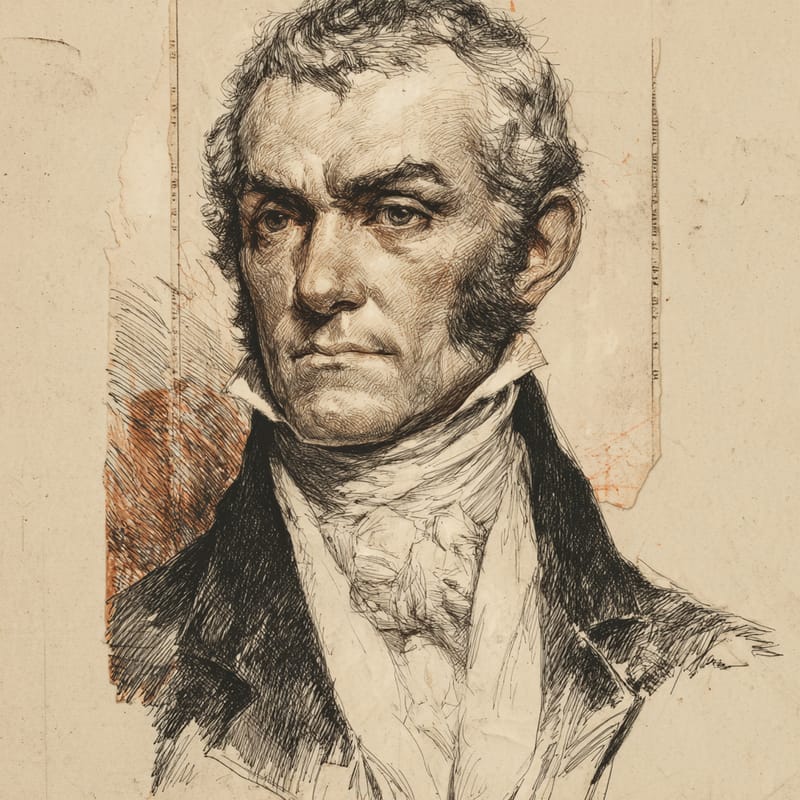
John Jacob Astor
Furs and Manhattan
America's first great fortune.
Rooted CapitalistOne of 729 ideologies · enter the Capitalist hall →- Role
- Merchant
- Era
- 1763–1848
- Region
- Germany / US
- Social band
- Rooted
- Placement
- +92 · +6 · −25
§ Where John Jacob Astor stands
3 axesAstor's career was private enterprise at full stretch: he built the American Fur Company into the dominant firm in its trade, lobbied for the abolition of the government-run Indian trading houses in 1822 and turned fur profits into Manhattan land. He welcomed government help when it suited him, seeking federal backing for Astoria and an 1816 law excluding foreign traders, which keeps him short of the pure market pole.
Astor worked through personal connections to power rather than office, cultivating Treasury Secretary Albert Gallatin, who like him was a European immigrant, and winning Thomas Jefferson's encouragement for Astoria. During the War of 1812 he joined other financiers in taking up federal loans when the Treasury was nearly empty, aligning his fortune with the young state rather than opposing it.
Astor was an old-world merchant patriarch whose values were thrift, property and family dynasty. He left the bulk of his fortune to his son William Backhouse Astor, founding one of America's great landed dynasties, and his chief public bequest, the Astor Library, reflected a traditional faith in learning as a civic monument rather than any interest in social reform.
How close are you to John Jacob Astor?
Three statements, one per axis. Answer them and we’ll drop you on the compass next to them.
§ The story
HistoricalJohn Jacob Astor (1763–1848) was a German-born American merchant who built the first great fortune in the United States through the fur trade and New York real estate. The son of a butcher in Walldorf, near Heidelberg, he worked in London with his brother, a maker of musical instruments, before emigrating to the United States in 1784. In New York he traded furs and instruments, and in 1808 he founded the American Fur Company, which grew to dominate the fur trade of the Great Lakes and the upper Missouri.
Astor's attempt to build a Pacific trading empire through Astoria, founded at the mouth of the Columbia River in 1811, collapsed during the War of 1812, but his ships carried furs to China and he helped finance the federal government's war loans. From the 1830s he withdrew from the fur trade and put his profits into Manhattan land, becoming the city's largest landlord. At his death he was the richest man in the United States; he left most of his estate to his son William and $400,000 to found the Astor Library.
Notable for
- 01American Fur Company
- 02First multi-millionaire in the US
- 03Manhattan real-estate empire
Key works & moments
- 1784Arrives in the United States from London and enters the fur trade in New York.
- 1808Founds the American Fur Company under a New York charter.
- 1811His Pacific Fur Company establishes Fort Astoria at the mouth of the Columbia River.
- 1813Helps finance the federal government's war loans during the War of 1812.
- 1834Sells his fur-trade interests and concentrates on Manhattan real estate.
- 1848Dies the richest man in America, leaving $400,000 to found the Astor Library.
§ Minds closest to John Jacob Astor
All minds →




§ Also in the Capitalist hall
Enter the hall →§ Common questions
4 answersWhat was John Jacob Astor's political ideology?
John Jacob Astor was a merchant capitalist with little interest in political theory: on the 99ideologies three-axis compass, a Rooted Capitalist. Economically he sat near the market pole (+92), building the dominant fur company and a Manhattan property empire while lobbying to close the government's own trading posts. On governance he was close to the centre (+6), working through connections with officials such as Albert Gallatin, and socially he was moderately traditional (−25), a thrifty patriarch focused on property and dynasty.
Was John Jacob Astor left-wing or right-wing?
He predates the modern labels and belonged to no political movement, but his outlook was that of a pro-business conservative. Astor sought profit wherever the law allowed, used political friendships to protect his trade, lent to the government in wartime and invested in land rather than reform. Critics in his own day condemned his wealth and his hard dealing as a landlord, while admirers celebrated him as the archetype of the immigrant who rose from nothing to great fortune.
How did John Jacob Astor make his fortune?
First in furs, then in land. Astor's American Fur Company, founded in 1808, bought pelts across the Great Lakes and the upper Missouri, often trading goods and alcohol with Native American hunters, and shipped furs to Europe and China, where his vessels loaded tea and silk for the return voyage. He reinvested the profits in Manhattan real estate, buying farmland beyond the built-up city and leasing lots as New York expanded. By his death in 1848 his estate was valued at around $20 million.
Which minds are closest to John Jacob Astor?
On the 99ideologies three-axis compass, the minds closest to John Jacob Astor are Charles Foster Kane (98% alike), J. P. Morgan (98% alike) and John D. Rockefeller (98% alike). The furthest is Emma Goldman (5% alike).