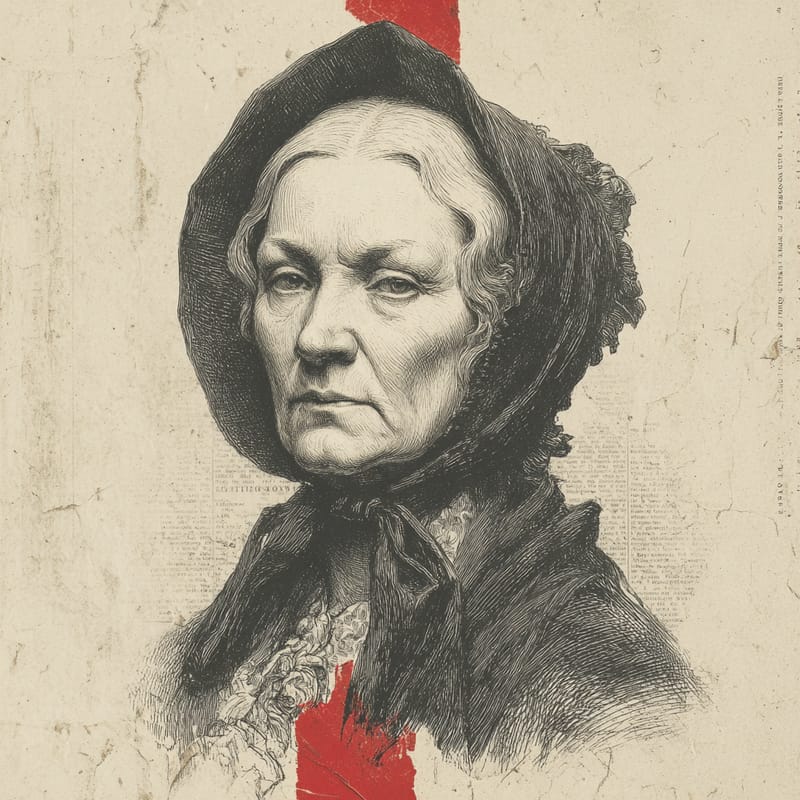
Hetty Green
The Witch of Wall Street
Value investing before its name.
Rooted CapitalistOne of 729 ideologies · enter the Capitalist hall →- Role
- Financier
- Era
- 1834–1916
- Region
- United States
- Social band
- Rooted
- Placement
- +96 · +4 · −30
§ Where Hetty Green stands
3 axesGreen's method was to buy low, hold cash and never borrow: after the Civil War she bought government bonds and railroad securities at depressed prices, and she lent money in panics when credit dried up, lending the City of New York more than $1 million in 1907. Her purely private, contrarian pursuit of returns, with no interest in public policy, puts her near the market pole.
Green was a pure market operator who never sought office or backed causes, and her dealings with the state were defensive: she fought long lawsuits over her family's estates and moved between modest apartments in Brooklyn and Hoboken, New Jersey, partly to avoid establishing a taxable residence in New York. Her indifference to politics leaves her near the governance centre.
Raised among New Bedford Quakers, Green lived by an austere, traditional code of thrift and self-denial, wearing the same plain black clothes for years and shunning display. She managed her own fortune in the male world of Wall Street, an unconventional achievement, but kept to conservative habits and passed her wealth to her son and daughter.
How close are you to Hetty Green?
Three statements, one per axis. Answer them and we’ll drop you on the compass next to them.
§ The story
HistoricalHenrietta Howland Robinson Green (1834–1916), known as Hetty Green, was an American financier and the richest woman in the United States in the late Gilded Age. Born into a wealthy Quaker whaling family in New Bedford, Massachusetts, she learned about business as a child by reading the financial news aloud to her father. In 1865 she inherited a fortune of several million dollars from him, and she spent years in court fighting over the will of her aunt Sylvia Ann Howland, a celebrated case she lost.
Green multiplied her inheritance through conservative, contrarian investing: she bought government and railroad bonds when others were selling, kept large cash reserves, avoided debt and lent heavily when credit was scarce, including to the City of New York during the Panic of 1907. Her black dresses, cheap lodgings and legendary thrift earned her the nickname the Witch of Wall Street. When she died in 1916 her fortune was estimated at more than $100 million, and she is often cited as an early practitioner of value investing.
Notable for
- 01Richest woman in Gilded-Age America
- 02Contrarian value investing
- 03Lent to New York City
Key works & moments
- 1865Inherits a fortune from her father, the New Bedford whaling merchant Edward Mott Robinson.
- 1868Loses her lawsuit over the will of her aunt, Sylvia Ann Howland.
- 1885Moves her fortune to the Chemical National Bank after the collapse of John J. Cisco & Son.
- 1907Lends the City of New York more than $1 million during the financial panic.
- 1916Dies in New York leaving an estate estimated at more than $100 million.
§ Minds closest to Hetty Green
All minds →

§ Also in the Capitalist hall
Enter the hall →§ Common questions
4 answersWhat was Hetty Green's political ideology?
Hetty Green was a financier rather than a political figure, but her outlook was pure private capitalism: on the 99ideologies three-axis compass, a Rooted Capitalist. Economically she sat near the market pole (+96), building a fortune by buying undervalued assets, hoarding cash and lending in panics. On governance she was close to the centre (+4), indifferent to politics and wary of taxes, and socially she was moderately traditional (−30), austere and thrifty in the Quaker manner of her upbringing.
Was Hetty Green left-wing or right-wing?
She took no part in party politics, but her values were those of the free-market right of her era: private property, thrift, self-reliance and suspicion of taxation. She accumulated wealth through markets rather than political connections and avoided public causes. Her rare success as a woman financier in the male world of Wall Street has made her a figure of interest to historians of women in business, though she never framed her career as part of any movement.
How did Hetty Green make her fortune?
Through patient, conservative investing. Green inherited several million dollars in 1865 and multiplied it by buying government bonds, railroad securities and real estate when prices were low, holding large cash reserves and avoiding borrowing. When panics struck she had money to lend at good rates, and in 1907 she lent the City of New York more than $1 million. She ran her affairs herself, often from the Chemical National Bank in Manhattan, and at her death in 1916 her fortune was estimated at more than $100 million.
Which minds are closest to Hetty Green?
On the 99ideologies three-axis compass, the minds closest to Hetty Green are J. P. Morgan (98% alike), John Jacob Astor (97% alike) and John D. Rockefeller (97% alike). The furthest is Emma Goldman (4% alike).