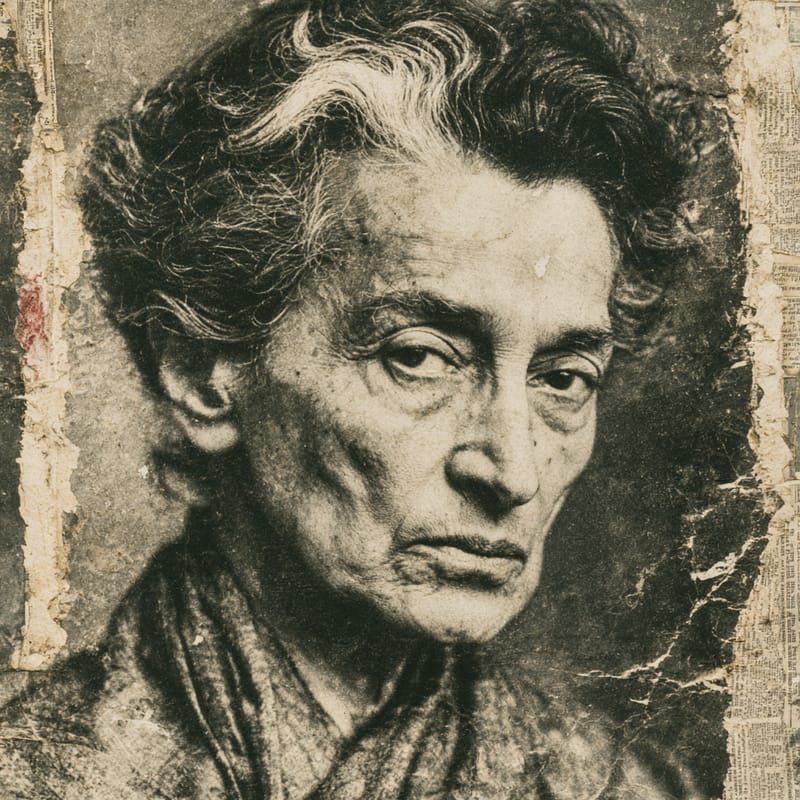
Indira Gandhi
Social LiberalOne of 729 ideologies · enter the Social Liberal hall →- Role
- —
- Era
- —
- Region
- —
- Social band
- Centre (no modifier)
- Placement
- −25 · +25 · 0
§ Where Indira Gandhi stands
3 axesGandhi governed in the name of socialism: she nationalised fourteen major banks in 1969 and took coal and general insurance into state hands in the early 1970s, campaigning on Garibi Hatao. Yet India remained a mixed economy with a large private sector, and in 1981 she accepted a large IMF loan and began cautiously easing controls, which keeps her left of centre rather than on the far left.
Gandhi concentrated power in the prime minister's office and her inner circle, and in June 1975 had an Emergency proclaimed after a court voided her election, suspending civil liberties, censoring the press and detaining opposition leaders. The 39th Amendment placed her election beyond judicial challenge. Yet she called elections in 1977, accepted defeat and returned to office through the ballot box in 1980.
Gandhi was a secular moderniser by conviction: her government ended the privy purses and privileges of India's former princes in 1971, and the 42nd Amendment of 1976 wrote 'socialist' and 'secular' into the preamble of the constitution. The Emergency's population drive, pushed by her son Sanjay, turned coercive, with mass sterilisations and slum demolitions that fuelled her party's rout across northern India in 1977.
How close are you to Indira Gandhi?
Three statements, one per axis. Answer them and we’ll drop you on the compass next to them.
§ The story
HistoricalIndira Priyadarshini Gandhi (1917–1984) was prime minister of India from 1966 to 1977 and from 1980 until her assassination in 1984, the first woman to hold the office. The only child of Jawaharlal Nehru, she studied at Santiniketan and Oxford, married Feroze Gandhi (no relation of Mahatma Gandhi) in 1942, and served as Congress president in 1959 and as information minister under Lal Bahadur Shastri. When Shastri died in 1966 the party's leaders chose her to succeed him, expecting a pliable figurehead.
Gandhi outmanoeuvred the Congress old guard, split the party in 1969 and won a landslide in 1971 on the slogan Garibi Hatao ('Remove Poverty'); later that year India's war with Pakistan secured the independence of Bangladesh. After a court voided her 1971 election in 1975, she had a state of Emergency proclaimed, ruling by decree for 21 months, censoring the press and jailing opponents, and voters ousted her in 1977. Returned in 1980, she sent the army into Amritsar's Golden Temple in June 1984 and was killed by two Sikh bodyguards that October, after which anti-Sikh riots killed thousands.
Key works & moments
- 1966Becomes prime minister after the death of Lal Bahadur Shastri.
- 1969Nationalises fourteen major banks; the Congress party splits over her leadership.
- 1971Wins a landslide on Garibi Hatao; war with Pakistan ends in Bangladesh's independence.
- 1975–77Emergency rule: civil liberties suspended, press censored, opposition leaders jailed.
- 1980Returns to power after the Janata government collapses.
- 1984Orders Operation Blue Star at the Golden Temple; assassinated by her Sikh bodyguards.
§ Minds closest to Indira Gandhi
All minds →


§ Also in the Social Liberal hall
Enter the hall →§ Common questions
4 answersWhat was Indira Gandhi's political ideology?
Indira Gandhi was a left-leaning Congress nationalist who governed in the name of socialism and secularism: on the 99ideologies three-axis compass, a Social Liberal. Economically she sat left of centre (−25), nationalising the major banks, coal and insurance and campaigning to remove poverty within a mixed economy. On governance she leaned authoritarian (+25), above all during the 1975–77 Emergency, though she called the 1977 election and left office when she lost. Socially she was a secular moderniser whose population drive turned coercive.
Was Indira Gandhi left-wing or right-wing?
Left-wing in economic policy, though her politics resist a simple label. Gandhi nationalised banks, abolished the princes' privy purses, moved India closer to the Soviet Union with the 1971 friendship treaty and added the word socialist to the constitution's preamble. Yet her most lasting imprint was on power itself: she centralised authority around the prime minister, ruled by decree during the Emergency and, in her last years, accepted an IMF loan and cautiously relaxed economic controls.
Why did Indira Gandhi declare a state of Emergency in 1975?
Officially because of a threat from internal disturbance; in practice, amid a crisis over her own position. On 12 June 1975 the Allahabad High Court found her guilty of electoral malpractice and voided her 1971 election, while Jayaprakash Narayan's protest movement demanded her resignation. On 25 June President Fakhruddin Ali Ahmed proclaimed an Emergency on her advice. Civil liberties were suspended, the press was censored and, by most estimates, more than 100,000 people were detained before she called elections, which she lost in March 1977.
Which minds are closest to Indira Gandhi?
On the 99ideologies three-axis compass, the minds closest to Indira Gandhi are Jacques Delors (90% alike), William Temple (90% alike) and Friedrich Naumann (89% alike). The furthest is Hans-Hermann Hoppe (29% alike).