
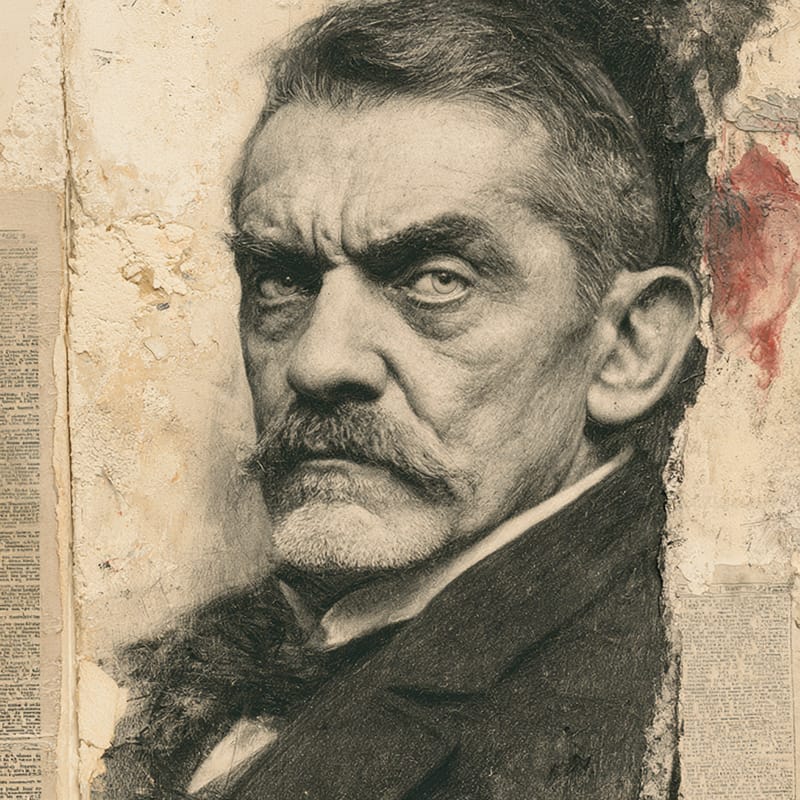
Friedrich Naumann
National-social liberalism
Liberty, plus a strong social state.
State LiberalOne of 729 ideologies · enter the State Liberal hall →- Role
- Politician & pastor
- Era
- 1860–1919
- Region
- Germany
- Social band
- Centre (no modifier)
- Placement
- −6 · +42 · +10
§ Where Friedrich Naumann stands
3 axesNaumann accepted industrial capitalism as the engine of national power but wanted it humanised. Through Die Hilfe and his book Neudeutsche Wirtschaftspolitik he argued for trade unions, social insurance and a voice for workers in industry, a social liberalism that rejected both Manchester laissez-faire and Marxist socialism and lands just left of centre.
Naumann wanted a powerful, reforming nation-state led from the liberal centre. Democracy and Empire (1900) called for a 'social emperorship' uniting the Kaiser with the masses, he supported the naval build-up of the 1900s, and Mitteleuropa (1915) envisaged a German-dominated bloc in Central Europe. After 1918 he turned to parliamentary democracy, co-founding the German Democratic Party.
Socially Naumann was a moderate reformer within a nationalist frame. He campaigned with the left liberals to abolish Prussia's unequal three-class franchise and widen political participation, drawing his social concern from Protestant charity work. Yet his liberalism stayed tied to Christian culture, nation and empire rather than to cultural radicalism, keeping him close to the centre.
How close are you to Friedrich Naumann?
Three statements, one per axis. Answer them and we’ll drop you on the compass next to them.
§ The story
HistoricalFriedrich Naumann (1860–1919) was a German Lutheran pastor, journalist and politician who became the leading theorist of social liberalism in the German Empire. Born in Saxony, he worked for the Protestant Inner Mission among the urban poor and was drawn to the Christian social movement before breaking with its conservatism. In 1896 he founded the National-Social Association, and after its electoral failure joined the left liberals, winning a Reichstag seat in 1907 and co-founding the German Democratic Party in 1918.
Naumann's goal was to reconcile the working class with the nation, the monarchy and liberal democracy, an idea he set out in Democracy and Empire (1900) and in his weekly Die Hilfe. He backed naval expansion and German world power, and his 1915 book Mitteleuropa proposed a German-led Central European bloc, which critics read as a blueprint for hegemony. In 1919 he helped shape the Weimar constitution's section on basic rights and briefly chaired the German Democratic Party before his death. In 1958 West German liberals named the FDP-affiliated Friedrich Naumann Foundation after him.
Notable for
- 01Founded 'National-Social' liberalism
- 02'Mitteleuropa'
- 03Namesake of the FDP's foundation
Key works & moments
- 1894Launches the weekly Die Hilfe, the voice of his Christian-social and later national-social ideas.
- 1896Founds the National-Social Association to win German workers for nation, empire and social reform.
- 1900Publishes Democracy and Empire, calling for a monarchy rooted in the masses.
- 1907Wins a Reichstag seat for the left-liberal Liberal Union.
- 1915Publishes Mitteleuropa, proposing a German-led economic and political union of Central Europe.
- 1919Sits in the Weimar National Assembly and is elected chairman of the German Democratic Party.
§ Minds closest to Friedrich Naumann
All minds →



§ Also in the State Liberal hall
Enter the hall →§ Common questions
4 answersWhat was Friedrich Naumann's political ideology?
Friedrich Naumann was a national-social liberal: on the 99ideologies three-axis compass, a State Liberal. Economically he sat just left of centre (−6), accepting capitalism while pressing for unions, social insurance and workers' participation. On governance he favoured a strong, reforming nation-state (+42), from his 'social emperorship' to the Mitteleuropa project, before embracing parliamentary democracy in 1918, and socially he was a mild reformer (+10) whose liberalism stayed rooted in Protestant culture and the nation.
Was Friedrich Naumann left-wing or right-wing?
He was a man of the liberal centre-left with a strong nationalist streak. In the politics of the German Empire, Naumann stood on the left wing of liberalism: he wanted to win workers away from Marxist social democracy through social reform, backed trade unions and opposed Prussia's unequal franchise. But his enthusiasm for naval power, empire and a German-led Central Europe placed him to the right of pacifist liberals and socialists, so he is best described as a national social liberal.
What was Friedrich Naumann's Mitteleuropa plan?
Mitteleuropa, published in 1915, was Naumann's proposal for a lasting economic and political union of Germany and Austria-Hungary, with neighbouring states drawn in, to form a Central European bloc able to compete with the British Empire, Russia and the United States. The book was a wartime bestseller in Germany. Naumann presented it as a federation built on a customs union and cooperation, but critics in Allied countries and later historians saw it as a plan for German hegemony, and the idea collapsed with the Central Powers' defeat in 1918.
Which minds are closest to Friedrich Naumann?
On the 99ideologies three-axis compass, the minds closest to Friedrich Naumann are Max Weber (96% alike), Tomáš Masaryk (96% alike) and Plutarco Elías Calles (94% alike). The furthest is Hans-Hermann Hoppe (28% alike).