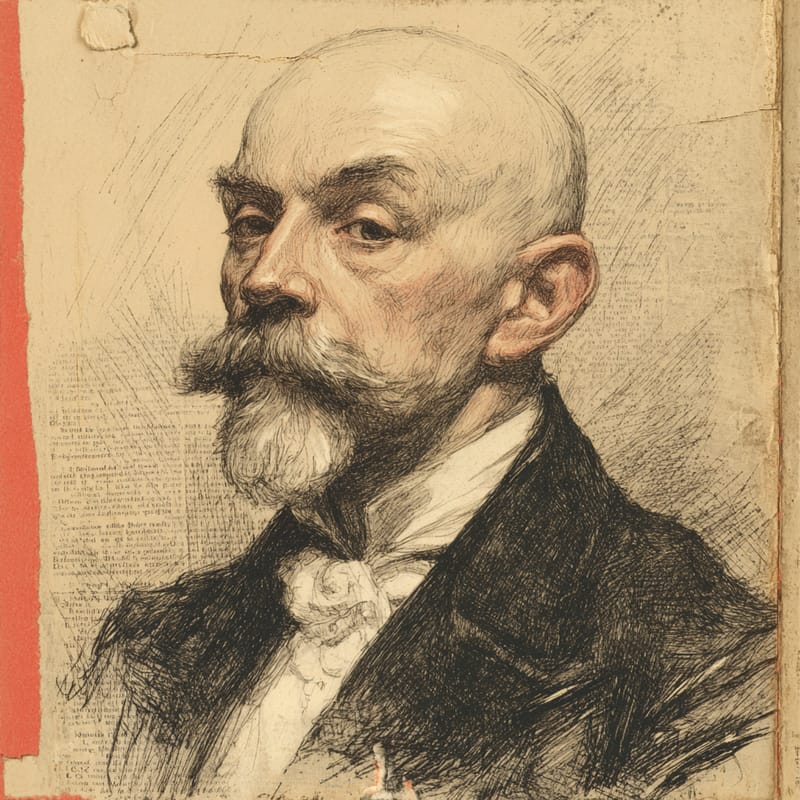
L. T. Hobhouse
The New Liberalism
Liberty needs the state's help.
Heterodox Social LiberalOne of 729 ideologies · enter the Social Liberal hall →- Role
- Sociologist
- Era
- 1864–1929
- Region
- United Kingdom
- Social band
- Heterodox
- Placement
- −30 · +20 · +35
§ Where L. T. Hobhouse stands
3 axesIn Liberalism (1911) Hobhouse argued that the right to work and the right to a living wage are as valid as the rights of person or property, and he defended graduated taxation of wealth created by society rather than by individual effort. He wanted public provision and regulation, not wholesale nationalisation, which keeps him left of centre but within liberalism.
Hobhouse wanted an active state that would override private coercion by employers and landlords and secure the conditions of a good life. But he insisted the state exists for its citizens, and in The Metaphysical Theory of the State (1918) he attacked the Hegelian idea of the state as a higher being, which keeps his statism moderate and democratic.
A rationalist and anti-imperialist, Hobhouse condemned the Boer War and the jingoism around it in Democracy and Reaction (1904). His sociology, from Morals in Evolution (1906) to The Elements of Social Justice (1922), treated moral progress as the gradual extension of rational ethics and of rights to ever wider groups of people.
How close are you to L. T. Hobhouse?
Three statements, one per axis. Answer them and we’ll drop you on the compass next to them.
§ The story
HistoricalLeonard Trelawny Hobhouse (1864–1929) was an English philosopher, sociologist and journalist, born in Cornwall into an Anglican clergyman's family; the campaigner Emily Hobhouse was his sister. Educated at Marlborough and Oxford, he taught philosophy at the university before becoming a leader writer for C. P. Scott's Manchester Guardian. In 1907 he was appointed to the first chair of sociology in Britain, the Martin White professorship at the London School of Economics, which he held until his death.
Hobhouse was the leading theorist of the New Liberalism that shaped the reforming Liberal governments after 1906. His short book Liberalism (1911) argued that freedom means the real opportunity to develop one's capacities, so the state must secure a living wage, security in old age and fair access to work, and may tax unearned wealth. He opposed the Boer War and later attacked Hegelian worship of the state. Critics on the right saw him as smuggling socialism into liberalism; for social liberals he remains a founding thinker.
Notable for
- 01'Liberalism' (1911)
- 02New Liberalism theory
- 03Positive-liberty argument
Key works & moments
- 1897Joins C. P. Scott's Manchester Guardian as a leader writer.
- 1904Publishes Democracy and Reaction, an attack on imperialism and jingoism.
- 1907Becomes Britain's first professor of sociology, at the London School of Economics.
- 1911Publishes Liberalism, the classic short statement of the New Liberalism.
- 1918The Metaphysical Theory of the State attacks Hegelian worship of the state.
- 1922The Elements of Social Justice sets out his mature theory of rights and distribution.
In their own words
“Liberty without equality is a name of noble sound and squalid result.”
§ Minds closest to L. T. Hobhouse
All minds →

§ Also in the Social Liberal hall
Enter the hall →§ Common questions
4 answersWhat was L. T. Hobhouse's political ideology?
L. T. Hobhouse was a New Liberal, the leading British theorist of social liberalism: on the 99ideologies three-axis compass, a Heterodox Social Liberal. Economically he sat left of centre (−30), arguing for a living wage, pensions and the taxation of unearned wealth while keeping private enterprise. On governance he favoured a stronger, more active state within liberal democracy (+20), and socially he was progressive (+35), an anti-imperialist who wanted every citizen to have the real means of self-development.
Was L. T. Hobhouse left-wing or right-wing?
Left of centre, from inside the liberal tradition. Hobhouse broke with laissez-faire and accepted much of the socialist critique of poverty and unearned wealth, even sketching a democratic, liberal form of socialism he could accept. But he rejected class war, wholesale nationalisation and bureaucratic socialism imposed from above, insisting that state action must serve individual liberty. That puts him on the reforming left of liberalism, close to the Labour movement on many policies but never a Marxist.
How did Hobhouse's New Liberalism differ from classical liberalism?
Classical liberalism treated freedom mainly as the absence of state interference and trusted free markets to reward effort. Hobhouse's New Liberalism argued that poverty, insecurity and unequal bargaining power made that freedom empty for many people, so the state must actively create the conditions for liberty through minimum wages, pensions, public education and progressive taxation. He presented this not as a break with liberalism but as its fulfilment, since the goal remained the free development of each individual.
Which minds are closest to L. T. Hobhouse?
On the 99ideologies three-axis compass, the minds closest to L. T. Hobhouse are Robert F. Wagner (97% alike), Lyndon B. Johnson (96% alike) and Hubert Humphrey (96% alike). The furthest is Hans-Hermann Hoppe (24% alike).