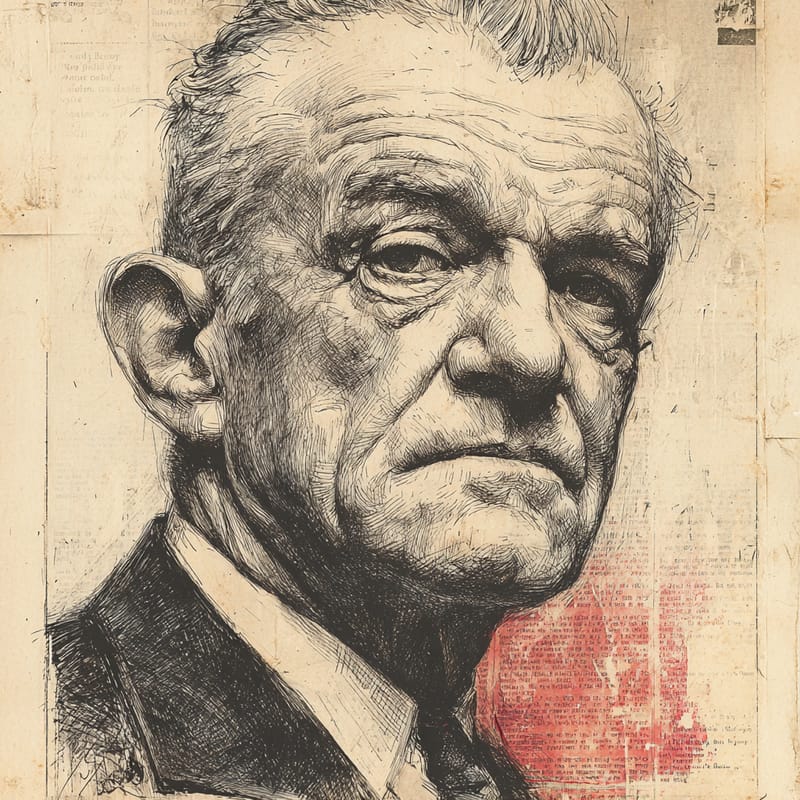
Lyndon B. Johnson
The Great Society
Civil rights and the war on poverty.
Heterodox Social LiberalOne of 729 ideologies · enter the Social Liberal hall →- Role
- President
- Era
- 1908–1973
- Region
- United States
- Social band
- Heterodox
- Placement
- −26 · +28 · +32
§ Where Lyndon B. Johnson stands
3 axesJohnson built the largest expansion of the American welfare state since the New Deal: the Economic Opportunity Act of 1964 launched the War on Poverty, and the 1965 Social Security amendments created Medicare and Medicaid. Yet he worked closely with business and cut income taxes through the Revenue Act of 1964, widening opportunity within capitalism rather than challenging private ownership.
Johnson believed in concentrated federal power used energetically. He bent Congress to his will with relentless personal lobbying, federal agencies enforced desegregation on the South, and the 1964 Gulf of Tonkin Resolution let him escalate the Vietnam War without a declaration of war, feeding a 'credibility gap' over his administration's candour.
A Southerner who had opposed civil-rights bills early in his congressional career, he became the president who dismantled legal segregation through the Civil Rights Act of 1964, the Voting Rights Act of 1965 and the Fair Housing Act of 1968. He also abolished national-origin immigration quotas in 1965 and named Thurgood Marshall the first Black Supreme Court justice in 1967.
How close are you to Lyndon B. Johnson?
Three statements, one per axis. Answer them and we’ll drop you on the compass next to them.
§ The story
HistoricalLyndon Baines Johnson (1908–1973) was the 36th president of the United States, serving from 1963 to 1969. Raised in the poor Texas Hill Country, he taught Mexican-American children in Cotulla, ran the Texas branch of Franklin Roosevelt's National Youth Administration and entered the House in 1937. Elected to the Senate in 1948 by a disputed 87-vote primary margin, he became a dominant majority leader from 1955, then John F. Kennedy's vice president, and succeeded him after his assassination on 22 November 1963.
Johnson won a landslide in 1964 and used it to pass the Great Society, the most ambitious domestic programme since the New Deal: civil-rights and voting-rights laws, Medicare, Medicaid, federal aid to schools and the War on Poverty. His escalation of the Vietnam War, which had more than half a million American troops deployed by 1968, split his party and destroyed his popularity, and on 31 March 1968 he announced he would not seek re-election. Historians rate his domestic record highly and his conduct of the war harshly.
Notable for
- 01Civil Rights and Voting Rights Acts
- 02Medicare and Medicaid
- 03The Great Society
Key works & moments
- 1957As Senate majority leader, steers through the first civil-rights act since Reconstruction.
- 1963Sworn in as president aboard Air Force One after Kennedy's assassination in Dallas.
- 1964Declares war on poverty, signs the Civil Rights Act and defeats Barry Goldwater in a landslide.
- 1965Signs the Voting Rights Act and Medicare; sends combat troops to Vietnam.
- 1968After the Tet Offensive, announces he will not seek another term.
In their own words
“This administration today, here and now, declares unconditional war on poverty in America.”
“I shall not seek, and I will not accept, the nomination of my party for another term as your President.”
§ Minds closest to Lyndon B. Johnson
All minds →

§ Also in the Social Liberal hall
Enter the hall →§ Common questions
4 answersWhat was Lyndon B. Johnson's political ideology?
Lyndon Johnson was a New Deal liberal whose presidency marked the high point of American social liberalism: on the 99ideologies three-axis compass, a Heterodox Social Liberal. Economically he sat left of centre (−26), creating Medicare, Medicaid and the War on Poverty while cutting taxes and working with business. On governance he leaned towards strong federal power (+28), wielded hard in Congress, in the South and in Vietnam, and socially he was progressive (+32), signing the landmark civil-rights, voting-rights and immigration laws of the 1960s.
Was Lyndon B. Johnson left-wing or right-wing?
Left of centre by American standards, with important qualifications. His domestic record is widely seen as the most liberal of any post-war president, but he was a pragmatic Texan deal-maker who had long accommodated Southern segregationists and defended the oil industry's tax breaks, and he was a committed Cold War hawk. The New Left of the 1960s saw him as the face of an imperial establishment because of Vietnam, while conservatives attacked the Great Society as federal overreach.
Did Lyndon Johnson's War on Poverty work?
Partly, and the verdict is still debated. The official poverty rate fell from 19 per cent in 1964 to about 11 per cent by 1973, and poverty among the elderly dropped sharply as Medicare and higher Social Security benefits took effect. Medicare, Medicaid, Head Start and federal school aid became permanent fixtures. Critics argue that some programmes cost more than promised, encouraged dependency and lost momentum as Vietnam drained money and attention, while defenders credit them with lasting gains in health and living standards.
Which minds are closest to Lyndon B. Johnson?
On the 99ideologies three-axis compass, the minds closest to Lyndon B. Johnson are Robert F. Wagner (97% alike), L. T. Hobhouse (96% alike) and William Temple (95% alike). The furthest is Hans-Hermann Hoppe (23% alike).