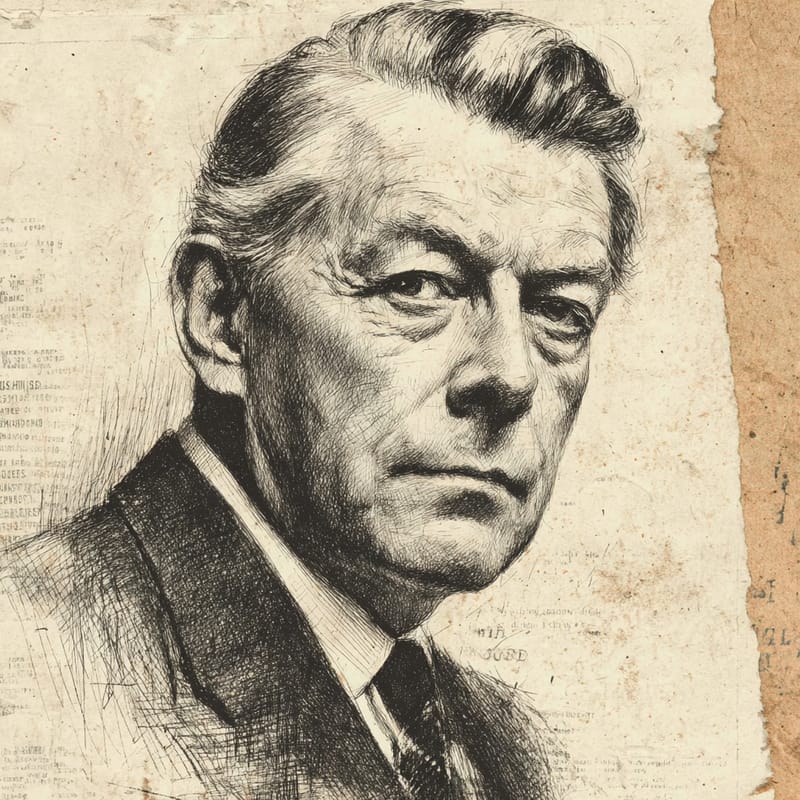
Roy Jenkins
The permissive society
Liberal reform of private life.
Reformist Social LiberalOne of 729 ideologies · enter the Social Liberal hall →- Role
- Home Secretary
- Era
- 1920–2003
- Region
- United Kingdom
- Social band
- Reformist
- Placement
- −24 · +22 · +55
§ Where Roy Jenkins stands
3 axesJenkins was a revisionist social democrat who accepted the mixed economy; The Labour Case (1959) argued for greater equality and better public services within it. As Chancellor from 1967 to 1970 he raised taxes and restrained spending to restore confidence after devaluation, and in 1981 he left Labour as it swung toward wider public ownership and withdrawal from Europe.
Jenkins used an activist state to widen personal freedom, giving government time to the 1967 bills on homosexuality and abortion and reforming criminal justice through the Criminal Justice Act 1967, which introduced majority jury verdicts and parole. He could also be firm: after the Birmingham pub bombings of 1974 he rushed through the Prevention of Terrorism Act, conceding that its powers were draconian.
Jenkins is closely identified with the liberal reforms of the late 1960s: the Sexual Offences Act 1967 decriminalised sex in private between men over 21 in England and Wales, the Abortion Act 1967 passed with his backing, and the Theatres Act 1968 ended stage censorship. In his second term he piloted the Sex Discrimination Act 1975 and introduced the bill that became the Race Relations Act 1976.
How close are you to Roy Jenkins?
Three statements, one per axis. Answer them and we’ll drop you on the compass next to them.
§ The story
HistoricalRoy Harris Jenkins (1920–2003), later Lord Jenkins of Hillhead, was a British Labour and then Social Democratic politician who served as Home Secretary, Chancellor of the Exchequer and, from 1977 to 1981, President of the European Commission, the only Briton to hold that post. The son of a Welsh miners' official who became a Labour MP, he studied at Balliol College, Oxford, worked as a codebreaker at Bletchley Park during the Second World War and entered Parliament in 1948, sitting for Birmingham Stechford from 1950 to 1977.
As Home Secretary from 1965 to 1967 Jenkins gave government support to the private members' bills that partially decriminalised sex between men and legalised abortion, and prepared the end of theatre censorship. He then served as Chancellor after the 1967 devaluation, led 69 Labour MPs to vote for European membership in 1971 and returned to the Home Office in 1974. Alienated by Labour's leftward turn, he co-founded the Social Democratic Party in 1981 and won Glasgow Hillhead in 1982. Social conservatives blamed the permissive society for moral decline; Jenkins preferred to call it the civilised society.
Notable for
- 01Decriminalised homosexuality
- 02Liberal social reforms of the 1960s
- 03Co-founded the SDP
Key works & moments
- 1959His private member's bill becomes the Obscene Publications Act, creating a defence of literary merit.
- 1967As Home Secretary, backs the Sexual Offences Act and the Abortion Act, both passed that year.
- 1971Leads 69 Labour MPs in voting with the Conservative government for entry to the European Economic Community.
- 1977Becomes President of the European Commission and promotes plans that lead to the European Monetary System.
- 1981Co-founds the Social Democratic Party with David Owen, Shirley Williams and Bill Rodgers.
- 1982Wins the Glasgow Hillhead by-election and becomes the SDP's first leader.
In their own words
“I define integration, therefore, not as a flattening process of assimilation but as equal opportunity, accompanied by cultural diversity, in an atmosphere of mutual tolerance.”
§ Minds closest to Roy Jenkins
All minds →

§ Also in the Social Liberal hall
Enter the hall →§ Common questions
4 answersWhat was Roy Jenkins's political ideology?
Roy Jenkins was a liberal social democrat: on the 99ideologies three-axis compass, a Reformist Social Liberal. Economically he sat mildly left of centre (−24), accepting the mixed economy and favouring public spending and greater equality over further nationalisation. On governance he leaned slightly toward the state (+22), using an activist government to widen personal freedom while also passing tough anti-terrorism powers in 1974. Socially he was clearly progressive (+55), backing the 1967 reforms on homosexuality and abortion and later laws against sex and race discrimination.
Was Roy Jenkins left-wing or right-wing?
Centre-left. Jenkins spent most of his career on Labour's right as a revisionist social democrat who accepted the mixed economy and championed European integration, and in 1981 he left to co-found the centrist Social Democratic Party, which merged with the Liberals in 1988 to form what became the Liberal Democrats. On social questions he was a committed liberal reformer whose record on homosexuality, abortion, censorship and race relations put him at the progressive end of British politics.
Did Roy Jenkins decriminalise homosexuality?
Not single-handedly, but his support was crucial. The Sexual Offences Act 1967, which decriminalised sex in private between men aged 21 or over in England and Wales, began as a private member's bill steered through the Commons by the Labour MP Leo Abse and through the Lords by the Earl of Arran. As Home Secretary, Jenkins ensured it had government time, as he did for David Steel's Abortion Act the same year. Scotland followed in 1980 and Northern Ireland in 1982, and an equal age of consent came only in 2001.
Which minds are closest to Roy Jenkins?
On the 99ideologies three-axis compass, the minds closest to Roy Jenkins are President Andrew Shepherd (96% alike), Hubert Humphrey (95% alike) and Pierre Trudeau (93% alike). The furthest is Hans-Hermann Hoppe (21% alike).