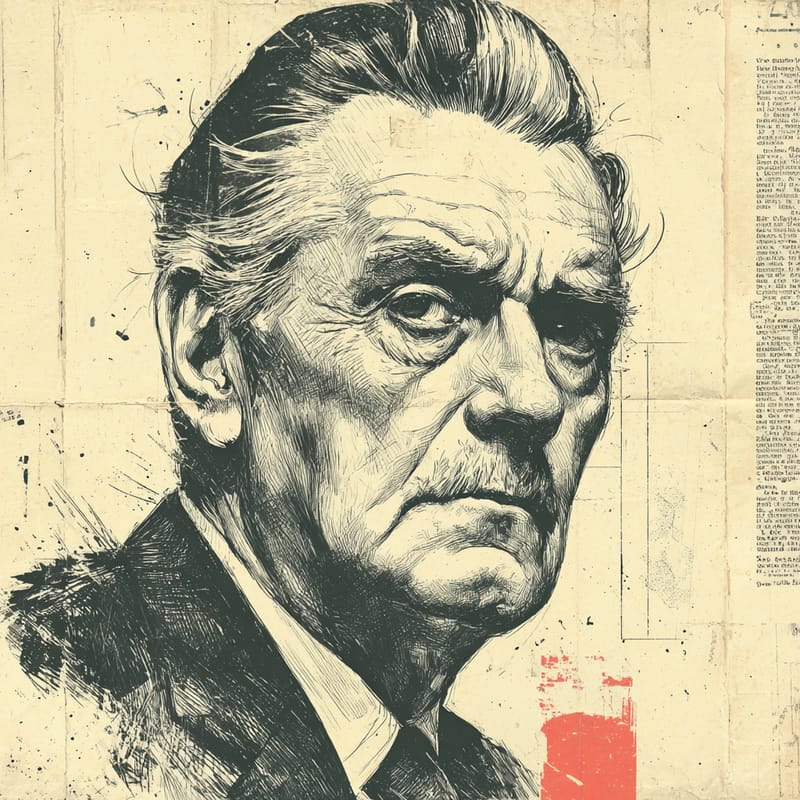
Georges Pompidou
Industrial modern France
Gaullist order, market growth.
Rooted Civic ConservativeOne of 729 ideologies · enter the Civic Conservative hall →- Role
- President
- Era
- 1911–1974
- Region
- France
- Social band
- Rooted
- Placement
- +32 · +46 · −28
§ Where Georges Pompidou stands
3 axesPompidou made industrial growth his priority, encouraging mergers to build national champions, motorways and high-technology projects such as Concorde, and opening France further to European competition. He was pragmatic about the social price of growth: in 1968 he conceded a 35 per cent rise in the minimum wage at Grenelle, and his government introduced the SMIC minimum wage in 1970, leaving him right of centre within a managed economy.
Pompidou kept the strong Gaullist presidency intact and ran government closely from the Élysée. After the May 1968 upheaval his government's 1970 'anti-wreckers' law made organisers of demonstrations liable for violence and damage, and state television and radio, through the ORTF, remained under tight political supervision. He nonetheless worked within the Fifth Republic's constitution and governed with parliamentary majorities.
Pompidou was a conservative of order with modern tastes. He rallied a frightened electorate after May 1968, defended the family and national cohesion, and in 1972 urged the French to draw a veil over the divisions of the Occupation. Yet he collected abstract art and commissioned the avant-garde arts centre at Beaubourg, and his governments replaced paternal with parental authority in 1970 and legislated equal pay in 1972.
How close are you to Georges Pompidou?
Three statements, one per axis. Answer them and we’ll drop you on the compass next to them.
§ The story
HistoricalGeorges Jean Raymond Pompidou (1911–1974) was president of France from 1969 until his death and, before that, prime minister from 1962 to 1968, the longest-serving premier of the Fifth Republic. The son of schoolteachers from the Auvergne, he studied at the École normale supérieure, taught literature, joined Charles de Gaulle's staff in 1944 and later became a senior executive at the Rothschild bank. He served as de Gaulle's chief of staff in 1958–59 and helped conduct the secret contacts that led to the Évian Accords ending the Algerian War.
Pompidou kept de Gaulle's strong presidency but gave Gaullism a more pragmatic, business-friendly and European face. During the May 1968 crisis he negotiated the Grenelle agreements with unions and employers, then led the Gaullists to a landslide in the June elections, only to be replaced as prime minister weeks later. As president he pursued industrial growth, backed nuclear power and high-speed rail, and lifted France's veto on British entry to the European Community. Critics faulted his tight hold on state broadcasting and his 1971 pardon of the former Vichy militia officer Paul Touvier.
Notable for
- 01Industrial modernisation
- 02Strong Gaullist presidency
- 03Patron of modern culture
Key works & moments
- 1962Appointed prime minister by de Gaulle, beginning six years in office.
- 1968Negotiates the Grenelle agreements to end the May general strike; replaced as prime minister in July.
- 1969Elected president after de Gaulle's resignation, defeating the centrist Alain Poher.
- 1969Launches plans for a modern arts centre at Beaubourg, later named the Centre Pompidou.
- 1971Meets Edward Heath in Paris and clears the way for British entry to the European Community.
- 1974Dies in office on 2 April from a rare blood cancer.
§ Minds closest to Georges Pompidou
All minds →

§ Also in the Civic Conservative hall
Enter the hall →The closest minds above are this hall’s whole roster.
§ Common questions
4 answersWhat was Georges Pompidou's political ideology?
Georges Pompidou was a pragmatic Gaullist conservative: on the 99ideologies three-axis compass, a Rooted Civic Conservative. Economically he sat right of centre (+32), driving industrial capitalism and European integration while accepting a managed economy and minimum-wage rises. On governance he leaned towards a strong state (+46), keeping the powerful Gaullist presidency and tight control of broadcasting, and socially he was moderately traditional (−28), a defender of order and the family with strikingly modern artistic tastes.
Was Georges Pompidou left-wing or right-wing?
Right-wing, in the moderate Gaullist sense. Pompidou led the main party of the French right, faced down the left-wing revolt of May 1968 and won the 1969 presidential election against the centrist Alain Poher after the divided left failed to reach the run-off. But Gaullism was never laissez-faire: Pompidou accepted large wage concessions, state-led industrial projects and a strong welfare state. He was more pro-business and pro-European than de Gaulle, which made him a bridge between Gaullism and the mainstream centre-right.
Why did Georges Pompidou lift the veto on British entry to the EEC?
Because he judged that enlargement now served French interests. De Gaulle had vetoed British membership in 1963 and 1967, but Pompidou, elected in 1969, saw Britain as a useful counterweight to an increasingly assertive West Germany, and he first secured a settlement of how the Common Agricultural Policy would be financed. After a decisive summit with Edward Heath in Paris in May 1971 he dropped the veto, and Britain, Ireland and Denmark joined in 1973, an enlargement French voters approved in a 1972 referendum.
Which minds are closest to Georges Pompidou?
On the 99ideologies three-axis compass, the minds closest to Georges Pompidou are Dwight D. Eisenhower (98% alike), William Howard Taft (98% alike) and Stanley Baldwin (96% alike). The furthest is Emma Goldman (13% alike).