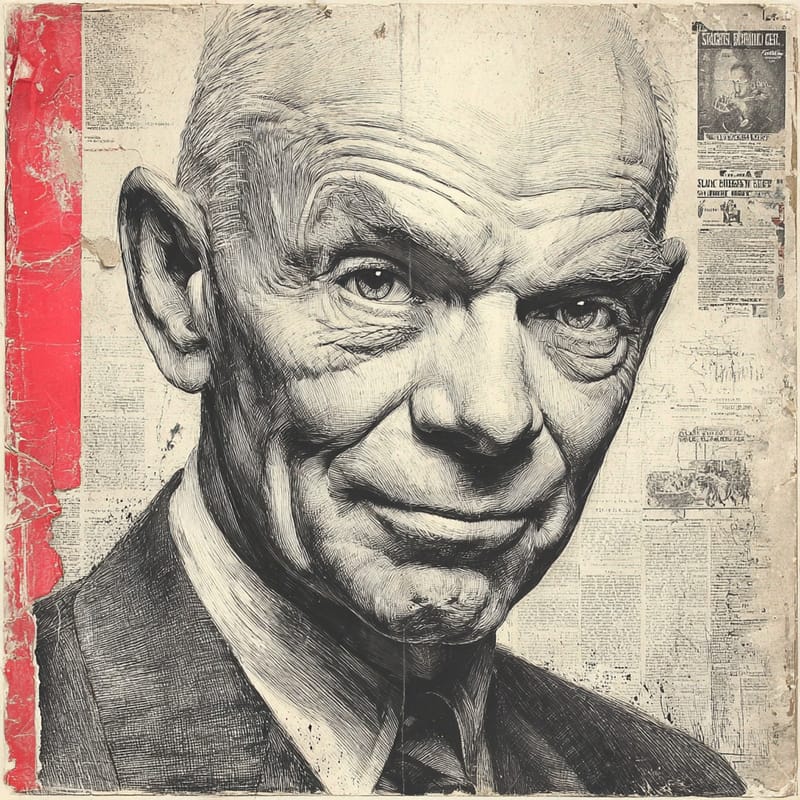
Dwight D. Eisenhower
Modern Republicanism
Order, prosperity, restraint.
Rooted Civic ConservativeOne of 729 ideologies · enter the Civic Conservative hall →- Role
- President
- Era
- 1890–1969
- Region
- United States
- Social band
- Rooted
- Placement
- +28 · +45 · −25
§ Where Dwight D. Eisenhower stands
3 axesEisenhower favoured balanced budgets and business confidence, but consolidated rather than dismantled the New Deal. Social Security amendments in 1954 and 1956 extended coverage to millions more workers and added disability insurance, and the 1956 Federal-Aid Highway Act launched the publicly funded Interstate system. The top income tax rate stayed above 90 per cent throughout his presidency, placing him right of centre but well short of laissez-faire.
A former supreme commander, Eisenhower ran an orderly, hierarchical White House built around the National Security Council and a powerful chief of staff, and he respected constitutional limits at home, using federal troops in Little Rock in 1957 to enforce a court order. Abroad he relied on nuclear deterrence and covert action, authorising CIA operations that toppled governments in Iran in 1953 and Guatemala in 1954.
Eisenhower reflected the cautious religiosity of 1950s America. He signed the 1954 law adding 'under God' to the Pledge of Allegiance and the 1956 act making 'In God We Trust' the national motto, and his 1953 Executive Order 10450 barred gay people from federal employment. He signed the Civil Rights Acts of 1957 and 1960 and appointed Earl Warren chief justice, but moved slowly on desegregation.
How close are you to Dwight D. Eisenhower?
Three statements, one per axis. Answer them and we’ll drop you on the compass next to them.
§ The story
HistoricalDwight David Eisenhower (1890–1969) was the 34th president of the United States, serving two terms from 1953 to 1961. Raised in Abilene, Kansas, and trained at West Point, he spent the interwar years as a staff officer before rising rapidly in the Second World War to command the Allied landings in North Africa and then, as Supreme Commander, the D-Day invasion of Normandy in June 1944. After the war he served as Army chief of staff, president of Columbia University and NATO's first supreme commander before winning the 1952 election as a Republican.
Eisenhower's 'Modern Republicanism' made peace with the New Deal rather than repealing it, combining balanced-budget instincts with major public investment and a Cold War strategy built on nuclear deterrence. He ended the fighting in Korea, declined to intervene militarily to save the French at Dien Bien Phu and sent troops to enforce school desegregation in Little Rock, yet he also authorised CIA-backed coups in Iran in 1953 and Guatemala in 1954 and was criticised for his caution towards McCarthyism and the civil rights movement. His farewell warning about the 'military-industrial complex' remains his most quoted legacy.
Notable for
- 01Interstate Highway System
- 02'Military-industrial complex' warning
- 03Modern Republicanism
Key works & moments
- 1944Commands the D-Day landings in Normandy as Supreme Commander of the Allied Expeditionary Force.
- 1952Wins the presidency for the Republicans, defeating Adlai Stevenson in a landslide.
- 1953Secures the Korean War armistice and delivers his 'Chance for Peace' speech on the cost of arms.
- 1956Signs the Federal-Aid Highway Act, creating the Interstate Highway System.
- 1957Sends the 101st Airborne Division to enforce school desegregation in Little Rock, Arkansas.
- 1961His farewell address warns against the 'military-industrial complex'.
In their own words
“In the councils of government, we must guard against the acquisition of unwarranted influence, whether sought or unsought, by the military-industrial complex.”
“Every gun that is made, every warship launched, every rocket fired signifies, in the final sense, a theft from those who hunger and are not fed, those who are cold and are not clothed.”
§ Minds closest to Dwight D. Eisenhower
All minds →

§ Also in the Civic Conservative hall
Enter the hall →The closest minds above are this hall’s whole roster.
§ Common questions
4 answersWhat was Dwight D. Eisenhower's political ideology?
Dwight D. Eisenhower was a moderate conservative who called his approach Modern Republicanism: on the 99ideologies three-axis compass, a Rooted Civic Conservative. Economically he sat right of centre (+28), favouring balanced budgets and business while keeping the New Deal's core programmes. On governance he leaned towards a strong but constitutional state (+45), from a powerful national security apparatus to covert action abroad, and socially he was moderately traditional (−25), reflecting the religious, cautious mood of the 1950s.
Was Dwight D. Eisenhower left-wing or right-wing?
Right of centre, but a moderate. Eisenhower ran as a Republican and distrusted big spending, yet he defeated his party's conservative, isolationist wing for the 1952 nomination, accepted Social Security and union rights, and built the Interstate highways with federal money. By later standards his tax rates and public investment look centrist, while his anti-communism, covert interventions and social caution kept him firmly in the conservative camp of his day.
What did Eisenhower mean by the military-industrial complex?
He meant the permanent alliance between a huge peacetime military establishment and the arms industry that supplied it, which he feared could distort American democracy. In his farewell address of 17 January 1961, Eisenhower noted that the United States had never before maintained a vast standing arms industry, and warned against its acquiring 'unwarranted influence' over government, spending and even scientific research. Coming from a five-star general and two-term president, the warning carried unusual weight and has been cited by critics of defence spending ever since.
Which minds are closest to Dwight D. Eisenhower?
On the 99ideologies three-axis compass, the minds closest to Dwight D. Eisenhower are Georges Pompidou (98% alike), William Howard Taft (97% alike) and Lord Shaftesbury (97% alike). The furthest is Emma Goldman (14% alike).