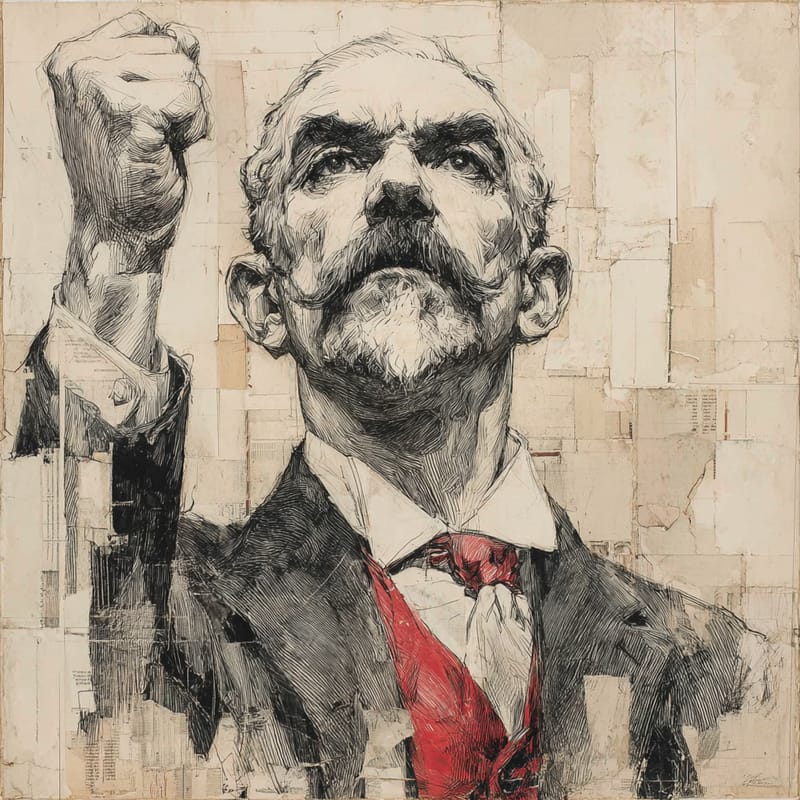
Willie Stark
The people's man, corrupted
Populism's rise and fall, in one life.
Rooted LongistOne of 729 ideologies · enter the Longist hall →- Role
- Governor (fiction)
- From
- All the King's Men
- Region
- United States
- Social band
- Rooted
- Placement
- −56 · +54 · −28
§ Where Willie Stark stands
3 axesStark promises to make the rich and the corporations pay for the poor. As governor he raises taxes to build highways, schools and, above all, the Willie Stark Hospital, a vast medical centre meant to give free care to anyone in the state who needs it. He is a redistributor rather than a socialist: business survives, and he cuts deals with contractors when he needs them.
Stark wins power at the ballot box but keeps it through fear. He beats an impeachment attempt by blackmailing and pressuring legislators, sends Jack Burden to dig up dirt on opponents such as Judge Irwin, and runs the state through bodyguards, patronage and threats. His creed is that good can only be made out of bad, the logic of a boss who believes the ends justify almost any means.
Stark is a son of the rural South who wins crowds by telling them he is a hick just like them and attacking city slickers and the old planter families. He has no interest in changing the region's social order; his rebellion is against the political and business elite, not against tradition, and his public appeals to plain-folk virtue sit beside a private life of affairs.
How close are you to Willie Stark?
Three statements, one per axis. Answer them and we’ll drop you on the compass next to them.
§ The story
FictionWillie Stark is the governor at the centre of Robert Penn Warren's novel All the King's Men, published in 1946 and awarded the Pulitzer Prize in 1947. Narrated by his aide Jack Burden, a disillusioned journalist, the novel follows Stark from honest county treasurer and political dupe to the most powerful man in his Southern state, a magnetic orator who rules through patronage, intimidation and blackmail until he is fatally shot in the state capitol.
Warren drew on Huey Long's Louisiana, though he insisted Stark was not a portrait of Long, and the novel turns on whether good ends can justify corrupt means. Stark builds roads, schools and a great free hospital while destroying anyone in his way. Robert Rossen's 1949 film won the Academy Award for Best Picture, with Broderick Crawford named Best Actor for the role, and a 2006 remake starred Sean Penn. The character remains the standard literary reference for the populist demagogue.
Notable for
- 01Hero of 'All the King's Men'
- 02Modelled on Huey Long
- 03Populist rise and fall
Key works & moments
- 1946Robert Penn Warren publishes All the King's Men; it wins the 1947 Pulitzer Prize.
- BackstoryUsed as a dupe to split a governor's race, Willie discovers his power and turns on his handlers.
- GovernorshipDefeats an impeachment attempt through blackmail and pressure on legislators.
- GovernorshipPlans a great free hospital and recruits the idealist Dr Adam Stanton to run it.
- ClimaxFatally shot in the state capitol by Adam Stanton, who is killed by Stark's bodyguard.
- 1949Broderick Crawford wins the Best Actor Oscar playing Stark in Robert Rossen's film.
In Willie Stark's words
“Man is conceived in sin and born in corruption and he passeth from the stink of the didie to the stench of the shroud. There is always something.”
§ Minds closest to Willie Stark
All minds →
§ Also in the Longist hall
Enter the hall →§ Common questions
4 answersWhat is Willie Stark's political ideology?
Willie Stark is a redistributive Southern populist modelled on the Huey Long style of politics: on the 99ideologies three-axis compass, a Rooted Longist. Economically he sits left of centre (−56), taxing the rich to pay for roads, schools and a free hospital; on governance he is clearly authoritarian (+54), ruling through blackmail, patronage and intimidation; and socially he leans traditional (−28), a self-described hick who champions plain folk without challenging the social order.
Is Willie Stark left-wing or right-wing?
Left-populist on economics, conservative in culture and authoritarian in method. Stark makes the rich and the corporations pay for roads, schools and a free hospital, which puts him on the economic left, but he has no programme of social change, plays to rural Southern traditions and rules through intimidation. Warren is less interested in his place on the spectrum than in what power does to a reformer, which is why Stark is cited across the political spectrum as a cautionary figure.
Was Willie Stark based on Huey Long?
Largely, though Warren resisted the label. Warren taught at Louisiana State University from 1934 to 1942, watching Long's machine at close quarters, and Stark shares Long's rural origins, his roads-and-hospitals programme, his impeachment fight, his rule through a political machine and his assassination in the state capitol. But Warren said he was not writing a biography of Long; he used the career to explore power, guilt and responsibility, and much of the novel's moral drama belongs to its narrator, Jack Burden.
Which minds are closest to Willie Stark?
On the 99ideologies three-axis compass, the minds closest to Willie Stark are Getúlio Vargas (98% alike), Huey Long (96% alike) and Juan Perón (96% alike). The furthest is Lysander Spooner (14% alike).