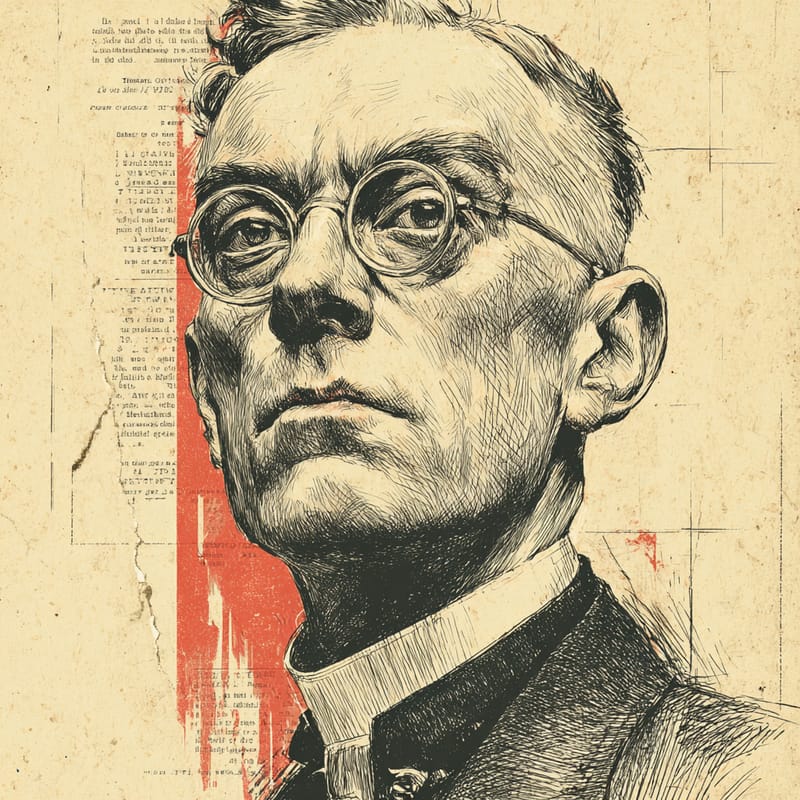
Charles Coughlin
The radio priest
Social justice turned demagoguery.
Traditional LongistOne of 729 ideologies · enter the Longist hall →- Role
- Radio priest
- Era
- 1891–1979
- Region
- United States / Canada
- Social band
- Traditional
- Placement
- −54 · +52 · −50
§ Where Charles Coughlin stands
3 axesCoughlin's National Union for Social Justice, founded in November 1934, demanded a government-owned central bank, nationalisation of key resources such as power and oil, a living annual wage and an end to private control of money and credit. He drew on papal encyclicals such as Quadragesimo Anno (1931) and championed silver against Wall Street, while defending private property and attacking communism as fiercely as bankers.
Coughlin's movement grew increasingly hostile to parliamentary democracy. In 1936 he backed William Lemke's third-party Union Party campaign; later he expressed admiration for Mussolini's corporate state and inspired the Christian Front, several of whose members were arrested by the FBI in 1940 on conspiracy charges that ended without convictions. His magazine Social Justice was barred from the US mails under the Espionage Act in 1942.
Coughlin was a reactionary Catholic traditionalist whose broadcasts curdled into antisemitism. In 1938 Social Justice serialised the forged Protocols of the Elders of Zion, and after the Kristallnacht pogrom that November he told listeners that Nazi persecution was a defence against communism, which he blamed on Jews. His archbishop ordered him to cease political activity in 1942.
How close are you to Charles Coughlin?
Three statements, one per axis. Answer them and we’ll drop you on the compass next to them.
§ The story
HistoricalCharles Edward Coughlin (1891–1979), known as Father Coughlin, was a Canadian-born Catholic priest whose radio broadcasts from the Shrine of the Little Flower in Royal Oak, Michigan, made him one of the most influential voices in Depression-era America. Ordained in 1916, he began broadcasting sermons in 1926, turned to politics as the Depression deepened and by the mid-1930s reached an audience estimated in the tens of millions on his own network of stations.
Coughlin first backed Franklin Roosevelt, then turned on him, attacking bankers and demanding monetary reform through his National Union for Social Justice. After the Union Party he backed flopped in 1936, his message darkened: by 1938 he was promoting the Protocols of the Elders of Zion and excusing Nazi persecution, and his followers formed the Christian Front. New broadcasting rules pushed him off the air around 1940, the government barred his magazine from the mails in 1942 and his church superiors silenced him; he served as a parish priest until 1966.
Notable for
- 01Mass radio demagoguery
- 02National Union for Social Justice
- 03Monetary-reform populism
Key works & moments
- 1926Begins broadcasting sermons on Detroit radio from his Royal Oak parish.
- 1934Founds the National Union for Social Justice as he breaks with Roosevelt.
- 1936Backs William Lemke's Union Party presidential bid, which wins about 2 per cent of the vote.
- 1938Social Justice serialises the forged Protocols; he excuses Nazi persecution after Kristallnacht.
- 1942His magazine is barred from the mails and church superiors order him out of politics.
§ Minds closest to Charles Coughlin
All minds →
§ Also in the Longist hall
Enter the hall →§ Common questions
4 answersWhat was Father Coughlin's political ideology?
Father Coughlin was a monetary populist who became an antisemitic, authoritarian demagogue: on the 99ideologies three-axis compass, a Traditional Longist. Economically he sat left of centre (−54), demanding a government-owned central bank, nationalised resources and a living wage; on governance he leaned clearly authoritarian (+52), increasingly hostile to democracy and admiring of Mussolini's corporate state; and socially he was strongly traditional (−50), a reactionary Catholic whose broadcasts turned to bigotry.
Was Father Coughlin left-wing or right-wing?
He began on the populist economic left and ended on the far right. In the early 1930s Coughlin attacked bankers, demanded nationalised banking and a living wage and initially backed the New Deal. But he was always a fierce anticommunist and Catholic traditionalist, and by 1938 his broadcasts and magazine promoted antisemitism and sympathy for fascist regimes. That trajectory, from redistributive monetary radicalism to authoritarian bigotry, is why he is usually studied as a forerunner of the American populist right.
Was Father Coughlin a fascist?
Historians differ over whether the label fits, but they agree he moved from economic populism to antisemitic, anti-democratic agitation. By the late 1930s Coughlin praised Mussolini's corporate state, published the forged Protocols of the Elders of Zion and defended Nazi Germany's actions after Kristallnacht as a response to communism. His followers in the Christian Front harassed Jewish New Yorkers, and in 1942 the government barred his magazine from the mails. He never led a fascist party, but he was the most prominent American voice sympathetic to fascism.
Which minds are closest to Charles Coughlin?
On the 99ideologies three-axis compass, the minds closest to Charles Coughlin are Tom Watson (97% alike), William Aberhart (96% alike) and Getúlio Vargas (92% alike). The furthest is Lysander Spooner (11% alike).