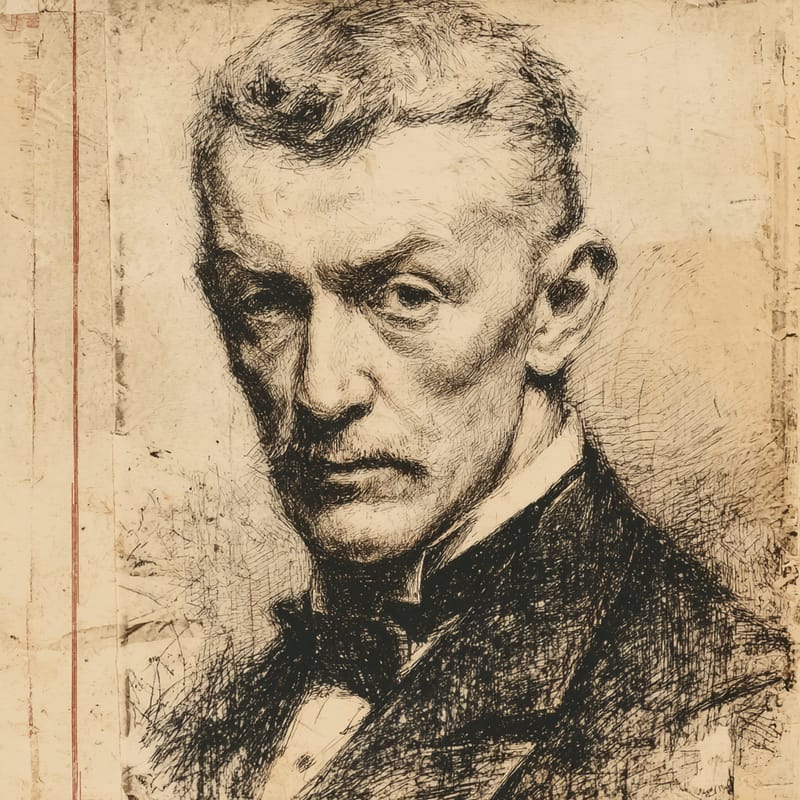
Tom Watson
The Populist firebrand
Agrarian revolt, then reaction.
Traditional LongistOne of 729 ideologies · enter the Longist hall →- Role
- Senator & Populist
- Era
- 1856–1922
- Region
- United States
- Social band
- Traditional
- Placement
- −52 · +46 · −48
§ Where Tom Watson stands
3 axesWatson championed the farmers' revolt against banks, railroads and crop-lien merchants. He pressed for the Farmers' Alliance sub-treasury plan, under which federal warehouses would lend to farmers against stored crops, and for free silver, a graduated income tax and public ownership of railroads and telegraphs, all demands of the People's Party Omaha Platform of 1892. He defended small property rather than collective ownership.
Watson was a mass-movement tribune who built a fierce personal following through his newspapers, the People's Party Paper and later The Jeffersonian. He denounced the fraud and violence Georgia Democrats used against Populists in the 1890s, yet in later years used his press to stir up mobs, notably during the Leo Frank case, which ended in a lynching in 1915.
Watson's social trajectory ran from biracial reform to hard reaction. In 1892 he appealed to Black and white farmers to unite and helped protect a Black Populist preacher, H. S. Doyle, from a lynch mob. By 1906 he backed the disfranchisement of Black voters, and in the 1910s his anti-Catholic and antisemitic campaigns helped prepare the ground for the Ku Klux Klan's revival in 1915.
How close are you to Tom Watson?
Three statements, one per axis. Answer them and we’ll drop you on the compass next to them.
§ The story
HistoricalThomas Edward Watson (1856–1922) was a Georgia lawyer, editor and politician who became the leading voice of Southern Populism. Elected to Congress in 1890 with Farmers' Alliance backing, he joined the new People's Party, secured the first federal funding for rural free mail delivery and in 1892 urged poor Black and white farmers to unite against the banks, railroads and merchants who exploited them both. He was the Populists' vice-presidential nominee in 1896 and their presidential candidate in 1904 and 1908.
After Populism collapsed, Watson turned his magazines and newspapers into vehicles for virulent attacks on Black Americans, Catholics and Jews. His articles inflamed the campaign against Leo Frank, a Jewish factory manager convicted of murder in Atlanta in 1913 in a case widely regarded as a miscarriage of justice, which ended in Frank's lynching in 1915, and he backed the disfranchisement of the Black voters he had once courted. Elected to the US Senate in 1920, he died in office in 1922. His career is a classic study of agrarian protest turning into reactionary bigotry.
Notable for
- 01Led Southern Populism
- 02The People's Party VP nominee
- 03Sub-treasury farm plan
Key works & moments
- 1890Elected to Congress from Georgia with Farmers' Alliance backing; soon joins the People's Party.
- 1892Urges Black and white farmers to unite in his essay The Negro Question in the South.
- 1893Secures the first federal appropriation for rural free delivery of mail.
- 1896Nominated for vice-president by the People's Party on William Jennings Bryan's ticket.
- 1913–15His writings inflame the Leo Frank case, which ends in Frank's lynching.
- 1920Elected to the US Senate from Georgia; dies in office in 1922.
In their own words
“You are kept apart that you may be separately fleeced of your earnings.”
§ Minds closest to Tom Watson
All minds →


§ Also in the Longist hall
Enter the hall →§ Common questions
4 answersWhat was Tom Watson's political ideology?
Tom Watson was an agrarian Populist whose later politics turned to nativist reaction: on the 99ideologies three-axis compass, a Traditional Longist. Economically he sat left of centre (−52), demanding cheap credit for farmers, a graduated income tax and public ownership of railroads; on governance he leaned authoritarian (+46), a mass-movement tribune who later stirred up mobs; and socially he was clearly traditional (−48), his early biracial appeals giving way to racism, antisemitism and anti-Catholicism.
Was Tom Watson left-wing or right-wing?
Both, at different stages. As a Populist in the 1890s he was on the economic left, calling for public ownership of railroads, a graduated income tax and cheap credit for farmers, and he reached across the colour line. In his later decades he moved hard to the right on race and religion, becoming a nativist and bigot while keeping much of his anti-corporate economics. His arc is often cited to show how left-populist economics can coexist with reactionary social politics.
Was Tom Watson a racist?
In his later career, unmistakably, and historians debate how far his earlier biracial stance was principled or tactical. In 1892 Watson asked Black and white farmers to see their common economic interest and defended Black Populists from violence, though he never challenged segregation itself. After the Populists' defeat he concluded that white unity mattered more, backed Black disfranchisement in 1906 and filled his publications with racist, antisemitic and anti-Catholic invective, contributing to the climate in which Leo Frank was lynched in 1915.
Which minds are closest to Tom Watson?
On the 99ideologies three-axis compass, the minds closest to Tom Watson are William Aberhart (98% alike), Charles Coughlin (97% alike) and Getúlio Vargas (92% alike). The furthest is Lysander Spooner (14% alike).