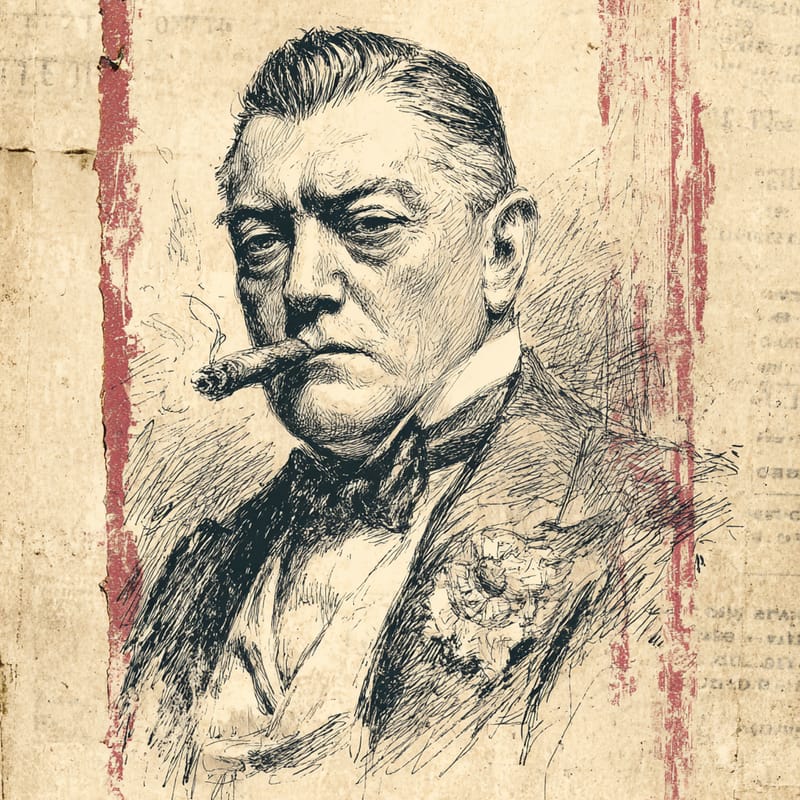
Getúlio Vargas
Father of the poor
Labour laws from above.
Rooted LongistOne of 729 ideologies · enter the Longist hall →- Role
- President
- Era
- 1882–1954
- Region
- Brazil
- Social band
- Rooted
- Placement
- −52 · +56 · −30
§ Where Getúlio Vargas stands
3 axesVargas pursued state-led industrialisation and labour protection rather than socialism. He decreed a national minimum wage in 1940, consolidated workers' rights in the 1943 Consolidation of Labour Laws and created state enterprises such as the National Steel Company (1941), Vale do Rio Doce (1942) and Petrobras (1953). Private enterprise remained, but trade unions were tied to the Ministry of Labour in a corporatist system.
In November 1937 Vargas cancelled the coming election, closed Congress and imposed the Estado Novo, citing a fabricated communist conspiracy known as the Cohen Plan. Parties were banned, the Department of Press and Propaganda censored newspapers and radio, and the political police jailed communists and Integralists alike. He returned in 1951 as an elected president governing within a democratic constitution.
Vargas's nationalism was paternalist and centralising. At a 1937 ceremony he had the flags of Brazil's states burned to symbolise a single nation, and his nationalisation campaign forced immigrant communities to use Portuguese and closed foreign-language schools. His 1932 electoral code gave women the vote, but he governed as a protective father of the nation rather than a liberaliser of social customs.
How close are you to Getúlio Vargas?
Three statements, one per axis. Answer them and we’ll drop you on the compass next to them.
§ The story
HistoricalGetúlio Dornelles Vargas (1882–1954) dominated Brazilian politics for a quarter of a century, ruling from 1930 to 1945 and again as elected president from 1951 to 1954. A lawyer from a ranching family in Rio Grande do Sul, he served as federal finance minister and as his state's governor before losing the disputed 1930 presidential election, after which a revolt backed by Rio Grande do Sul, Minas Gerais and Paraíba carried him to power as provisional president.
Vargas centralised a fragmented federation, laid the foundations of Brazilian industry and gave urban workers a minimum wage and a labour code, earning the title father of the poor. He did so largely as a dictator: his Estado Novo of 1937–45 closed Congress, censored the press and jailed opponents, and in 1936 his government deported the pregnant German-Jewish communist Olga Benário to Nazi Germany, where she was later killed. Returned to power by election, he founded Petrobras before a political crisis drove him to suicide in 1954.
Notable for
- 01The 'Estado Novo'
- 02Sweeping labour legislation
- 03Dominated Brazil for decades
Key works & moments
- 1930Leads the October revolution that topples the Old Republic and becomes provisional president.
- 1937Closes Congress in a 10 November coup and proclaims the authoritarian Estado Novo.
- 1943Issues the Consolidation of Labour Laws, Brazil's comprehensive labour code.
- 1945–50Deposed by the army in 1945, he wins the presidency back at the polls in 1950.
- 1953Creates the state oil company Petrobras after a nationalist campaign for state control of oil.
- 1954Shoots himself in the Catete Palace amid a military crisis, leaving a political testament.
In their own words
“Serenely, I take the first step on the road to eternity, and I leave life to enter history.”
§ Minds closest to Getúlio Vargas
All minds →
§ Also in the Longist hall
Enter the hall →The closest minds above are this hall’s whole roster.
§ Common questions
4 answersWhat was Getúlio Vargas's political ideology?
Getúlio Vargas was a nationalist, corporatist populist known as the father of the poor: on the 99ideologies three-axis compass, a Rooted Longist. Economically he sat left of centre (−52), granting labour rights and building state industries within a capitalist economy; on governance he was clearly authoritarian (+56), ruling as dictator under the Estado Novo; and socially he leaned traditional (−30), a paternalist nationalist who centralised the nation and courted the working masses from above.
Was Getúlio Vargas left-wing or right-wing?
He fits neither cleanly. Vargas's labour laws, minimum wage and state companies made him the founding figure of Brazil's labour-oriented politics, and his Brazilian Labour Party carried that legacy after 1945. But his Estado Novo borrowed from European corporatism and authoritarian nationalism, persecuted communists and was at first courted by the fascist-style Integralists. On balance he was a left-leaning nationalist populist who used authoritarian means, which is why both the Brazilian left and right have claimed parts of his legacy.
What was the Estado Novo in Brazil?
The Estado Novo, or New State, was Vargas's dictatorship from 1937 to 1945. He launched it with a coup on 10 November 1937, justified by the forged Cohen Plan for a communist uprising, and imposed a centralising constitution that closed Congress, abolished parties and gave him rule by decree. The regime censored the press, persecuted communists and Integralists, and organised workers in state-controlled unions, while also passing the minimum wage and the 1943 labour code. The military ended it by deposing Vargas in October 1945.
Which minds are closest to Getúlio Vargas?
On the 99ideologies three-axis compass, the minds closest to Getúlio Vargas are Willie Stark (98% alike), Huey Long (94% alike) and Juan Perón (94% alike). The furthest is Lysander Spooner (14% alike).