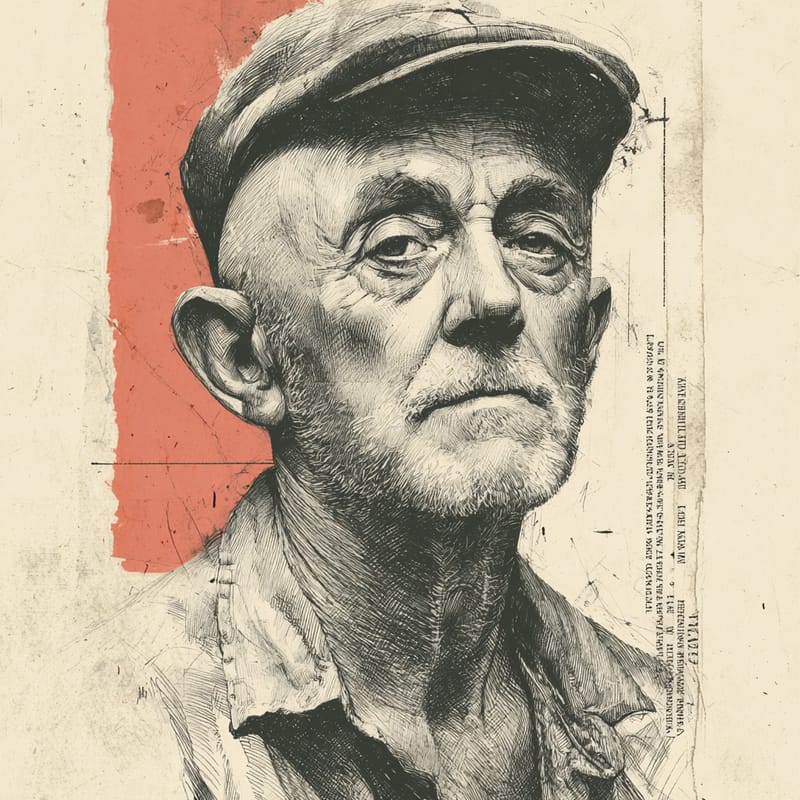
Wendell Berry
The agrarian conscience
Land, locality, and stewardship.
Traditional DistributistOne of 729 ideologies · enter the Distributist hall →- Role
- Writer & farmer
- Era
- b. 1934
- Region
- United States
- Social band
- Traditional
- Placement
- −30 · +38 · −40
§ Where Wendell Berry stands
3 axesBerry attacks industrial capitalism and corporate agribusiness for replacing farmers with machines, chemicals and debt. The Unsettling of America (1977) condemned the federal push for ever-larger farms, and later essays such as those in Home Economics (1987) call for local economies in which ownership is widespread and land is kept in small hands. He defends private property and markets at a human scale rather than collective ownership.
Berry's order is local and moral rather than libertarian. In Sex, Economy, Freedom and Community (1993) he argues that freedom cut loose from obligations to family, neighbours and place destroys communities, and he looks to settled membership and inherited practice rather than distant federal or corporate power. He has also asked government to restrain corporations, joining a 2011 sit-in at the Kentucky governor's office against mountaintop-removal mining.
Berry defends traditional rural culture, the household economy, marriage and religion as the bonds that hold communities together, and he is sceptical of technological progress: his 1987 essay Why I Am Not Going to Buy a Computer explained his preference for pencil and paper. A Christian critic of the churches' failures toward the land, he roots morality in stewardship of creation and fidelity to place.
How close are you to Wendell Berry?
Three statements, one per axis. Answer them and we’ll drop you on the compass next to them.
§ The story
LivingWendell Berry (born 1934) is an American novelist, poet, essayist and farmer from Henry County, Kentucky. After studying at the University of Kentucky, holding a writing fellowship at Stanford under Wallace Stegner and teaching in New York, he returned home in the mid-1960s to farm at Lanes Landing near Port Royal, on the Kentucky River, combining farm work with teaching at the University of Kentucky. His fiction, beginning with Nathan Coulter in 1960, chronicles the imaginary farming town of Port William across generations.
Berry's essays, above all The Unsettling of America (1977), indict industrial agriculture, agribusiness and the federal farm policy associated with Secretary of Agriculture Earl Butz for emptying the countryside, degrading soil and breaking communities. He champions small family farms, local economies and stewardship rooted in affection for a particular place. He has joined protests against nuclear power and mountaintop-removal coal mining, and received the National Humanities Medal for 2010. His influence reaches environmentalists, the local-food movement, Christian conservatives and anti-corporate radicals alike, making him a writer claimed across the political divide.
Notable for
- 01'The Unsettling of America'
- 02Agrarian essays and poetry
- 03Local-economy advocacy
Key works & moments
- 1960Publishes his first novel, Nathan Coulter, opening the Port William saga.
- 1965Settles on his farm at Lanes Landing on the Kentucky River.
- 1977Publishes The Unsettling of America: Culture and Agriculture.
- 1987Publishes the essay Why I Am Not Going to Buy a Computer.
- 2000Publishes Jayber Crow, a novel told by the barber of Port William.
- 2011Joins a sit-in at the Kentucky governor's office against mountaintop-removal mining.
In their own words
“I begin with the proposition that eating is an agricultural act.”
§ Minds closest to Wendell Berry
All minds →

§ Also in the Distributist hall
Enter the hall →§ Common questions
4 answersWhat is Wendell Berry's political ideology?
Wendell Berry is an agrarian localist whose defence of small farms, widespread property and rooted community parallels distributism: on the 99ideologies three-axis compass, a Traditional Distributist. Economically he sits left of centre (−30), attacking corporate agribusiness and industrial capitalism while defending small private holdings. On governance he leans toward order (+38), valuing communal obligation and local limits over individual licence, and socially he is traditional (−40), grounding life in family, place, faith and inherited practice.
Is Wendell Berry left-wing or right-wing?
Neither, and he rejects both labels. His environmentalism, his criticism of corporations and his protests against war, nuclear power and coal mining endear him to the left, while his defence of family farms, marriage, religion and local tradition, and his scepticism of technology and centralised government, appeal to traditional conservatives. Berry has criticised both major parties for serving the same industrial economy, and he is best described as an agrarian traditionalist who stands outside the usual divide.
What is The Unsettling of America about?
It is Berry's 1977 indictment of industrial agriculture. He argues that American farm policy, with its drive for ever-larger, mechanised and chemical-dependent farms, uprooted farming families, eroded soil and severed the culture of agriculture from the land, treating food as just another industrial product. Berry calls instead for small, diversified farms owned by those who work them, careful stewardship and strong local communities, and the book became a founding text of the sustainable agriculture and local-food movements.
Which minds are closest to Wendell Berry?
On the 99ideologies three-axis compass, the minds closest to Wendell Berry are John Médaille (96% alike), Dorothy Day (96% alike) and E. F. Schumacher (94% alike). The furthest is Lysander Spooner (23% alike).