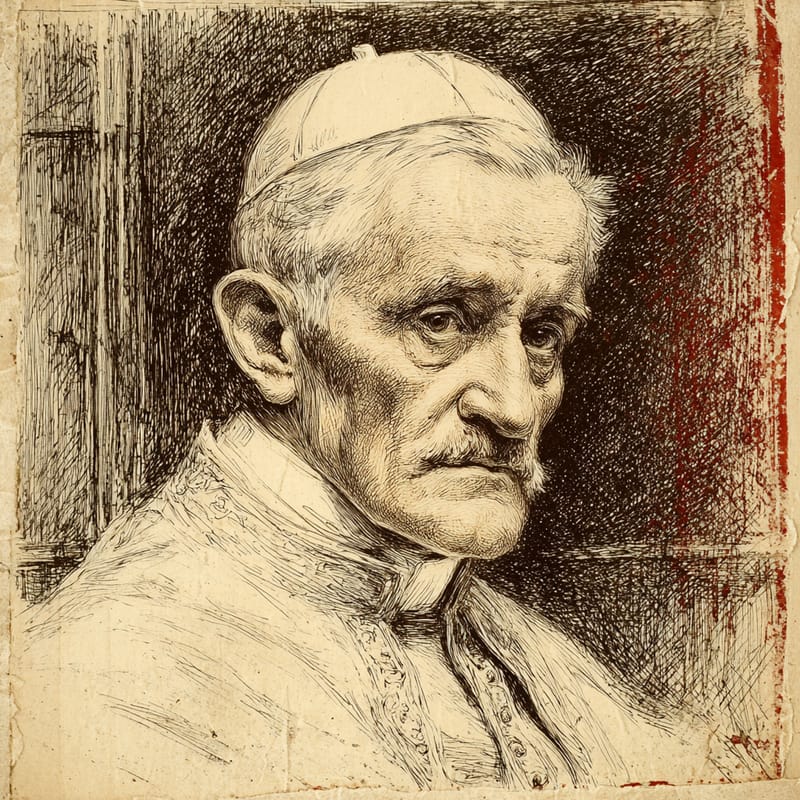
Pope Leo XIII
Rerum Novarum
The charter of Catholic social teaching.
Reactionary DistributistOne of 729 ideologies · enter the Distributist hall →- Role
- Pope
- Era
- 1810–1903
- Region
- Papal States / Italy
- Social band
- Reactionary
- Placement
- −24 · +55 · −65
§ Where Pope Leo XIII stands
3 axesRerum Novarum (1891) steered between socialism and laissez-faire. It defended private property as a natural right and rejected class war, but insisted that wages be enough to support a frugal and well-behaved worker, that working hours and children's labour be limited and that the state take special care of the poor. Leo urged that as many people as possible should become owners, the principle distributists later built on.
Leo upheld hierarchical authority in Church and state. His encyclicals Diuturnum (1881) and Immortale Dei (1885) taught that political authority comes from God rather than the people and that the state should profess the Catholic faith, and Libertas (1888) rejected unlimited freedoms of worship, speech and the press. Yet in 1892 he urged French Catholics to accept their republic, holding that the Church could live with any just form of government.
Leo was a firm defender of the family and Catholic morality. Arcanum (1880) upheld marriage as an indissoluble sacrament under Church authority and condemned divorce, Humanum Genus (1884) denounced Freemasonry as an enemy of the Church and Christian society, and Testem Benevolentiae (1899) warned American Catholics against adapting doctrine to modern culture. His Aeterni Patris (1879) made Thomist philosophy the bulwark of orthodox thought.
How close are you to Pope Leo XIII?
Three statements, one per axis. Answer them and we’ll drop you on the compass next to them.
§ The story
HistoricalPope Leo XIII, born Vincenzo Gioacchino Pecci (1810–1903), led the Catholic Church from 1878 until his death, one of the longest pontificates in its history. Born into minor nobility at Carpineto Romano in the Papal States, he served as papal nuncio in industrialising Belgium and then spent more than three decades as Bishop of Perugia before his election as pope at the age of 67, eight years after the new Kingdom of Italy had seized Rome and ended the Papal States.
Leo sought to reconcile the Church with the modern world without surrendering its claims. His encyclical Rerum Novarum (1891) condemned socialism and defended private property while insisting on just wages, decent working conditions and workers' right to form associations, founding modern Catholic social teaching and inspiring Christian democratic parties, Catholic trade unions and the distributism of Chesterton and Belloc. He revived the philosophy of Thomas Aquinas, urged French Catholics to accept the Republic in 1892 and opened the Vatican Archives to scholars, yet he also condemned Freemasonry, declared Anglican ordinations invalid and never recognised the Italian state's seizure of Rome.
Notable for
- 01'Rerum Novarum'
- 02Founded Catholic social teaching
- 03Defended workers and property
Key works & moments
- 1878Elected pope after the death of Pius IX, eight years after the fall of papal Rome.
- 1879Issues Aeterni Patris, reviving the philosophy of Thomas Aquinas in Catholic teaching.
- 1885Issues Immortale Dei on the Christian constitution of states.
- 1891Issues Rerum Novarum on capital and labour, founding modern Catholic social teaching.
- 1892Urges French Catholics to accept the Third Republic, launching the Ralliement.
- 1896Declares Anglican ordinations invalid in the bull Apostolicae Curae.
In their own words
“Each needs the other: capital cannot do without labor, nor labor without capital.”
§ Minds closest to Pope Leo XIII
All minds →


§ Also in the Distributist hall
Enter the hall →§ Common questions
4 answersWhat was Pope Leo XIII's political ideology?
Leo XIII was a Catholic social conservative who sought a middle way between socialism and unrestrained capitalism: on the 99ideologies three-axis compass, a Reactionary Distributist. Economically he sat left of centre (−24), defending private property yet demanding just wages, workers' associations and state protection for the poor in Rerum Novarum. On governance he leaned toward authority (+55), teaching that power comes from God and that states should profess the Catholic faith, and socially he was strongly traditional (−65), defending indissoluble marriage and Church authority.
Was Pope Leo XIII left-wing or right-wing?
Right-wing overall, with a progressive streak on labour. Leo condemned socialism, defended private property and hierarchical authority, opposed divorce and religious liberalism, and refused to accept the Italian state's capture of Rome. Yet Rerum Novarum's support for workers' associations, a living wage and laws protecting workers placed him ahead of many liberal governments of the 1890s, and it was embraced by social reformers and Christian democrats. He is best described as a conservative reformer.
What is Rerum Novarum about?
It is Leo XIII's 1891 encyclical on the condition of the working classes, the founding document of modern Catholic social teaching. Responding to industrial poverty and the rise of socialism, it rejected class struggle and defended private property as a natural right, but it also held that employers must pay a wage sufficient for a frugal and well-behaved worker, that hours and child labour should be limited, and that workers may form associations. Later popes marked its anniversaries with encyclicals such as Quadragesimo Anno (1931) and Centesimus Annus (1991).
Which minds are closest to Pope Leo XIII?
On the 99ideologies three-axis compass, the minds closest to Pope Leo XIII are G. K. Chesterton (96% alike), Hilaire Belloc (96% alike) and Vincent McNabb (96% alike). The furthest is Emma Goldman (11% alike).