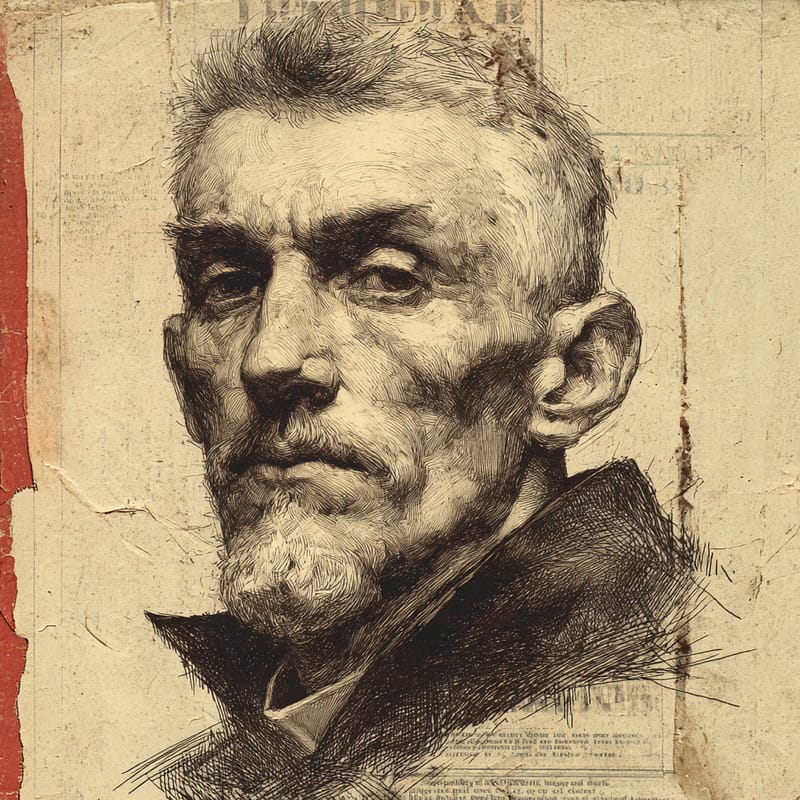
Vincent McNabb
Back to the land
Distributism as a way of life.
Traditional DistributistOne of 729 ideologies · enter the Distributist hall →- Role
- Priest & writer
- Era
- 1868–1943
- Region
- Ireland / UK
- Social band
- Traditional
- Placement
- −28 · +46 · −62
§ Where Vincent McNabb stands
3 axesMcNabb taught that real freedom required households to own and work productive land, so that they need not depend on wages from factories or relief from the state. In The Church and the Land he called for families to leave the industrial cities for smallholdings, a programme the Catholic Land Movement attempted in the 1930s, and he rejected both industrial capitalism and socialism as forms of dependence.
McNabb's ideal order was the Christian family under the guidance of the Church, with the home and parish rather than the state or the market at the centre of social life. Nazareth or Social Chaos held up the Holy Family's household at Nazareth as the pattern for society, and he treated Catholic teaching from Leo XIII's Rerum Novarum (1891) onward as the authority for social reform.
McNabb was an ascetic Catholic traditionalist who saw industrial, urban life as a threat to faith, family and morals. He held up the rural household, centred on prayer and work, as the setting in which Catholic morality could survive, and lived in austere poverty as a Dominican friar, preaching that message at Speakers' Corner from the 1920s until his death in 1943.
How close are you to Vincent McNabb?
Three statements, one per axis. Answer them and we’ll drop you on the compass next to them.
§ The story
HistoricalVincent McNabb (1868–1943) was an Irish-born Dominican priest, preacher and writer who became the most uncompromising voice of English distributism. Born in Portaferry, County Down, he entered the Dominican order in 1885 and was ordained a priest in 1891, later serving as prior of Dominican houses in England. From the 1920s he was a familiar figure at Speakers' Corner in Hyde Park, preaching for the Catholic Evidence Guild in his Dominican habit and debating all comers.
A friend of G. K. Chesterton and Hilaire Belloc, McNabb pushed their distributism toward a literal return to the land. In books such as The Church and the Land and Nazareth or Social Chaos he urged Catholic families to leave the industrial cities for self-sufficient smallholdings, and his preaching inspired the Catholic Land Movement of the 1930s, which tried to settle unemployed families on farms. He lived with conspicuous austerity, practising the simplicity he preached. Critics found his rejection of industrial life impractical, while admirers saw him as distributism's prophet and conscience.
Notable for
- 01'The Church and the Land'
- 02Back-to-the-land distributism
- 03Catholic Land Movement
Key works & moments
- 1885Enters the Dominican order; he is ordained a priest in 1891.
- 1920sBegins preaching at Speakers' Corner in Hyde Park for the Catholic Evidence Guild.
- 1920sPublishes The Church and the Land, urging Catholic families back to the soil.
- 1930sInspires the Catholic Land Movement, which tries to settle unemployed families on farms.
- 1930sPublishes Nazareth or Social Chaos, holding up the Holy Family as the model for society.
§ Minds closest to Vincent McNabb
All minds →

§ Also in the Distributist hall
Enter the hall →§ Common questions
4 answersWhat was Vincent McNabb's political ideology?
Vincent McNabb was a back-to-the-land distributist who wanted Catholic families to own and work their own land: on the 99ideologies three-axis compass, a Traditional Distributist. Economically he sat left of centre (−28), rejecting wage dependence under industrial capitalism and state socialism alike. On governance he leaned toward order (+46), placing the family and the Church at the centre of social authority, and socially he was strongly traditional (−62), an ascetic friar who saw urban industrial life as corrosive of faith and morals.
Was Vincent McNabb left-wing or right-wing?
He fits neither side well but belongs more naturally to the traditionalist right. His attacks on industrial capitalism, factory labour and the concentration of wealth echo left-wing critiques, and he championed the urban poor. But his remedy was not collective ownership or state welfare: it was a return to family smallholdings, religious discipline and the authority of the Catholic Church, a conservative and agrarian vision that set him against socialists and modern liberals alike.
What was the Catholic Land Movement?
It was a 1930s effort by British Catholics to resettle unemployed urban families on the land, inspired by distributism and above all by Vincent McNabb's preaching. Regional Catholic Land Associations raised funds, trained men on farms and established small settlements where families could work smallholdings. The movement put into practice McNabb's belief that independence came from owning productive land, but its settlements remained small, many struggled financially, and the movement faded during the 1940s.
Which minds are closest to Vincent McNabb?
On the 99ideologies three-axis compass, the minds closest to Vincent McNabb are Hilaire Belloc (98% alike), G. K. Chesterton (97% alike) and Samwise Gamgee (96% alike). The furthest is Emma Goldman (15% alike).