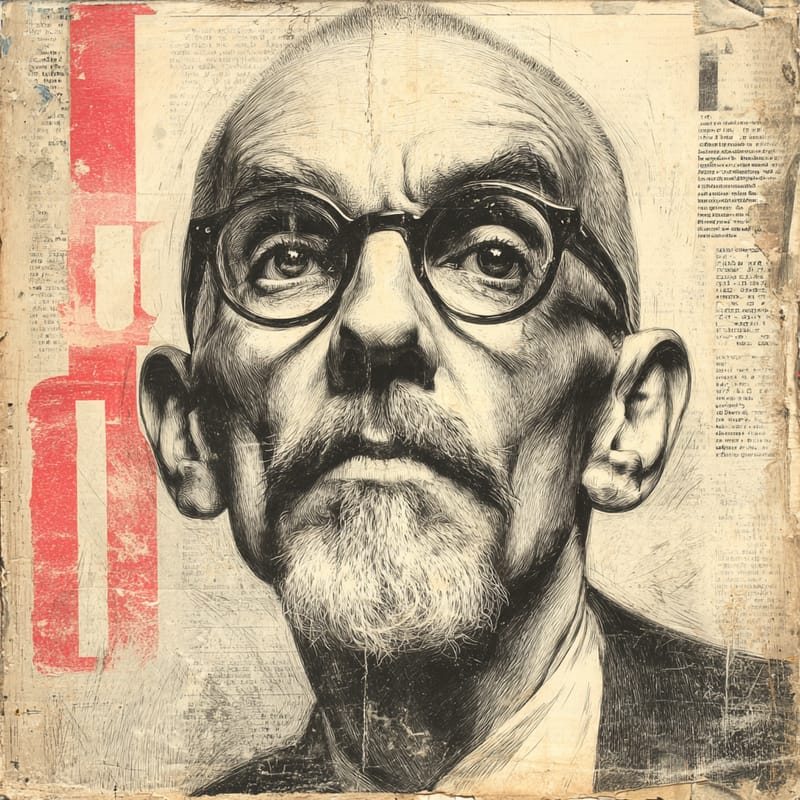
Walter Ulbricht
The planned republic
State socialism, walled in.
Rooted State SocialistOne of 729 ideologies · enter the State Socialist hall →- Role
- General Secretary
- Era
- 1893–1973
- Region
- East Germany
- Social band
- Rooted
- Placement
- −34 · +80 · −14
§ Where Walter Ulbricht stands
3 axesUlbricht nationalised large industry and banks, completed the collectivisation of agriculture in 1960 and built a Soviet-style planned economy, so his record is decidedly socialist. Yet the lean has limits: his 1963 New Economic System of Planning and Management introduced profit incentives and enterprise autonomy, and thousands of small private and semi-state firms survived until Honecker nationalised them in 1972.
Ulbricht built a hard one-party security state. The Stasi was founded in 1950, the 1953 uprising was suppressed with Soviet troops, and the Berlin Wall, begun on 13 August 1961, sealed the border under a regime in which guards shot people trying to escape. Two months earlier he had told a press conference that nobody intended to build a wall.
Ulbricht's East Germany was secular but socially austere and conformist. His Ten Commandments of Socialist Morality, announced in 1958, preached patriotism, discipline, decency and respect for family, the state promoted the secular Jugendweihe ceremony in place of church confirmation, and the party's Eleventh Plenum of 1965 banned critical films and books and condemned Western-style beat music.
How close are you to Walter Ulbricht?
Three statements, one per axis. Answer them and we’ll drop you on the compass next to them.
§ The story
HistoricalWalter Ulbricht (1893–1973) was the founding leader of communist East Germany. A Leipzig cabinetmaker, he joined the Social Democrats in 1912, moved to the Communist Party soon after its foundation and sat in the Reichstag from 1928 to 1933. He spent the Nazi years in exile, mainly in Moscow, and on 30 April 1945 returned to Berlin at the head of the Ulbricht Group, a team of German communists flown in to rebuild political life under Soviet occupation.
Ulbricht engineered the forced merger of the Communist and Social Democratic parties into the Socialist Unity Party in 1946 and led it from 1950 to 1971, building the German Democratic Republic on the Soviet model. His drive for the construction of socialism provoked the uprising of 17 June 1953, crushed by Soviet tanks, and the flight of millions of citizens westward, which he halted by building the Berlin Wall in August 1961. Forced out by Erich Honecker with Moscow's support in 1971, he died two years later.
Notable for
- 01Built the GDR's planned economy
- 02Oversaw the Berlin Wall
- 03SED party leader
Key works & moments
- 1945Returns from Moscow on 30 April at the head of the Ulbricht Group.
- 1946Engineers the forced merger of the KPD and SPD into the Socialist Unity Party.
- 1952Proclaims the planned construction of socialism, accelerating collectivisation and heavy industry.
- 1953Higher work quotas spark the 17 June uprising, crushed by Soviet tanks.
- 1961Begins the Berlin Wall on 13 August, two months after denying any such plan.
- 1971Forced to resign as party leader in favour of Erich Honecker.
In their own words
“Nobody has the intention of building a wall.”
§ Minds closest to Walter Ulbricht
All minds →

§ Also in the State Socialist hall
Enter the hall →§ Common questions
4 answersWhat was Walter Ulbricht's political ideology?
Walter Ulbricht was a Moscow-trained Marxist-Leninist who built East Germany on the Soviet model: on the 99ideologies three-axis compass, a Rooted State Socialist. Economically he sat left of centre (−34), nationalising industry and planning the economy while later experimenting with profit incentives and tolerating small private firms. On governance he was strongly authoritarian (+80), ruling through the party, the Stasi and the Wall. Socially he leaned traditional (−14), imposing an austere, conformist morality.
Was Walter Ulbricht left-wing or right-wing?
Left-wing. Ulbricht was a communist from his twenties who spent most of the Nazi era in Soviet exile and built a socialist state with nationalised industry, collective farms and central planning. His regime's authoritarianism, militarism and cultural conservatism reminded critics of older German traditions, but its ideology and economic system were unmistakably Marxist-Leninist, and it defined itself against capitalist West Germany.
Did Walter Ulbricht build the Berlin Wall?
Yes, his regime did. Facing the flight of millions of East Germans to the West, Ulbricht pressed Moscow for permission to close the open border in Berlin, and Nikita Khrushchev agreed in the summer of 1961. On 13 August border troops sealed the sector boundary with barbed wire, soon replaced by concrete, in an operation organised by Erich Honecker as the party's security secretary. Only two months earlier Ulbricht had publicly denied any intention to build a wall.
Which minds are closest to Walter Ulbricht?
On the 99ideologies three-axis compass, the minds closest to Walter Ulbricht are The Ministry (archetype) (96% alike), János Kádár (96% alike) and Hafez al-Assad (94% alike). The furthest is Hans-Hermann Hoppe (12% alike).