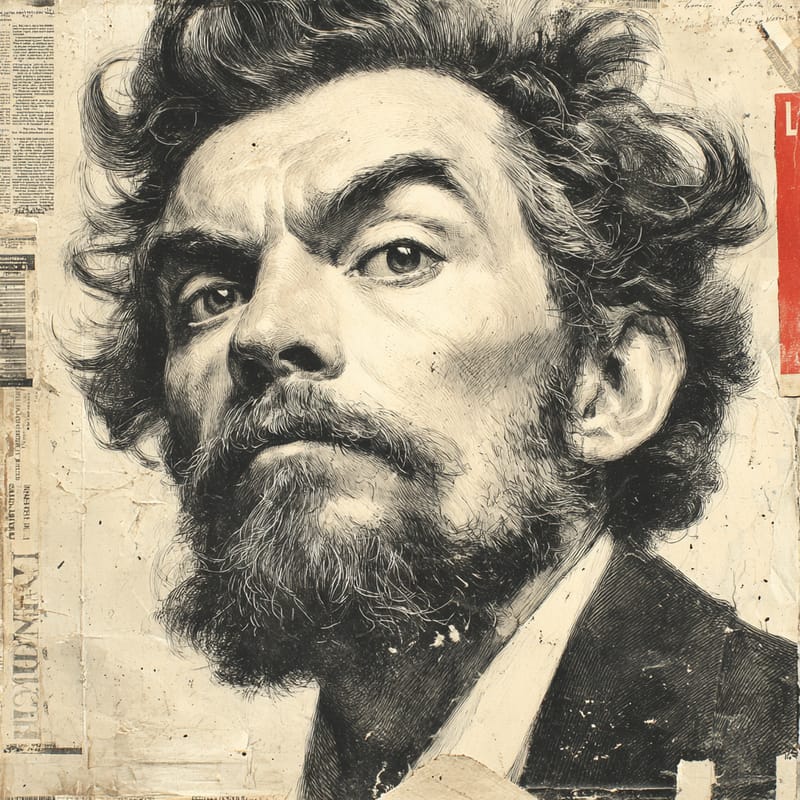
Ferdinand Lassalle
Socialism through the state
The workers' party meets the strong state.
State SocialistOne of 729 ideologies · enter the State Socialist hall →- Role
- Socialist organiser
- Era
- 1825–1864
- Region
- Germany
- Social band
- Centre (no modifier)
- Placement
- −30 · +64 · +6
§ Where Ferdinand Lassalle stands
3 axesLassalle's socialism was moderate by later standards. In his Open Reply Letter of 1863 he argued that an iron law of wages kept workers at subsistence under capitalism, and that the remedy was producer cooperatives financed by state credit, letting workers own their enterprises, rather than wholesale expropriation or Marx's revolutionary abolition of capital.
Lassalle believed the existing state could become the instrument of workers' liberation once universal suffrage gave them control of it. He led his association with near-dictatorial authority under its statutes, and in 1863–64 he negotiated privately with Bismarck, hoping the Prussian state would grant suffrage and support cooperatives, a courtship of power that Marx and Engels scorned.
Socially Lassalle was a reform-minded modernist of his time rather than a radical. He championed democratic suffrage and workers' education and dignity, and his 1862 lecture On the Essence of Constitutions argued that constitutions merely reflect the real balance of power, yet he appealed to German national feeling and accepted the Prussian state as the framework of progress.
How close are you to Ferdinand Lassalle?
Three statements, one per axis. Answer them and we’ll drop you on the compass next to them.
§ The story
HistoricalFerdinand Lassalle (1825–1864) was a German socialist writer and orator who founded the first independent workers' party in Germany. Born into a prosperous Jewish family in Breslau, he studied Hegelian philosophy in Breslau and Berlin, won fame through a long legal battle on behalf of Countess Sophie von Hatzfeldt, and was jailed for agitation during the revolution of 1848–49. A friend and correspondent of Karl Marx, he wrote on philosophy and law before turning to mass politics in 1862.
In May 1863 Lassalle founded the General German Workers' Association in Leipzig, campaigning for universal manhood suffrage and state-funded producer cooperatives as the path to workers' emancipation. He also held secret talks with Otto von Bismarck, whom he hoped to win for suffrage reform, which later fuelled accusations that he had flirted with the Prussian monarchy. In August 1864 he died after a duel in Geneva over a love affair. In 1875 his association merged with the Eisenach socialists of August Bebel and Wilhelm Liebknecht to form the forerunner of today's Social Democratic Party.
Notable for
- 01Founded the ADAV (1863)
- 02State-aided cooperatives
- 03Father of German state socialism
Key works & moments
- 1848–49Jailed for revolutionary agitation in the Rhineland during the upheavals of 1848.
- 1862Delivers his lectures On the Essence of Constitutions and the Workers' Programme in Berlin.
- 1863Publishes his Open Reply Letter to Leipzig workers, demanding universal suffrage and state-aided cooperatives.
- 1863Founds the General German Workers' Association in Leipzig on 23 May.
- 1863–64Holds secret talks with Otto von Bismarck on suffrage and the social question.
- 1864Dies in Geneva on 31 August from wounds suffered in a duel.
§ Minds closest to Ferdinand Lassalle
All minds →

§ Also in the State Socialist hall
Enter the hall →The closest minds above are this hall’s whole roster.
§ Common questions
4 answersWhat was Ferdinand Lassalle's political ideology?
Ferdinand Lassalle was a state socialist who believed that a democratic state could deliver workers' emancipation: on the 99ideologies three-axis compass, a State Socialist. Economically he sat moderately left (−30), proposing state-financed producer cooperatives rather than wholesale nationalisation. On governance he leaned authoritarian (+64), trusting a strong state and leading his party with commanding personal authority. Socially he sat near the centre (+6), a reform-minded democrat of his era.
Was Ferdinand Lassalle left-wing or right-wing?
Left-wing. Lassalle founded Germany's first workers' party and campaigned for universal suffrage and state support for workers' cooperatives, and his movement became one of the two parents of the Social Democratic Party. His willingness to negotiate with Bismarck and his faith in the Prussian state led Marxists to accuse him of accommodating the conservative order, but his aims were socialist and democratic.
Why did Marx criticise Lassalle?
Because they disagreed about the state and about strategy. Marx rejected Lassalle's iron law of wages, his reliance on state-aided cooperatives and his willingness to bargain with Bismarck, seeing these as illusions that would tie workers to the Prussian monarchy instead of overthrowing capitalism, and he disparaged Lassalle in private correspondence. After Lassalle's death, Marx's 1875 Critique of the Gotha Programme attacked the Lassallean ideas written into the united party's founding programme.
Which minds are closest to Ferdinand Lassalle?
On the 99ideologies three-axis compass, the minds closest to Ferdinand Lassalle are Stafford Cripps (97% alike), Walther Rathenau (95% alike) and The Ministry (archetype) (94% alike). The furthest is Hans-Hermann Hoppe (16% alike).