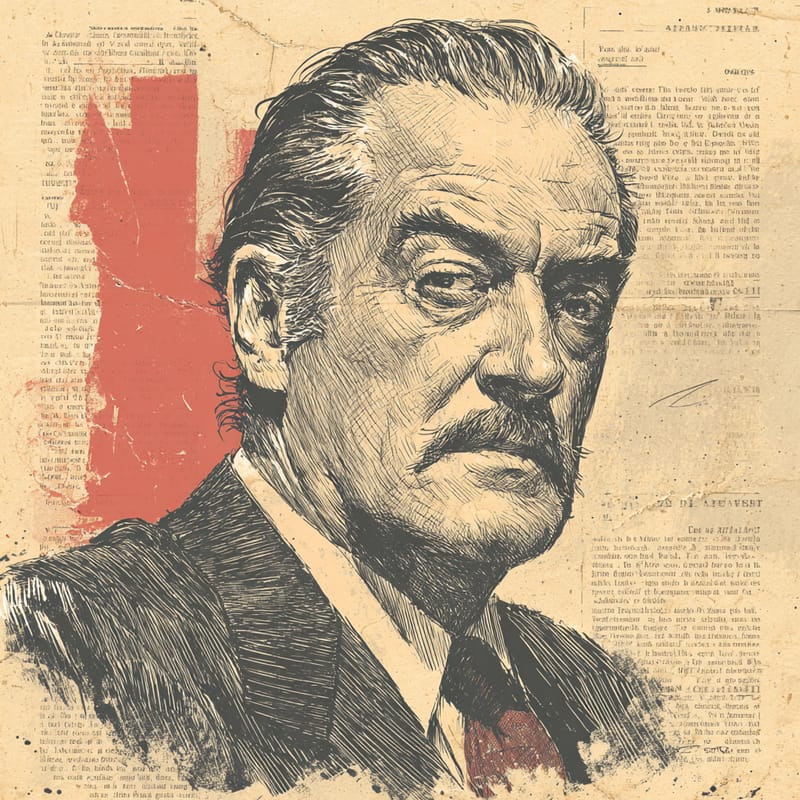
Michel Aflaq
Unity, freedom, socialism
The founding theorist of Ba'athism.
Ba'athistOne of 729 ideologies · enter the Ba'athist hall →- Role
- Founder & theorist
- Era
- 1910–1989
- Region
- Syria
- Social band
- Centre (no modifier)
- Placement
- −50 · +70 · −10
§ Where Michel Aflaq stands
3 axesAflaq's socialism was a means to national revival rather than a class programme. His writings, collected as Fi Sabil al-Ba'ath, rejected Marxist class struggle and materialism, and the 1947 party constitution combined land reform and public ownership of major utilities and industries with protection of private property and inheritance within limits, a mixed, state-led model often called Arab socialism.
Aflaq envisaged a single disciplined party leading the Arab nation's revolutionary transformation, a vision that in practice became military seizures of power in Iraq and Syria in 1963. Though himself a civilian intellectual pushed aside by soldiers, he spent his last two decades as figurehead of the Iraqi Ba'ath's National Command, lending his name to Saddam Hussein's dictatorship.
Aflaq was a secular nationalist with a romantic attachment to Arab heritage. In his 1943 lecture In Memory of the Arab Prophet he, a Christian, presented Islam and the Prophet Muhammad as the supreme expression of the Arab national genius and urged Arabs of every faith to embrace that heritage, so his secularism rested on reverence for tradition rather than rejection of it.
How close are you to Michel Aflaq?
Three statements, one per axis. Answer them and we’ll drop you on the compass next to them.
§ The story
HistoricalMichel Aflaq (1910–1989) was the principal founder and ideologue of Ba'athism. Born into a Greek Orthodox Christian family in Damascus, he studied history and philosophy at the Sorbonne, where he met Salah al-Din al-Bitar, and returned to teach history in Damascus. In the 1940s the two built the Arab Ba'ath movement, and at its 1947 founding congress Aflaq was chosen as its leader. He served briefly as Syria's minister of education in 1949 and led the party's National Command from 1954 to 1965.
Aflaq's slogan of unity, freedom and socialism, and his vision of one Arab nation with an eternal mission, inspired a movement that seized power in both Iraq and Syria in 1963. But the party's officers soon sidelined its civilian founders: the 1966 coup in Damascus drove him into exile, and he spent his later years in Baghdad as secretary-general of the Iraqi-led party, lending ideological legitimacy to Saddam Hussein's regime. He died in Paris in 1989 and was buried in Baghdad, where the government claimed he had converted to Islam, a claim that has been disputed.
Notable for
- 01Founded the Ba'ath Party
- 02'Unity, Freedom, Socialism'
- 03Pan-Arab nationalism
Key works & moments
- 1943Delivers his lecture In Memory of the Arab Prophet, casting Islam as the genius of Arab nationhood.
- 1947Co-founds the Ba'ath Party at its first congress in Damascus and is chosen as its leader.
- 1949Serves briefly as Syria's minister of education.
- 1966Ousted by the military coup in Damascus and driven into exile.
- 1970sSettles in Baghdad as secretary-general of the Iraqi-led Ba'ath National Command.
- 1989Dies in Paris in June and is buried in Baghdad.
§ Minds closest to Michel Aflaq
All minds →

§ Also in the Ba'athist hall
Enter the hall →§ Common questions
4 answersWhat was Michel Aflaq's political ideology?
Michel Aflaq founded Ba'athism, an ideology of pan-Arab nationalism, secular state-led socialism and single-party rule: on the 99ideologies three-axis compass, a Ba'athist. Economically he sat left of centre (−50), favouring Arab socialism with a large state sector but limited private property. On governance he was strongly authoritarian (+70), trusting a vanguard party to lead the nation. Socially he leaned slightly traditional (−10), grounding secular nationalism in reverence for Arab and Islamic heritage.
Was Michel Aflaq left-wing or right-wing?
Left of centre economically, nationalist above all. Aflaq's Ba'athism called itself socialist and promised land reform and nationalisation, but it rejected Marxism, class struggle and internationalism in favour of the unity of the Arab nation, and Ba'athist regimes frequently persecuted communists. It is best described as a nationalist, authoritarian form of socialism, closer in structure to other single-party nationalist movements than to Western left-wing parties.
What is Ba'athism?
Ba'athism, from the Arabic word for renaissance or resurrection, is the ideology Aflaq and Bitar developed in Damascus in the 1940s. It holds that the Arabs form one nation that should be united in a single state, summed up in the slogan unity, freedom, socialism, and it mixes secular Arab nationalism, state-led socialism and rule by a vanguard party. Rival Ba'athist regimes ruled Syria from 1963 to 2024 and Iraq from 1968 to 2003.
Which minds are closest to Michel Aflaq?
On the 99ideologies three-axis compass, the minds closest to Michel Aflaq are Ahmed Hassan al-Bakr (98% alike), Salah al-Din al-Bitar (98% alike) and Hafez al-Assad (94% alike). The furthest is Hans-Hermann Hoppe (11% alike).