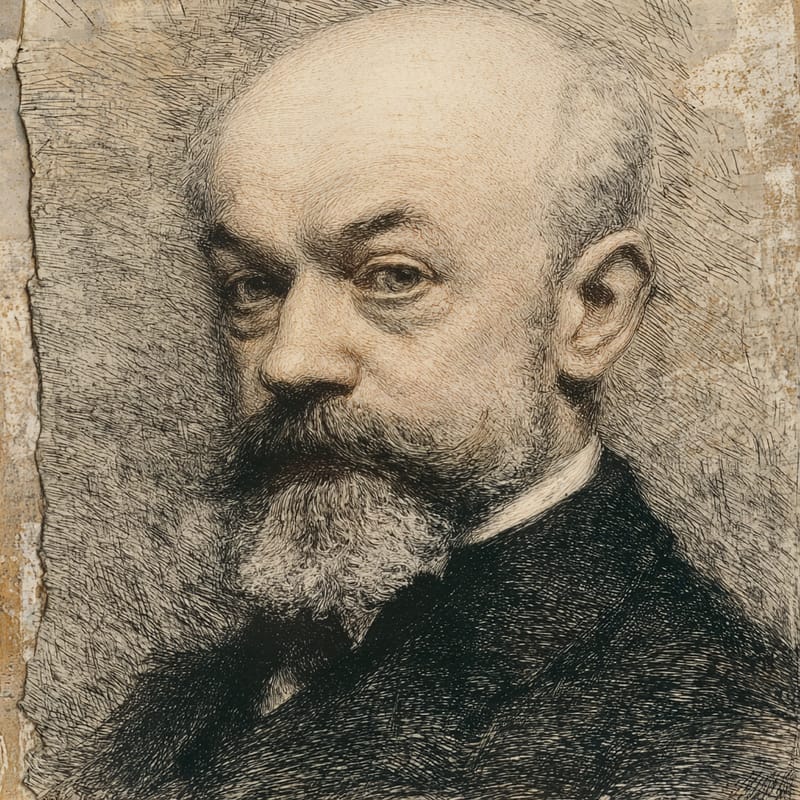
Walther Rathenau
The planned economy
Industry organised by the state.
State SocialistOne of 729 ideologies · enter the State Socialist hall →- Role
- Industrialist & minister
- Era
- 1867–1922
- Region
- Germany
- Social band
- Centre (no modifier)
- Placement
- −26 · +64 · −6
§ Where Walther Rathenau stands
3 axesRathenau argued for an organised economy between free-market capitalism and socialism. His wartime raw materials system placed key industries under state-supervised war corporations, and in Von kommenden Dingen (1917) and Die neue Wirtschaft (1918) he proposed a planned, rationalised economy run by self-governing industrial associations under state oversight, with limits on inheritance and luxury, while preserving private ownership.
Rathenau believed a strong, guiding state should rationalise and direct industry in the national interest, a vision drawn from his experience running the 1914 raw materials system and admired by later planners. In politics, however, he was a liberal republican who served the Weimar democracy, so his statism lay in economic direction rather than in dictatorship.
Rathenau was a cultured liberal-conservative moderniser, a patron of the arts and a prolific essayist on the spiritual costs of mechanised modern life. His 1897 essay Höre, Israel!, published under a pseudonym, urged German Jews to assimilate fully into German culture, and he combined patriotic nationalism with a cautious, elite-led approach to social change.
How close are you to Walther Rathenau?
Three statements, one per axis. Answer them and we’ll drop you on the compass next to them.
§ The story
HistoricalWalther Rathenau (1867–1922) was a German industrialist, writer and statesman. The son of Emil Rathenau, founder of the electrical giant AEG, he studied physics and chemistry, ran several businesses and became chairman of AEG in 1915. When war broke out in 1914 he persuaded the Prussian War Ministry to create a Raw Materials Department, which he led, organising the allocation of scarce materials for the war economy. After the 1918 revolution he helped found the liberal German Democratic Party.
Rathenau entered government as minister of reconstruction in 1921, backing a policy of fulfilment, meeting Allied reparations demands to demonstrate their impossibility, and became foreign minister in February 1922. In April he signed the Treaty of Rapallo with Soviet Russia. As a wealthy Jew and a supporter of the republic, he was the target of a vicious nationalist and antisemitic campaign, and on 24 June 1922 members of the far-right Organisation Consul shot him dead in Berlin. His murder prompted the Law for the Protection of the Republic.
Notable for
- 01Organised the WWI war economy
- 02Theorist of the planned economy
- 03Weimar foreign minister
Key works & moments
- 1897Publishes the essay Höre, Israel!, urging German Jews to assimilate fully.
- 1914Persuades the War Ministry to create a Raw Materials Department, which he heads.
- 1917Publishes Von kommenden Dingen, his vision of an organised post-war economy.
- 1918Helps found the liberal German Democratic Party after the November Revolution.
- 1922As foreign minister, signs the Treaty of Rapallo with Soviet Russia in April.
- 1922Assassinated in Berlin on 24 June by members of the far-right Organisation Consul.
§ Minds closest to Walther Rathenau
All minds →

§ Also in the State Socialist hall
Enter the hall →The closest minds above are this hall’s whole roster.
§ Common questions
4 answersWhat was Walther Rathenau's political ideology?
Walther Rathenau was a liberal industrialist who championed a state-organised, planned economy: on the 99ideologies three-axis compass, a State Socialist. Economically he sat moderately left (−26), favouring state-guided industrial associations and limits on inherited wealth while keeping private ownership. On governance he leaned authoritarian (+64), trusting a strong state to direct production. Socially he leaned slightly traditional (−6), a cultured patriot and liberal-conservative moderniser.
Was Walther Rathenau left-wing or right-wing?
He sat between the camps. Rathenau was a leading industrialist and a member of the liberal German Democratic Party, not a socialist, yet his ideas of a planned, organised economy with curbs on inherited wealth went well beyond the free-market liberalism of his class. Nationalists hated him as a Jew and as a defender of the republic and of fulfilling Versailles, while socialists distrusted him as a capitalist, so he is best described as a liberal statist of the centre.
Why was Walther Rathenau assassinated?
Because far-right nationalists saw him as the embodiment of everything they hated about the Weimar Republic. As a wealthy Jewish industrialist who served the republic, pursued the fulfilment of reparations and signed the Rapallo treaty with Soviet Russia, he was the target of an antisemitic hate campaign. On 24 June 1922 members of Organisation Consul, a secret terrorist group of former Freikorps officers, shot him in his car in Berlin. The murder provoked mass demonstrations in defence of the republic.
Which minds are closest to Walther Rathenau?
On the 99ideologies three-axis compass, the minds closest to Walther Rathenau are Stafford Cripps (97% alike), The Ministry (archetype) (96% alike) and János Kádár (96% alike). The furthest is Hans-Hermann Hoppe (18% alike).