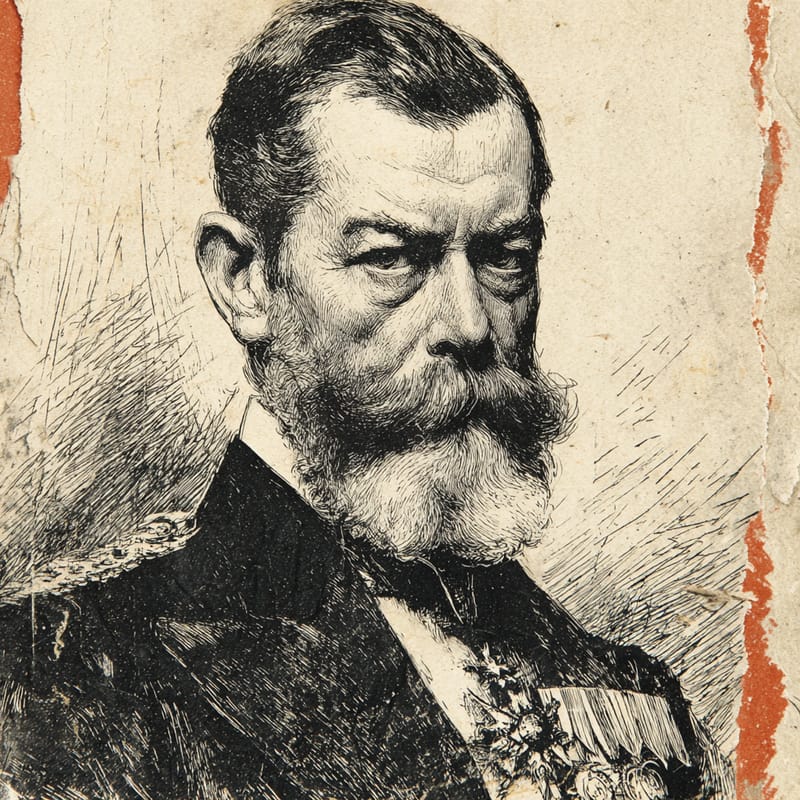
The Bonapartist moderniser (archetype)
Order, progress, and the strong man
Liberal economy under a guiding ruler.
Rooted State LiberalOne of 729 ideologies · enter the State Liberal hall →- Role
- Plebiscitary liberal autocrat
- From
- Archetype
- Region
- —
- Social band
- Rooted
- Placement
- +6 · +52 · −18
§ Where The Bonapartist moderniser (archetype) stands
3 axesThe Bonapartist moderniser champions capitalism and growth but steers them from the top. Napoleon III encouraged the Pereire brothers' Crédit Mobilier bank in 1852, backed railway concessions and Baron Haussmann's rebuilding of Paris, and signed the 1860 Cobden–Chevalier free-trade treaty with Britain over protectionist objections. The state remains planner of public works and guarantor of investment, so the archetype sits barely right of centre.
Power is concentrated in an executive that appeals over the heads of parliament to the people through plebiscites. Louis-Napoléon's 1851 coup was ratified by referendum, the empire was restored by another in 1852, and official candidates, press controls and a weak legislature kept opposition in check, even after the liberalising reforms of the 1860s and the 1870 plebiscite that endorsed them.
The archetype marries material progress to conservative order. Napoleon III leaned on the Catholic Church, kept French troops in Rome to protect the pope for most of 1849–1870 and promoted family, property and national glory, yet he also flirted with social reform, writing The Extinction of Pauperism in 1844 and legalising strikes in 1864. The balance is rooted rather than reactionary.
How close are you to The Bonapartist moderniser (archetype)?
Three statements, one per axis. Answer them and we’ll drop you on the compass next to them.
§ The story
ArchetypeThe Bonapartist moderniser is a ruler who takes or keeps power through a coup or plebiscite, claims to embody the nation directly above the quarrels of parties and parliaments, and uses that authority to drive economic modernisation. Its defining case is Louis-Napoléon Bonaparte, who seized power in the coup of 2 December 1851, became Emperor Napoleon III and presided over railway building, new credit banks, free trade and the rebuilding of Paris; his uncle Napoleon I's Consulate supplied the template.
The archetype recurs when a frightened middle class and a divided elite will trade political liberty for order and prosperity, often after revolutionary upheaval. Karl Marx's The Eighteenth Brumaire of Louis Bonaparte (1852) explained it as a state rising above deadlocked classes, and Friedrich Engels later applied the label to Bismarck's Germany. The type shows that economic and political liberalism can come apart, and that legitimacy built on success and glory is fragile: the Second Empire collapsed after defeat at Sedan in 1870.
Notable for
- 01Plebiscitary legitimacy
- 02State-led modernisation
- 03Liberal economy, illiberal politics
Key works & moments
- 1799Napoleon Bonaparte's Brumaire coup and plebiscite-backed Consulate create the template of rule above party.
- 1851Louis-Napoléon's coup of 2 December dissolves the National Assembly; a plebiscite ratifies it.
- 1852Karl Marx publishes The Eighteenth Brumaire of Louis Bonaparte, the classic analysis of Bonapartism.
- 1853–70Baron Haussmann rebuilds Paris with boulevards, sewers and parks under imperial direction.
- 1860The Cobden–Chevalier Treaty opens an era of Anglo-French free trade.
- 1870Defeat by Prussia at Sedan brings down the Second Empire.
§ Minds closest to The Bonapartist moderniser (archetype)
All minds →

§ Also in the State Liberal hall
Enter the hall →§ Common questions
4 answersWhat is the Bonapartist moderniser's political ideology?
The Bonapartist moderniser stands for Bonapartism: on the 99ideologies three-axis compass, a Rooted State Liberal. Economically it sits just right of centre (+6), promoting capitalism, free trade and railways while the state directs public works and credit. On governance it is clearly authoritarian (+52), concentrating power in a plebiscite-backed executive above parties and parliament, and socially it is moderately traditional (−18), pairing material progress with Church, family and order.
Is the Bonapartist moderniser left-wing or right-wing?
It is usually classed on the authoritarian right, but it deliberately borrows from both sides. Napoleon III restored universal male suffrage in 1851, wrote about ending poverty, legalised strikes in 1864 and won the votes of peasants and many workers, all appeals over the heads of conservative notables. Yet his regime rested on the army, the Church, property and press controls. Historians therefore describe Bonapartism as a populist, order-first politics that cuts across the left–right divide.
What is Bonapartism?
Bonapartism is rule by a strong leader who claims a direct mandate from the nation, usually through plebiscites, and governs above parties in the name of order, national glory and prosperity. It takes its name from Napoleon I and especially Napoleon III, whose Second Empire (1852–1870) combined authoritarian politics with rapid economic modernisation. In The Eighteenth Brumaire of Louis Bonaparte, Marx argued that such regimes arise when no social class can rule on its own, letting the state appear independent of all of them.
Which minds are closest to The Bonapartist moderniser (archetype)?
On the 99ideologies three-axis compass, the minds closest to The Bonapartist moderniser (archetype) are Sergei Witte (97% alike), Camillo Cavour (97% alike) and Giovanni Giolitti (94% alike). The furthest is Emma Goldman (18% alike).