
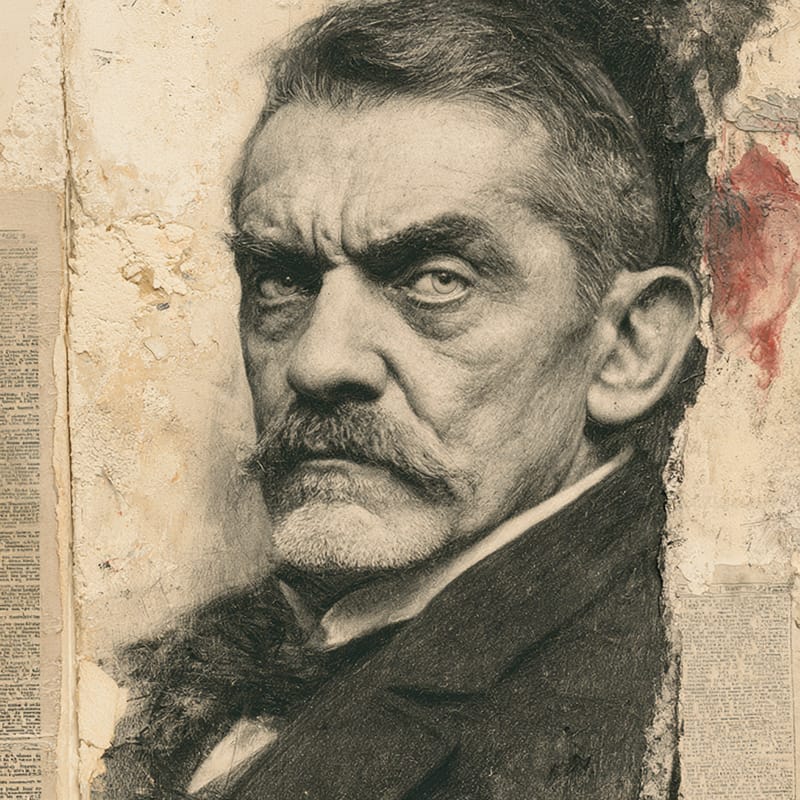
Sergei Witte
Industrialise from above
Capitalism by command of the state.
Rooted State LiberalOne of 729 ideologies · enter the State Liberal hall →- Role
- Minister & Premier
- Era
- 1849–1915
- Region
- Russia
- Social band
- Rooted
- Placement
- +10 · +48 · −15
§ Where Sergei Witte stands
3 axesWitte was a capitalist moderniser who believed only the state could jump-start Russian industry, an outlook he set out in an 1889 pamphlet on the German economist Friedrich List. As finance minister he kept high protective tariffs, built state railways, introduced a state vodka monopoly from 1894 and adopted the gold standard in 1897 to attract foreign investment: a market economy forced into being by the state.
Witte served the autocracy and believed in strong central authority, but accepted that it had to bend to survive. His October Manifesto of 1905 conceded civil liberties and a legislative Duma, yet as prime minister he presided over the crushing of the Moscow uprising of December 1905 and punitive expeditions in the provinces, and his government prepared the 1906 Fundamental Laws that preserved the tsar's sweeping powers.
Socially Witte was a pragmatic moderniser from a conservative, Orthodox imperial milieu rather than a liberal reformer. He supported religious toleration and the October Manifesto's promise of freedom of conscience, and from 1902 chaired a special conference on agriculture that criticised the peasant commune as a brake on progress. Yet he remained a monarchist loyal to the dynasty and wary of popular democracy.
How close are you to Sergei Witte?
Three statements, one per axis. Answer them and we’ll drop you on the compass next to them.
§ The story
HistoricalCount Sergei Yulyevich Witte (1849–1915) was the leading economic moderniser of late Imperial Russia. Born in Tiflis to a father of Baltic German descent, he made his name as a railway manager in Odessa and Kiev before entering the finance ministry. As minister of finance from 1892 to 1903 he drove the construction of the Trans-Siberian Railway, put the rouble on the gold standard and drew in foreign capital, and in 1905 he became chairman of the new Council of Ministers, Russia's first constitutional prime minister.
Witte's aim was to turn an agrarian empire into an industrial power from above, and the 1890s saw rapid growth in railways, coal, iron and steel. He negotiated the 1905 Treaty of Portsmouth ending the Russo-Japanese War on terms that spared Russia an indemnity, and during the 1905 revolution persuaded Nicholas II to issue the October Manifesto, promising civil liberties and an elected Duma. Distrusted by the tsar and by liberals and conservatives alike, he left office in April 1906 after securing a large French loan, and died in 1915 opposed to the war with Germany.
Notable for
- 01Trans-Siberian Railway
- 02Put Russia on the gold standard
- 03Drafted the October Manifesto
Key works & moments
- 1889Publishes a pamphlet on Friedrich List setting out the case for state-led industrialisation.
- 1892Becomes finance minister and pushes forward the Trans-Siberian Railway.
- 1897Puts the rouble on the gold standard to attract foreign investment.
- 1903Removed from the finance ministry after clashing with court favourites over Far Eastern policy.
- 1905Negotiates the Treaty of Portsmouth and drafts the October Manifesto promising civil liberties and a Duma.
- 1905–06Serves as Russia's first constitutional prime minister until April 1906.
§ Minds closest to Sergei Witte
All minds →




§ Also in the State Liberal hall
Enter the hall →§ Common questions
4 answersWhat was Sergei Witte's political ideology?
Sergei Witte was a state-capitalist moderniser loyal to the monarchy: on the 99ideologies three-axis compass, a Rooted State Liberal. Economically he sat slightly right of centre (+10), building a capitalist industrial economy through tariffs, state railways and the gold standard. On governance he leaned strongly towards authority (+48), serving the autocracy while conceding an elected Duma in 1905, and socially he was mildly traditional (−15), a pragmatic Orthodox monarchist who nonetheless backed religious toleration.
Was Sergei Witte left-wing or right-wing?
He was a conservative moderniser who fits neither camp cleanly. Witte rejected socialism and revolution and served the tsar loyally, which places him on the right of the Russian spectrum. But reactionaries hated him for the October Manifesto and for favouring industry over the landed nobility, while liberals distrusted him as an agent of the autocracy. He resembles the conservative state-builders of nineteenth-century Europe: pro-capitalist, monarchist and willing to reform chiefly to preserve the existing order.
What was the October Manifesto?
The October Manifesto was the decree Nicholas II issued on 17 October 1905 (30 October in the Western calendar), drafted under Witte's direction, to end a nationwide general strike during the 1905 revolution. It promised freedom of conscience, speech, assembly and association, a broader franchise and a State Duma whose consent would be required for new laws. It split the opposition by satisfying moderate liberals, but the Fundamental Laws of 1906 kept vast powers for the tsar, including control of ministers and the right to dissolve the Duma.
Which minds are closest to Sergei Witte?
On the 99ideologies three-axis compass, the minds closest to Sergei Witte are Camillo Cavour (99% alike), The Bonapartist moderniser (archetype) (97% alike) and Giovanni Giolitti (94% alike). The furthest is Emma Goldman (19% alike).