
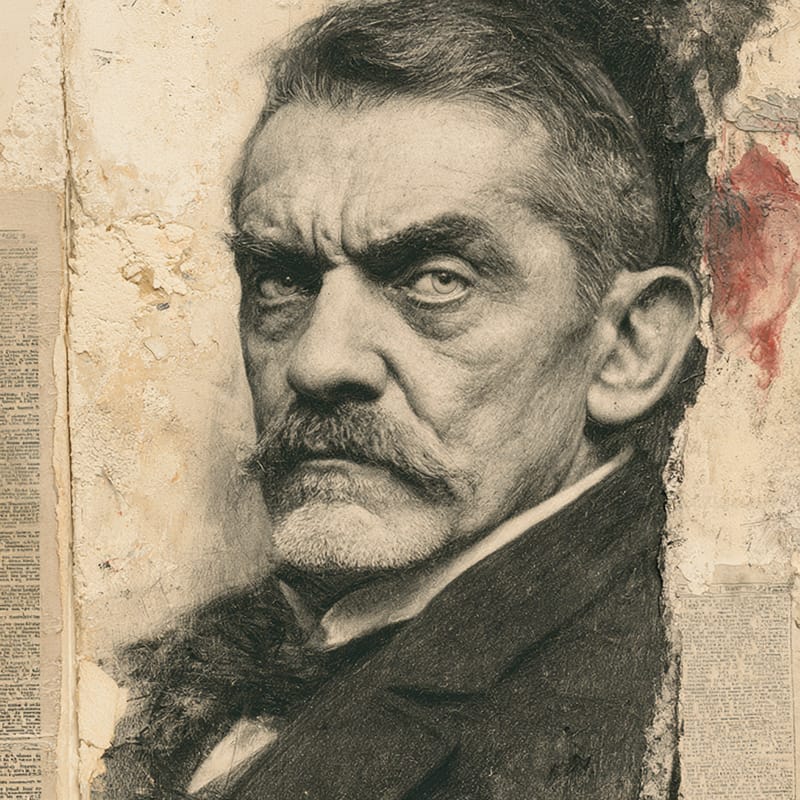
Max Weber
The national liberal mind
Power, bureaucracy, and the nation.
State LiberalOne of 729 ideologies · enter the State Liberal hall →- Role
- Sociologist & politician
- Era
- 1864–1920
- Region
- Germany
- Social band
- Centre (no modifier)
- Placement
- +2 · +44 · +5
§ Where Max Weber stands
3 axesWeber accepted capitalism as the most rational and productive economic order, and in a 1918 lecture to Austro-Hungarian officers on socialism he warned that nationalising industry would only enlarge bureaucracy. Yet as a member of the Verein für Socialpolitik he supported social insurance and workers' right to organise, and he feared the 'iron cage' of rationalised capitalism, keeping him near the centre.
Weber prized a strong nation-state led by responsible elites. He defined the state by its monopoly of legitimate force in Politics as a Vocation (1919), argued in Parliament and Government in a Reconstructed Germany (1918) for a parliament that would train real leaders, and championed a directly elected Reich president as a counterweight to party machines.
Weber was a secular modernist rather than a traditionalist, analysing religion's retreat in a 'disenchanted' world without wishing to reverse it, and he moved in feminist circles through his wife, Marianne Weber. But he was also a nationalist who in the 1890s warned against Polish migrant labour in eastern Germany, leaving him only fractionally on the progressive side.
How close are you to Max Weber?
Three statements, one per axis. Answer them and we’ll drop you on the compass next to them.
§ The story
HistoricalMaximilian Karl Emil Weber (1864–1920) was a German sociologist, economist and political commentator, widely counted among the founders of modern sociology. Born in Erfurt and raised in Berlin in the household of a National Liberal politician, he trained in law and became professor of economics at Freiburg in 1894 and at Heidelberg in 1896. A breakdown in 1897–98 pushed him out of regular teaching, but he went on to write The Protestant Ethic and the Spirit of Capitalism (1904–05) and the studies later published as Economy and Society.
Weber's politics were those of a liberal nationalist. His 1895 Freiburg inaugural lecture placed the power interests of the German nation above all else, and in the First World War he opposed unrestricted submarine warfare and sweeping annexations while demanding parliamentary government. In 1918 he co-founded the German Democratic Party, and in 1919 he advised the German delegation at Versailles and pressed for a strong, popularly elected president in the new constitution. His theory of charismatic and plebiscitary leadership remains contested, with some historians arguing that it helped legitimise the later cult of the Führer.
Notable for
- 01'The Protestant Ethic'
- 02Theory of the modern state
- 03Drafted Weimar constitutional ideas
Key works & moments
- 1895His Freiburg inaugural lecture puts the power interests of the German nation first.
- 1904–05Publishes The Protestant Ethic and the Spirit of Capitalism.
- 1917Delivers 'Science as a Vocation' and campaigns in the press for parliamentary government.
- 1918Co-founds the German Democratic Party and joins expert talks on drafting a new constitution.
- 1919Delivers 'Politics as a Vocation' and advises the German peace delegation at Versailles.
- 1921–22Economy and Society, his unfinished masterwork, is published posthumously.
In their own words
“Politics is a strong and slow boring of hard boards. It takes both passion and perspective.”
“A state is a human community that (successfully) claims the monopoly of the legitimate use of physical force within a given territory.”
§ Minds closest to Max Weber
All minds →


§ Also in the State Liberal hall
Enter the hall →§ Common questions
4 answersWhat was Max Weber's political ideology?
Max Weber was a liberal nationalist: on the 99ideologies three-axis compass, a State Liberal. Economically he sat just right of centre (+2), defending capitalism against socialism while backing social insurance and workers' right to organise. On governance he favoured a strong, elite-led nation-state (+44), with a powerful elected president and a parliament that would train leaders, and socially he was close to the centre (+5), a secular modernist whose nationalism tempered his liberalism.
Was Max Weber left-wing or right-wing?
He belonged to the liberal centre, leaning right on national questions. Weber attacked Germany's conservative Junker elite, called for parliamentary government and co-founded the left-liberal German Democratic Party in 1918. But he rejected socialism, criticised the revolutionary left of 1918–19 and put national power at the heart of politics, so he fits neither the socialist left nor the monarchist right. National liberal is the label most historians use for him.
Did Max Weber help write the Weimar Constitution?
Yes, in part. In December 1918 Weber took part in the expert consultations convened by Hugo Preuss, the constitution's chief drafter, and he argued in print for a strong Reich president elected directly by the people as a counterweight to parliament and party machines. That idea entered the constitution adopted in August 1919. Because the president's emergency powers were abused in the Weimar Republic's final years, historians such as Wolfgang Mommsen have debated whether Weber's ideal of plebiscitary leadership weakened German democracy.
Which minds are closest to Max Weber?
On the 99ideologies three-axis compass, the minds closest to Max Weber are Eleftherios Venizelos (98% alike), Plutarco Elías Calles (97% alike) and Friedrich Naumann (96% alike). The furthest is Emma Goldman (26% alike).