
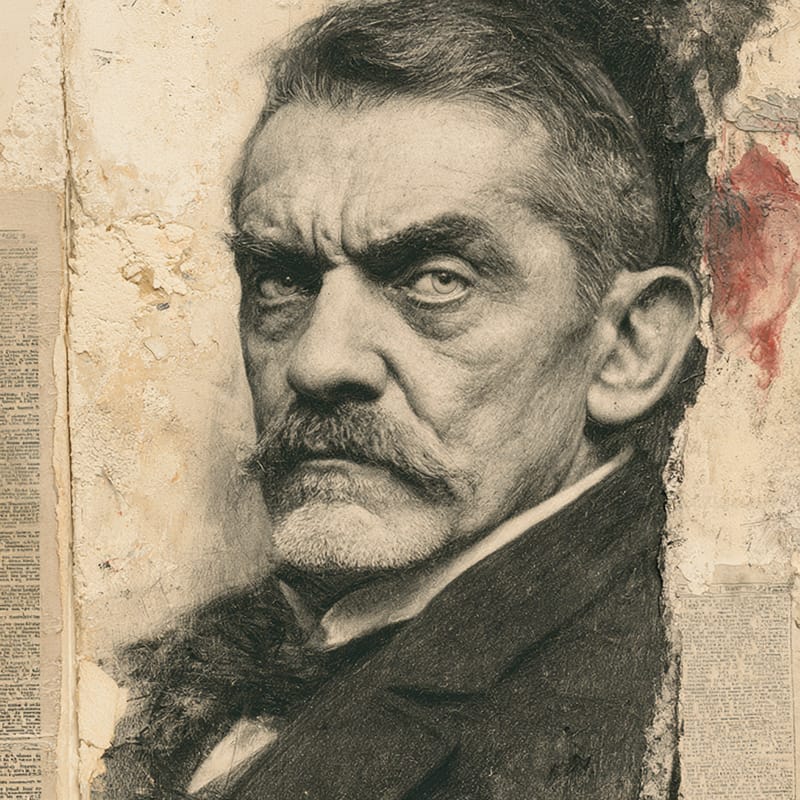
Camillo Cavour
Architect of Italy
Liberal ends, statecraft's means.
Rooted State LiberalOne of 729 ideologies · enter the State Liberal hall →- Role
- Prime Minister
- Era
- 1810–1861
- Region
- Italy
- Social band
- Rooted
- Placement
- +8 · +45 · −15
§ Where Camillo Cavour stands
3 axesCavour was a convinced free-trader in the mould of the British liberals he admired. As minister in 1850–51 he negotiated commercial treaties lowering tariffs with France, Britain and Belgium, and he championed railways, banks and modern agriculture. He nonetheless used state guarantees and public money to build Piedmont's railways and strengthen its finances, keeping him only moderately on the market side.
Cavour believed in parliamentary government, but under a monarchy and a narrow property-based franchise, and he built the Italian state through realpolitik and central control. His 1852 'connubio' with Urbano Rattazzi's centre-left gave him a dominant majority, and he extended Piedmont's laws and institutions to the newly annexed regions rather than building a federation.
Cavour was a moderate rather than a democrat: he distrusted Giuseppe Mazzini's revolutionary republicanism and the politics of the street, and defended monarchy, property and order. Yet he backed laws curbing clerical privilege, including the 1855 suppression of contemplative religious orders, and summed up his aim as a free Church in a free State, a liberal rather than reactionary conservatism.
How close are you to Camillo Cavour?
Three statements, one per axis. Answer them and we’ll drop you on the compass next to them.
§ The story
HistoricalCamillo Benso, Count of Cavour (1810–1861), was the Piedmontese statesman who engineered the unification of Italy. Born into an aristocratic Turin family, he left the army young, studied economics and politics in France and Britain, and modernised agriculture on the family estates. In 1847 he co-founded the newspaper Il Risorgimento; after entering parliament in 1848 he served as minister of agriculture and commerce and of finance, and in 1852 became prime minister of the Kingdom of Sardinia, a post he held, with one short break, until his death.
Cavour combined liberal economics and constitutional monarchy with ruthless diplomacy. He sent troops to the Crimean War to win a hearing for Piedmont, secretly agreed with Napoleon III at Plombières in 1858 to provoke war with Austria, and paid for French help by ceding Savoy and Nice in 1860. He then annexed central Italy by plebiscite and, alarmed by Garibaldi's conquest of the South, sent Piedmontese troops through the Papal States to take control of unification. He died less than three months after the Kingdom of Italy was proclaimed in 1861, with Rome and Venice still outside it.
Notable for
- 01Engineered Italian unification
- 02Liberal economic reform
- 03Founded 'Il Risorgimento'
Key works & moments
- 1847Co-founds the Turin newspaper Il Risorgimento to campaign for constitutional reform.
- 1850–51As minister, negotiates free-trade treaties with France, Britain and Belgium.
- 1852Becomes prime minister of Piedmont-Sardinia through the 'connubio' with Rattazzi's centre-left.
- 1855Sends Piedmontese troops to the Crimean War, earning a seat at the 1856 Paris peace congress.
- 1858Secretly agrees with Napoleon III at Plombières on a joint war against Austria.
- 1861Becomes the first prime minister of the Kingdom of Italy and dies in June.
In their own words
“A free Church in a free State.”
§ Minds closest to Camillo Cavour
All minds →




§ Also in the State Liberal hall
Enter the hall →§ Common questions
4 answersWhat was Camillo Cavour's political ideology?
Camillo Cavour was a moderate constitutional liberal: on the 99ideologies three-axis compass, a Rooted State Liberal. Economically he sat slightly right of centre (+8), a free-trader who still used the state to build railways and banks. On governance he leaned towards a strong state (+45), unifying Italy through diplomacy, war and centralised institutions under a monarchy, and socially he was mildly traditional (−15), defending order and a narrow franchise while curbing clerical privilege.
Was Camillo Cavour left-wing or right-wing?
He belonged to the liberal centre-right of his era. Cavour was a progressive in Piedmontese terms, backing free trade, constitutional government and limits on Church power against Catholic conservatives and absolutists. But he feared the democratic and republican left of Mazzini and Garibaldi, defended monarchy and a franchise limited to property-owners, and preferred diplomacy and elite politics to popular revolution. Moderate liberal is the most accurate description.
Did Cavour want a united Italy?
Not at first, and historians still debate how far his aims extended. For most of his career Cavour sought a strong, enlarged kingdom of northern Italy under the House of Savoy, freed from Austrian control, rather than a unitary state including the South and Rome. Garibaldi's conquest of Sicily and Naples in 1860 forced his hand: to keep unification under monarchical and moderate control, he annexed the South and in 1861 had parliament declare Rome the future capital.
Which minds are closest to Camillo Cavour?
On the 99ideologies three-axis compass, the minds closest to Camillo Cavour are Sergei Witte (99% alike), The Bonapartist moderniser (archetype) (97% alike) and Giovanni Giolitti (95% alike). The furthest is Emma Goldman (21% alike).