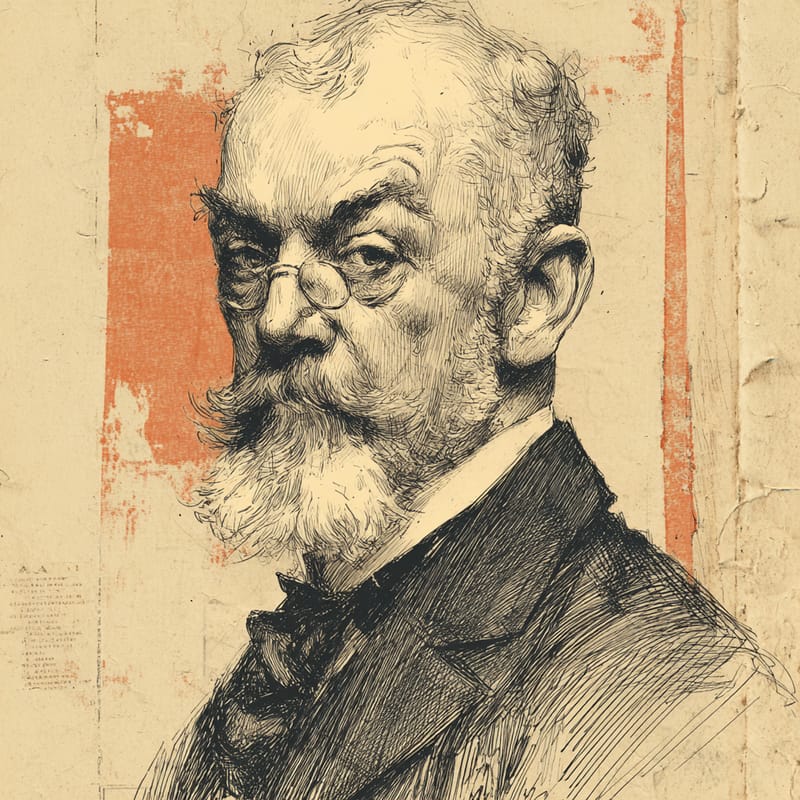
Sidney Webb
Fabian gradualism
The inevitability of gradualness.
Heterodox SocialistOne of 729 ideologies · enter the Socialist hall →- Role
- Reformer
- Era
- 1859–1947
- Region
- United Kingdom
- Social band
- Heterodox
- Placement
- −72 · +30 · +35
§ Where Sidney Webb stands
3 axesWebb wanted public ownership extended step by step through expert administration. He wrote the 1918 Clause IV commitment to common ownership of the means of production, built municipal services on the London County Council, and co-wrote the 1909 Minority Report of the Royal Commission on the Poor Laws, which proposed replacing the workhouse with public services to prevent destitution.
Webb's socialism was administrative and elitist. Fabians, he believed, should permeate existing institutions and guide policy through expertise, and he told Labour's 1923 conference that change would come through the inevitability of gradualness. His faith in planning by experts later led him to admire the Soviet state in Soviet Communism: A New Civilisation? (1935).
Webb was a reform-minded but austere progressive. The 1909 Minority Report sketched a national minimum of health, education and income for all, yet like many Fabians of his era he took a paternalist, at times eugenic, view of the poor, and as colonial secretary he issued the 1930 Passfield White Paper restricting Jewish immigration to Palestine.
How close are you to Sidney Webb?
Three statements, one per axis. Answer them and we’ll drop you on the compass next to them.
§ The story
HistoricalSidney James Webb (1859–1947), later Lord Passfield, was a British socialist, social investigator and administrator. A London-born clerk who rose through the civil service by examination, he joined the Fabian Society in 1885 and contributed to Fabian Essays in Socialism (1889). In 1892 he married Beatrice Potter, and as Sidney and Beatrice Webb they became the most influential partnership in British social reform, producing landmark histories of trade unionism and local government.
Webb sat on the London County Council from 1892 to 1910, co-founded the London School of Economics in 1895 and the New Statesman in 1913, and in 1918 drafted Labour's constitution, including Clause IV. He served as President of the Board of Trade in the first Labour government in 1924 and as colonial secretary from 1929 to 1931. In 1935 the Webbs published Soviet Communism: A New Civilisation?, a largely admiring study of Stalin's USSR that has been widely criticised for whitewashing famine and repression.
Notable for
- 01Drafted Labour's Clause IV
- 02Co-founded the LSE
- 03Fabian gradualism
Key works & moments
- 1889Contributes to Fabian Essays in Socialism, the society's founding manifesto of gradualism.
- 1895Co-founds the London School of Economics with Beatrice Webb and fellow Fabians.
- 1909Co-writes the Poor Law Minority Report, a blueprint for the welfare state.
- 1918Drafts Labour's constitution, including Clause IV's commitment to common ownership.
- 1923Proclaims 'the inevitability of gradualness' as chairman of the Labour Party conference.
- 1935With Beatrice, publishes Soviet Communism: A New Civilisation?
In their own words
“the inevitability of gradualness”
§ Minds closest to Sidney Webb
All minds →


§ Also in the Socialist hall
Enter the hall →§ Common questions
4 answersWhat was Sidney Webb's political ideology?
Sidney Webb was a Fabian socialist who believed in gradual, expert-led reform: on the 99ideologies three-axis compass, a Heterodox Socialist. Economically he sat well to the left (−72), committing Labour to common ownership through Clause IV. On governance he leaned toward the state (+30), trusting administrators and planners and later admiring Soviet planning. Socially he was moderately progressive (+35), designing a national minimum of welfare while sharing the paternalist, sometimes eugenic, assumptions of Edwardian reformers.
Was Sidney Webb left-wing or right-wing?
Left-wing. Webb was a socialist who wrote Labour's commitment to common ownership, served in two Labour governments and spent his life building the institutions of British social democracy. His method was gradual and bureaucratic rather than revolutionary, and in his last years he praised Stalin's Soviet Union, a judgement that critics on both left and right have condemned. He belongs to socialism's administrative, Fabian wing.
What did Sidney Webb mean by 'the inevitability of gradualness'?
He meant that socialism would come step by step through democratic reform, not by sudden revolution. In his 1923 address as Labour Party chairman, Webb argued that lasting change had to be democratic and acceptable to a majority, gradual, and constitutional and peaceful, with each reform building on the last until public ownership and social provision transformed Britain. The phrase summed up the Fabian strategy of permeating institutions, and critics on the left later quoted it as a byword for timidity.
Which minds are closest to Sidney Webb?
On the 99ideologies three-axis compass, the minds closest to Sidney Webb are Léon Jouhaux (96% alike), Aneurin Bevan (95% alike) and Pietro Nenni (95% alike). The furthest is Hans-Hermann Hoppe (9% alike).