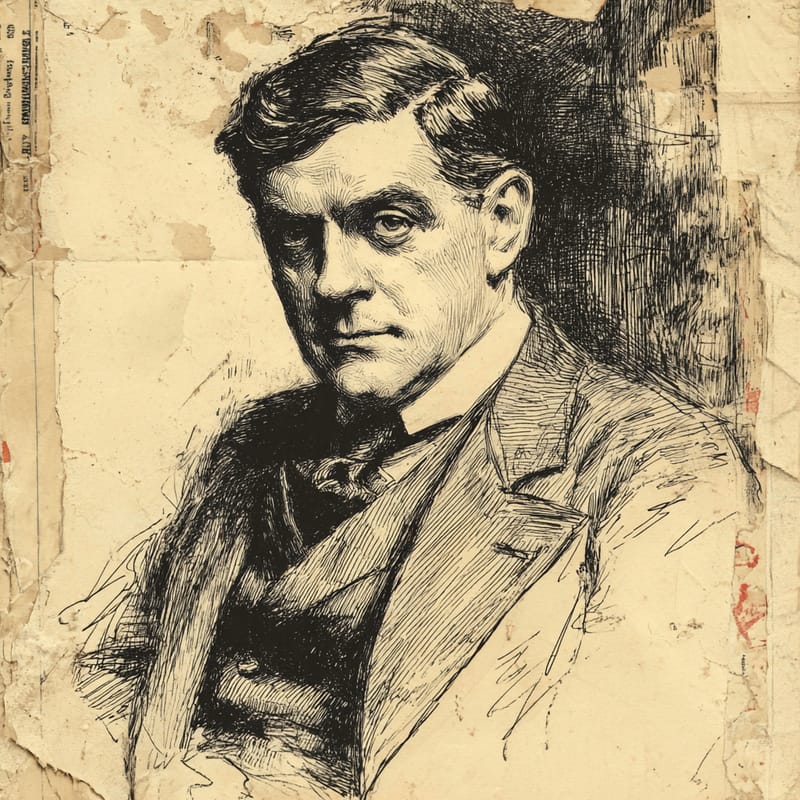
Aneurin Bevan
Founded the NHS
Socialism made flesh in a hospital.
Reformist SocialistOne of 729 ideologies · enter the Socialist hall →- Role
- Minister
- Era
- 1897–1960
- Region
- United Kingdom
- Social band
- Reformist
- Placement
- −74 · +24 · +45
§ Where Aneurin Bevan stands
3 axesBevan believed public ownership should replace private profit in essential services and industries. His National Health Service Act of 1946 nationalised Britain's hospitals and made medical care free at the point of use, and In Place of Fear (1952) argued that parliamentary democracy must be used to shift economic power from private property to the community.
Bevan was a democratic socialist who saw Parliament as the instrument for winning power from wealth. He built the NHS as a centrally funded, nationally run service, rejecting local-authority control of hospitals, but he fought for socialism through elections, the Commons and Labour conferences, and was briefly expelled from the party in 1939 for backing a Popular Front against fascism.
Bevan was a fiery progressive of the Welsh mining left, shaped by the Tredegar Workmen's Medical Aid Society whose model he later took national. He opposed fascism in the 1930s, denounced the Suez invasion at a Trafalgar Square rally in 1956 and saw universal health care as a matter of social dignity rather than charity.
How close are you to Aneurin Bevan?
Three statements, one per axis. Answer them and we’ll drop you on the compass next to them.
§ The story
HistoricalAneurin 'Nye' Bevan (1897–1960) was a Welsh Labour politician and the founder of Britain's National Health Service. The son of a miner from Tredegar in Monmouthshire, he went down the pit at thirteen, became a union activist, studied at the Central Labour College in London and led local miners during the 1926 General Strike. Elected MP for Ebbw Vale in 1929, he held the seat until his death, and in 1934 he married the Labour politician Jennie Lee.
As Minister of Health from 1945 to 1951 in Clement Attlee's government, Bevan created the NHS, launched on 5 July 1948 as a comprehensive service free at the point of use, and drove a large council-housing programme. He resigned in 1951 over charges for NHS dentures and spectacles and led the Bevanite left against Hugh Gaitskell, while his combative style, including calling the Tories lower than vermin, made him a hate figure on the right. He was deputy leader of the Labour Party when he died in 1960.
Notable for
- 01Created the National Health Service
- 02'In Place of Fear'
- 03Voice of the Labour left
Key works & moments
- 1929Elected MP for Ebbw Vale, a seat he holds until his death.
- 1939Expelled from Labour for backing a Popular Front against fascism; readmitted later that year.
- 1946Steers the National Health Service Act through Parliament as Minister of Health.
- 1948The NHS opens on 5 July, free at the point of use.
- 1951Resigns from the cabinet over charges for NHS dentures and spectacles.
- 1957Tells Labour's conference that unilateral disarmament would send a Foreign Secretary 'naked into the conference chamber'.
In their own words
“No society can legitimately call itself civilised if a sick person is denied medical aid because of lack of means.”
“So far as I am concerned they are lower than vermin.”
§ Minds closest to Aneurin Bevan
All minds →

§ Also in the Socialist hall
Enter the hall →§ Common questions
4 answersWhat was Aneurin Bevan's political ideology?
Aneurin Bevan was a democratic socialist of the Labour left: on the 99ideologies three-axis compass, a Reformist Socialist. Economically he sat well to the left (−74), favouring public ownership and building a nationalised health service free at the point of use. On governance he leaned mildly toward the state (+24), trusting a centrally run public sector but pursuing it through Parliament and elections. Socially he was progressive (+45), an anti-fascist and anti-imperialist voice of the Welsh mining communities.
Was Aneurin Bevan left-wing or right-wing?
Left-wing, and the leader of Labour's left for a decade. Bevan was a socialist who wanted public ownership to displace private profit, created the NHS and resigned in 1951 rather than accept health charges. He fought the party's right under Hugh Gaitskell through the 1950s, yet he was a parliamentary democrat, not a revolutionary, and in 1957 he broke with many of his own followers by rejecting unilateral nuclear disarmament.
Did Aneurin Bevan found the NHS?
Yes. As Minister of Health from 1945, Bevan designed the National Health Service, steered the National Health Service Act of 1946 through Parliament and launched the service on 5 July 1948. He built on earlier work, including the 1942 Beveridge Report and wartime plans for a national health service, and on mutual-aid schemes like Tredegar's. His decisive choices were to nationalise the hospitals and make all care free at the point of use, and he brought the doctors in after a bitter fight with the British Medical Association.
Which minds are closest to Aneurin Bevan?
On the 99ideologies three-axis compass, the minds closest to Aneurin Bevan are Pietro Nenni (98% alike), Léon Jouhaux (98% alike) and August Bebel (97% alike). The furthest is Hans-Hermann Hoppe (8% alike).