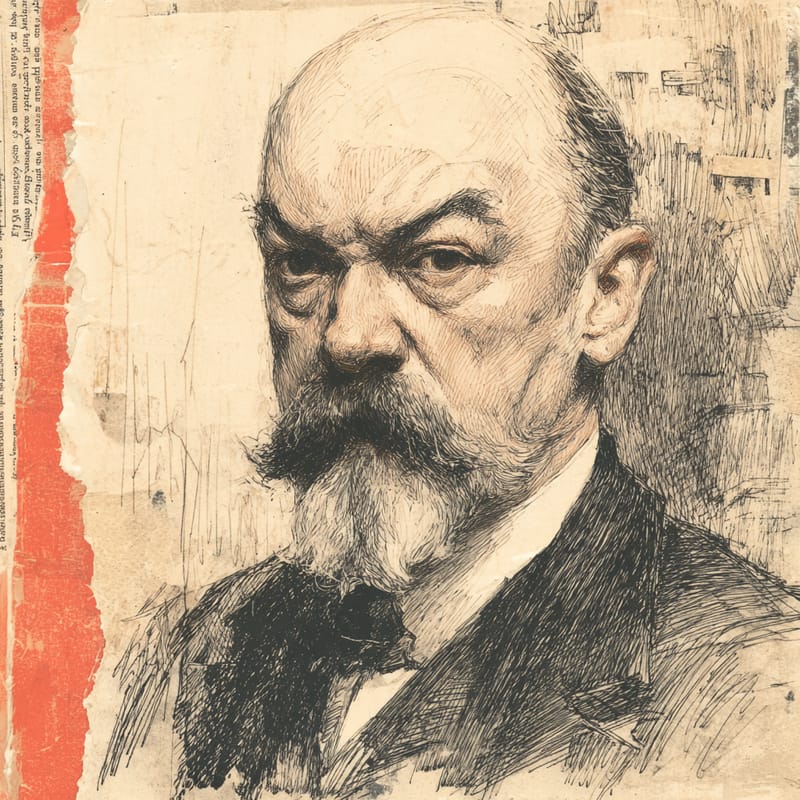
Léon Jouhaux
Labour and the social state
Unions inside the democratic order.
Reformist SocialistOne of 729 ideologies · enter the Socialist hall →- Role
- Union & socialist leader
- Era
- 1879–1954
- Region
- France
- Social band
- Reformist
- Placement
- −74 · +22 · +40
§ Where Léon Jouhaux stands
3 axesJouhaux pursued socialism through collective bargaining and public ownership rather than insurrection. After 1918 the CGT under his leadership called for industrialised nationalisations of key sectors, run jointly by workers, consumers and the state, and in 1936 he signed the Matignon Agreements, which brought wage rises and collective agreements, followed by laws on paid holidays and the forty-hour week.
Jouhaux turned the unions into a pillar of the democratic republic. He joined the Union sacrée in 1914, sat in national and international labour bodies, and from 1947 presided over France's Economic Council, an advisory assembly of organised interests. His model was socialism delivered through unions and a negotiating state, not party dictatorship, which is why he broke with the communists in 1947.
Jouhaux was a progressive internationalist whose cause was peace through organised labour. He helped found the International Labour Organization in 1919, supported the League of Nations and disarmament between the wars, and after 1945 promoted international trade-union cooperation, work recognised by the Nobel Peace Prize in 1951.
How close are you to Léon Jouhaux?
Three statements, one per axis. Answer them and we’ll drop you on the compass next to them.
§ The story
HistoricalLéon Jouhaux (1879–1954) was the leading French trade unionist of the first half of the twentieth century. Born in Paris, he went to work young at the state match factory in Aubervilliers, became active in its union and rose through the revolutionary syndicalist Confédération générale du travail, whose general secretary he became in 1909. He held the post until 1947, steering the CGT through two world wars, the 1921 split with the communists and their reunification in 1936.
Jouhaux moved the CGT from revolutionary syndicalism toward bargaining with employers and the state. He rallied it to the Union sacrée in 1914, helped create the International Labour Organization in 1919, signed the Matignon Agreements of 1936 and was deported by the Nazis in 1943. In 1947–48 he left the communist-dominated CGT to found CGT–Force Ouvrière, and he won the Nobel Peace Prize in 1951. Critics on the revolutionary left saw his 1914 turn as a betrayal of internationalism.
Notable for
- 01Led the CGT
- 02Nobel Peace Prize, 1951
- 03Built the social state
Key works & moments
- 1909Becomes general secretary of the CGT, a post he holds until 1947.
- 1914Rallies the CGT behind the Union sacrée as France goes to war.
- 1919Helps found the International Labour Organization at the Paris Peace Conference.
- 1936Signs the Matignon Agreements during the Popular Front's wave of strikes.
- 1948Founds CGT–Force Ouvrière after breaking with the communist-led CGT.
- 1951Awarded the Nobel Peace Prize.
§ Minds closest to Léon Jouhaux
All minds →

§ Also in the Socialist hall
Enter the hall →§ Common questions
4 answersWhat was Léon Jouhaux's political ideology?
Léon Jouhaux was a reformist trade-union socialist: on the 99ideologies three-axis compass, a Reformist Socialist. Economically he sat well to the left (−74), favouring nationalisation of key industries, collective bargaining and public provision. On governance he leaned mildly toward the state (+22), building unions into the institutions of the democratic republic and rejecting communist control. Socially he was progressive (+40), an internationalist who sought peace through organised labour and won the Nobel Peace Prize in 1951.
Was Léon Jouhaux left-wing or right-wing?
Left-wing, on the reformist side. Jouhaux led the CGT, France's largest union federation, for nearly four decades and wanted key industries nationalised and run with workers' participation. But he chose negotiation and parliamentary politics over revolution, backed the war effort in 1914 and broke with the communists in 1947, which made him a target of the revolutionary left. His Force Ouvrière became the main non-communist pole of French trade unionism.
Why did Léon Jouhaux win the Nobel Peace Prize?
He was honoured in 1951 for a lifetime of work for peace through the international labour movement. Jouhaux had helped create the International Labour Organization in 1919, believing that social justice between and within nations was a condition of lasting peace. Between the wars he supported the League of Nations and disarmament, and after 1945 he promoted international trade-union cooperation, making him one of the best-known labour internationalists of his generation.
Which minds are closest to Léon Jouhaux?
On the 99ideologies three-axis compass, the minds closest to Léon Jouhaux are Aneurin Bevan (98% alike), Pietro Nenni (97% alike) and Sidney Webb (96% alike). The furthest is Hans-Hermann Hoppe (10% alike).