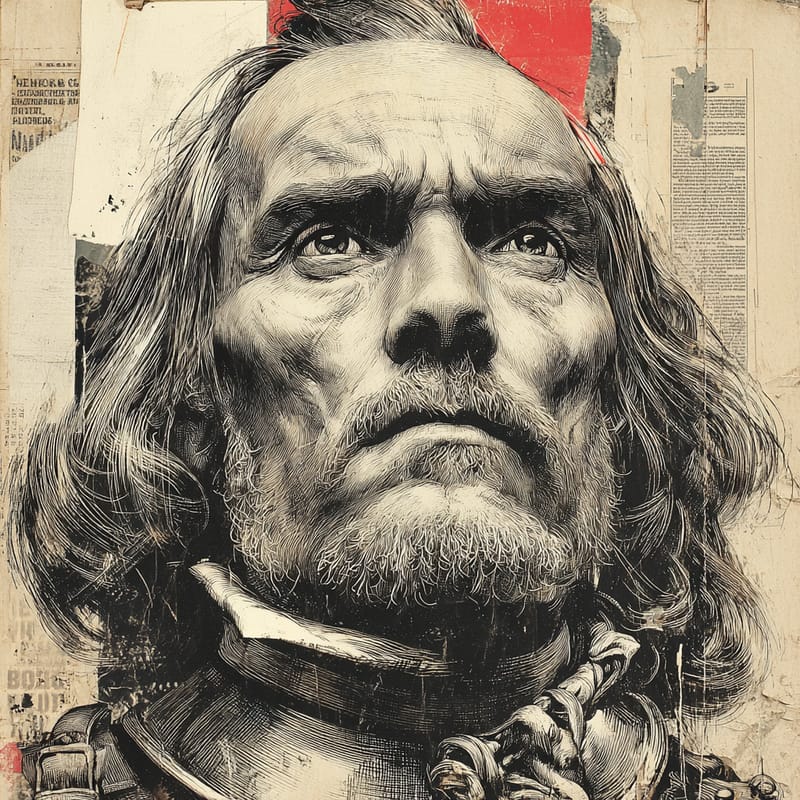
Oliver Cromwell
The godly commonwealth
Puritan rule by the sword and scripture.
Reactionary Autocratic TheocratOne of 729 ideologies · enter the Autocratic Theocrat hall →- Role
- Lord Protector
- Era
- 1599–1658
- Region
- England
- Social band
- Reactionary
- Placement
- +8 · +90 · −70
§ Where Oliver Cromwell stands
3 axesCromwell defended property and commerce rather than levelling them. At the Putney Debates of 1647 he and Henry Ireton resisted the Levellers' demand for manhood suffrage as a threat to property, he crushed the Leveller mutiny at Burford in 1649, and the Commonwealth and Protectorate pursued mercantilist expansion through the 1651 Navigation Act, war with the Dutch and the seizure of Jamaica in 1655.
Cromwell ruled as a military strongman. In April 1653 he used troops to expel the Rump Parliament, the Instrument of Government of December 1653 made him Lord Protector for life, and in 1655 he divided England into districts under major-generals who policed security and morals, though he repeatedly summoned parliaments and declined the title of king.
Cromwell's regime pursued a godly reformation of manners. Theatres stayed closed, Christmas festivities were suppressed and the Rump's 1650 Adultery Act made adultery a capital crime, while the major-generals shut alehouses and banned cockfighting and horse racing. He allowed freedom of worship to most Protestant sects and readmitted Jews to England from 1656, but Catholic and Anglican worship were repressed.
How close are you to Oliver Cromwell?
Three statements, one per axis. Answer them and we’ll drop you on the compass next to them.
§ The story
HistoricalOliver Cromwell (1599–1658) was an English soldier and statesman who led Parliament's armies to victory in the civil wars and ruled as Lord Protector of England, Scotland and Ireland from 1653 until his death. Born into a minor gentry family in Huntingdon and educated at Sidney Sussex College, Cambridge, he underwent an intense Puritan conversion and sat in the parliaments of 1628 and 1640. In the First Civil War he rose from cavalry captain to lieutenant-general of the New Model Army, winning decisive victories at Marston Moor and Naseby.
Cromwell signed the death warrant of Charles I, executed in January 1649, then crushed resistance in Scotland and in Ireland, where his troops massacred the garrisons and many civilians of Drogheda and Wexford. In 1653 he expelled the Rump Parliament and became Lord Protector under the Instrument of Government, England's first written constitution, ruling with army support and for a time through regional major-generals. He refused the crown in 1657. Admired by some as a champion of parliament and religious liberty and reviled in Ireland, he was exhumed after the Restoration and his corpse hanged in 1661.
Notable for
- 01Led the New Model Army
- 02Lord Protector of the Commonwealth
- 03Puritan moral governance
Key works & moments
- 1645Commands the New Model Army's cavalry in its decisive victory over the king at Naseby.
- 1649Signs the death warrant of Charles I, who is executed on 30 January.
- 1649Storms Drogheda and Wexford in Ireland; garrisons and many civilians are massacred.
- 1653Expels the Rump Parliament and becomes Lord Protector under the Instrument of Government.
- 1655Places England under the rule of the major-generals.
- 1657Refuses the crown offered by Parliament in the Humble Petition and Advice.
In their own words
“I beseech you, in the bowels of Christ, think it possible you may be mistaken.”
§ Minds closest to Oliver Cromwell
All minds →

§ Also in the Autocratic Theocrat hall
Enter the hall →§ Common questions
4 answersWhat was Oliver Cromwell's political ideology?
Cromwell was a Puritan Independent who believed in a godly commonwealth backed by the sword: on the 99ideologies three-axis compass, a Reactionary Autocratic Theocrat. Economically he sat just right of centre (+8), defending property and mercantile expansion against the Levellers. On governance he was strongly authoritarian (+90), ruling through the army after expelling Parliament, and socially he was firmly traditional (−70), enforcing Puritan morals while tolerating most Protestant sects.
Was Oliver Cromwell left-wing or right-wing?
Neither term existed in his time, but by the compass's measures he leans right. Cromwell fought and executed a king and helped abolish the monarchy and House of Lords, which later radicals admired, yet he defended property, crushed the egalitarian Levellers, ruled through the army and enforced Puritan moral discipline. His legacy has been claimed by parliamentarians and republicans on the left and by champions of national strength on the right, and in Ireland he is remembered above all for conquest.
Was Oliver Cromwell a dictator?
In practice, largely yes, though not in name. After 1653 Cromwell's power rested on the army: he expelled the Rump Parliament by force, governed as Lord Protector for life under a constitution drafted by army officers, dissolved parliaments that defied him and in 1655 imposed rule by major-generals. Yet he refused the crown in 1657, kept summoning parliaments and compared himself to a constable keeping the peace, so historians still debate whether he was a military dictator or a reluctant ruler seeking a settlement.
Which minds are closest to Oliver Cromwell?
On the 99ideologies three-axis compass, the minds closest to Oliver Cromwell are Pope Innocent III (96% alike), John Calvin (96% alike) and Miguel Primo de Rivera (96% alike). The furthest is Emma Goldman (0% alike).