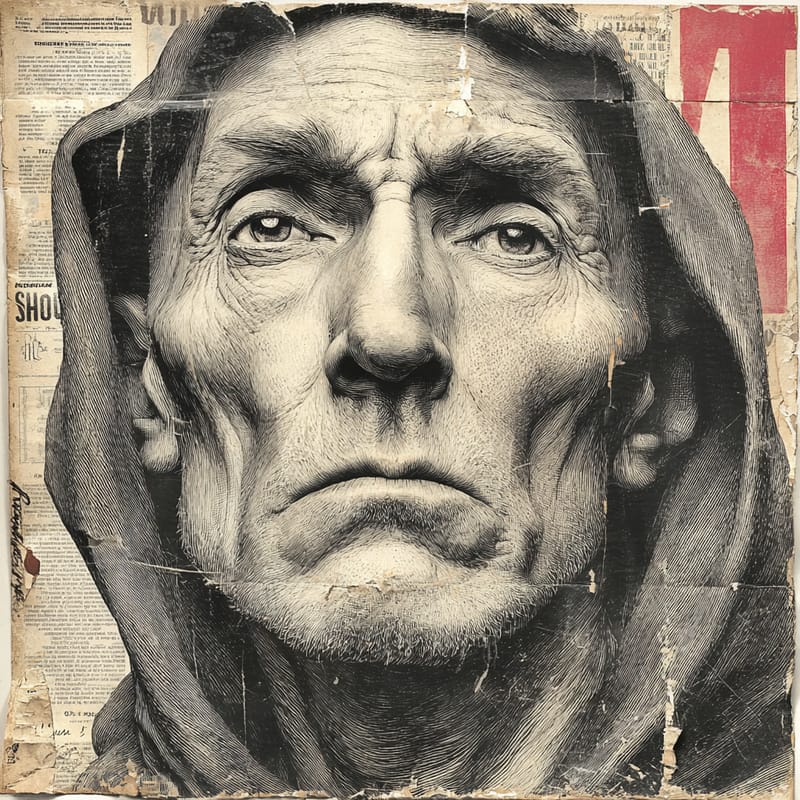
Girolamo Savonarola
Bonfire of the vanities
A friar's puritan republic.
Reactionary Autocratic TheocratOne of 729 ideologies · enter the Autocratic Theocrat hall →- Role
- Friar & ruler
- Era
- 1452–1498
- Region
- Florence
- Social band
- Reactionary
- Placement
- −8 · +90 · −82
§ Where Girolamo Savonarola stands
3 axesSavonarola's economics were a moral critique rather than a programme. He preached against usury, avarice and the luxury of the rich and urged generosity to the poor, and the bonfire of the vanities of February 1497 burned fine clothes, cosmetics, mirrors, playing cards and other costly goods. He praised simplicity over the commercial splendour of Medici Florence without challenging private property itself.
Though the regime he backed was a republic, Savonarola treated it as an instrument of divine will, claiming prophetic authority and calling Christ the true king of Florence. Through his followers, the Piagnoni, he shaped the work of the Great Council created in 1494, and in August 1497, when five Medici supporters were executed without the appeal to that council he had earlier championed, he stayed silent, a failure Machiavelli condemned in his Discourses on Livy.
Savonarola waged a puritan campaign against Renaissance worldliness. He demanded laws against sodomy, gambling and blasphemy, and organised boys to go door to door collecting vanities, from mirrors, cosmetics and carnival masks to indecent pictures and books by Boccaccio, which were burned in the Piazza della Signoria in 1497 and 1498. He wanted art, learning and festivity subordinated to piety.
How close are you to Girolamo Savonarola?
Three statements, one per axis. Answer them and we’ll drop you on the compass next to them.
§ The story
HistoricalGirolamo Savonarola (1452–1498) was a Dominican friar and preacher from Ferrara who dominated the politics of Florence in the 1490s. He joined the Dominicans in Bologna in 1475 and settled at the convent of San Marco in Florence, becoming its prior in 1491. His apocalyptic sermons warned of a scourge coming to punish Italy's corruption, and when Charles VIII of France invaded in 1494 and the Medici were driven out of Florence, many citizens saw the prophecy fulfilled and turned to the friar for leadership.
Holding no office, Savonarola steered the restored republic from the pulpit. He championed the broad Great Council established in December 1494, urged Florentines to take Christ as their king and pressed for laws against gambling, blasphemy and sodomy, while bands of boys collected luxuries for the bonfires of the vanities of 1497 and 1498. His attacks on the corruption of Pope Alexander VI brought excommunication in 1497. After a planned trial by fire collapsed in April 1498, a crowd stormed San Marco; he was arrested, tortured, and hanged and burned with two fellow friars in the Piazza della Signoria on 23 May 1498.
Notable for
- 01Ruled Florence as a theocracy
- 02The Bonfire of the Vanities
- 03Excommunicated and executed
Key works & moments
- 1475Leaves Ferrara to join the Dominican order in Bologna.
- 1491Becomes prior of San Marco in Florence, preaching against the city's corruption.
- 1494Meets the invading Charles VIII as a Florentine envoy; the Medici fall and a Great Council is created.
- 1497Florence holds a great bonfire of the vanities at his urging; Pope Alexander VI excommunicates him.
- 1498Writes a treatise on the government of Florence defending its republican constitution.
- 1498A trial by fire collapses; he is arrested, tortured, hanged and burned on 23 May.
§ Minds closest to Girolamo Savonarola
All minds →

§ Also in the Autocratic Theocrat hall
Enter the hall →§ Common questions
4 answersWhat was Girolamo Savonarola's political ideology?
Savonarola was a prophetic reformer who wanted Florence remade as a godly republic under Christ: on the 99ideologies three-axis compass, a Reactionary Autocratic Theocrat. Economically he sat just left of centre (−8), preaching against usury and luxury without challenging property. On governance he was near the authoritarian extreme (+90), steering the republic's moral life through prophetic authority, and socially he was strongly traditional (−82), campaigning against gambling, sodomy and worldly art.
Was Savonarola left-wing or right-wing?
Right-wing on the compass, though he defies easy labels. His demand for moral legislation, his bonfires of books and art and his claim to speak for God place him on the authoritarian, traditionalist side. Yet he attacked the wealth of the Medici and the corruption of the papacy, preached for the poor and backed a broader republican government than Florence had known, which is why nineteenth-century Italian patriots and liberal Catholics admired him as a reformer and martyr.
Why was Savonarola executed?
Because he lost first the papacy's tolerance and then Florence's support. Pope Alexander VI excommunicated him in 1497 for defying orders to stop preaching and for his attacks on Rome, and later threatened the city with an interdict. When a challenge to prove his cause by a trial by fire collapsed in April 1498, the crowd turned on him and the government arrested him. After torture and trials before civil and papal commissioners, he was condemned as a heretic and schismatic and hanged and burned with two fellow friars on 23 May 1498.
Which minds are closest to Girolamo Savonarola?
On the 99ideologies three-axis compass, the minds closest to Girolamo Savonarola are Hassan al-Banna (99% alike), The High Sparrow (99% alike) and Abul A'la Maududi (97% alike). The furthest is Emma Goldman (0% alike).