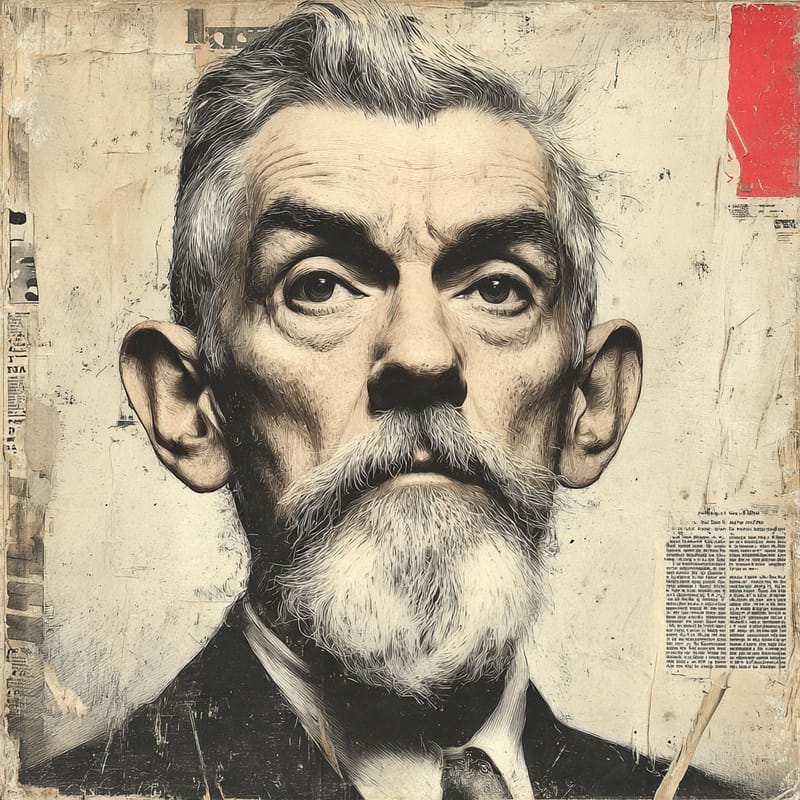
Charles Maurras
Integral nationalism
Throne, altar, and the organic nation.
Reactionary IntegralistOne of 729 ideologies · enter the Integralist hall →- Role
- Theorist
- Era
- 1868–1952
- Region
- France
- Social band
- Reactionary
- Placement
- +2 · +78 · −74
§ Where Charles Maurras stands
3 axesMaurras subordinated economics to politics and sat near the centre, between liberal capitalism and socialism. He favoured an organic order of families, provinces and trades in the tradition of the Catholic corporatist René de La Tour du Pin, and in 1911 young Action Française followers joined revolutionary syndicalists in the Cercle Proudhon, seeking a nationalist alternative to both bourgeois liberalism and Marxism.
Maurras's motto politique d'abord, politics first, demanded a strong state before any other reform, and his Enquête sur la monarchie (1900) called for a traditional, hereditary, anti-parliamentary and decentralised monarchy. His movement's street militants, the Camelots du Roi, joined the riots of 6 February 1934, and he backed Pétain's authoritarian Vichy regime from 1940.
Maurras was deeply reactionary. He blamed the Revolution of 1789, Romanticism and individualism for French decline, defended Catholic order and hierarchy, and preached what he called state antisemitism, demanding the exclusion of Jews from public life; he was a leading anti-Dreyfusard and later supported Vichy's antisemitic laws. Traditional authority, not individual rights, was the basis of his nation.
How close are you to Charles Maurras?
Three statements, one per axis. Answer them and we’ll drop you on the compass next to them.
§ The story
HistoricalCharles Maurras (1868–1952) was a French writer and political theorist, the chief ideologue of the royalist movement Action Française. Born in Martigues in Provence and deaf from his teens, he came to Paris as a literary critic and poet. The Dreyfus affair turned him to politics: he joined Action Française soon after its founding in 1899, converted it to monarchism, and from 1908 ran its daily newspaper with Léon Daudet, becoming one of the most influential voices of the French right.
Maurras preached integral nationalism, a hereditary and anti-parliamentary monarchy, and an exclusionary nation from which he sought to bar Jews, Protestants, Freemasons and foreigners; his antisemitism was open and central to his thought. An agnostic who prized the Catholic Church as a pillar of order, he saw his movement condemned by Pope Pius XI in 1926. He welcomed Pétain's regime in 1940 as a divine surprise, was sentenced to life imprisonment for collaboration in 1945, and died in 1952, months after his release on health grounds.
Notable for
- 01Founded Action Française
- 02Coined 'integral nationalism'
- 03'Politique d'abord'
Key works & moments
- 1899Joins the newly founded Action Française and wins it over to monarchism.
- 1900Publishes Enquête sur la monarchie, his case for a hereditary, anti-parliamentary king.
- 1908Launches the daily L'Action française with Léon Daudet.
- 1926Pope Pius XI condemns Action Française, and its newspaper is placed on the Index.
- 1938Elected to the Académie française.
- 1945Sentenced in Lyon to life imprisonment for collaboration with the enemy.
§ Minds closest to Charles Maurras
All minds →

§ Also in the Integralist hall
Enter the hall →The closest minds above are this hall’s whole roster.
§ Common questions
4 answersWhat was Charles Maurras's political ideology?
Charles Maurras was the founder of integral nationalism and a royalist reactionary: on the 99ideologies three-axis compass, a Reactionary Integralist. Economically he sat near the centre (+2), preferring a corporatist order of families, provinces and trades to either liberal capitalism or socialism. On governance he was strongly authoritarian (+78), demanding a hereditary, anti-parliamentary monarchy. Socially he was deeply traditional (−74), defending Catholic order, hierarchy and an exclusionary nation.
Was Charles Maurras left-wing or right-wing?
Right-wing, and one of the founding figures of the modern French far right. Maurras opposed the legacy of the French Revolution, parliamentary democracy and the republic, and he championed monarchy, church, nation and an exclusionary antisemitism. His movement's flirtation with syndicalism before 1914 has led some to see anti-capitalist currents in it, but his ideas inspired authoritarian regimes from Vichy France to Salazar's Portugal.
Was Charles Maurras a fascist?
Historians disagree. Ernst Nolte's 1963 study Three Faces of Fascism treated Action Française as one of fascism's three faces alongside Italian Fascism and Nazism, and Maurras shared fascism's hatred of liberalism, democracy and Jews. But many scholars see him instead as a reactionary monarchist: he wanted to restore a king rather than build a mass revolutionary movement, distrusted the cult of a modern leader, and remained hostile to Germany even while supporting Vichy.
Which minds are closest to Charles Maurras?
On the 99ideologies three-axis compass, the minds closest to Charles Maurras are Othmar Spann (99% alike), The Corporate State (archetype) (99% alike) and Miguel Primo de Rivera (98% alike). The furthest is Emma Goldman (0% alike).