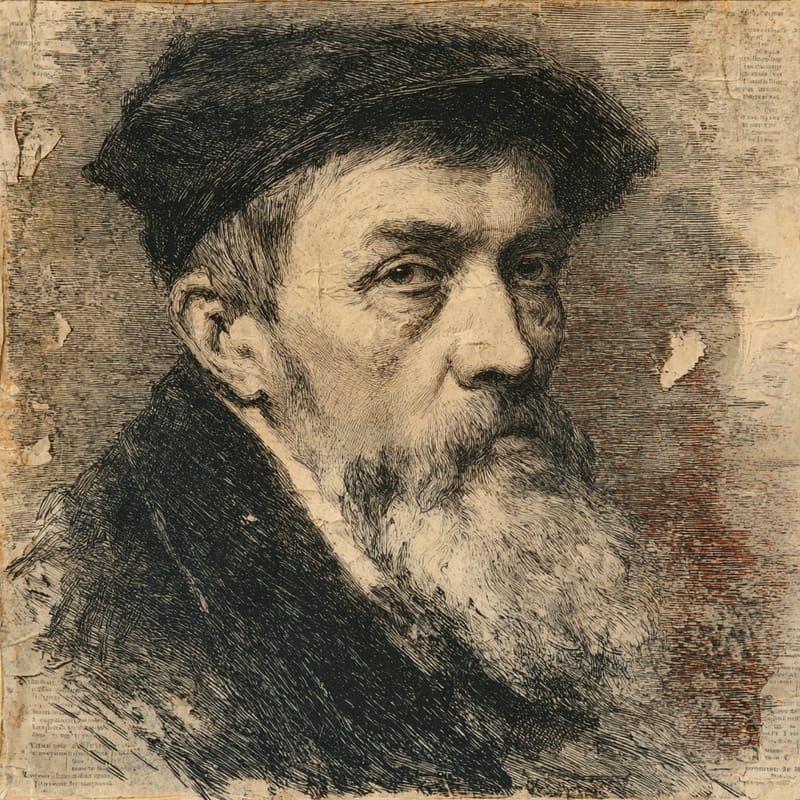
John Calvin
The Geneva theocracy
A city governed by doctrine.
Reactionary Autocratic TheocratOne of 729 ideologies · enter the Autocratic Theocrat hall →- Role
- Reformer & ruler
- Era
- 1509–1564
- Region
- Geneva
- Social band
- Reactionary
- Placement
- +5 · +88 · −80
§ Where John Calvin stands
3 axesCalvin's economics sat near the centre. He broke with the medieval ban on lending at interest, accepting moderate interest in a letter on usury in the 1540s, yet insisted that commerce serve the neighbour and condemned exploitation of the poor. Geneva's deacons organised poor relief, and Max Weber's The Protestant Ethic and the Spirit of Capitalism (1905) later linked Calvinist discipline to the rise of capitalism.
Calvin built a partnership of church and state in which religious discipline carried civic force. The 1541 Ecclesiastical Ordinances set up the Consistory to police belief and morals, while the city councils punished offenders it referred with fines, imprisonment, banishment and, for heresy, death, as in the burning of Michael Servetus in 1553. Formal sovereignty stayed with the magistrates, but dissent from Reformed doctrine was not tolerated.
Calvin's Geneva regulated private life in the name of godliness. From 1541 the Consistory disciplined residents for blasphemy, adultery, dancing, gambling and lingering Catholic practices, and sumptuary laws restricted dress and feasting. His Institutes taught predestination and the depravity of fallen human nature, a severe theology that justified close moral supervision of the whole community.
How close are you to John Calvin?
Three statements, one per axis. Answer them and we’ll drop you on the compass next to them.
§ The story
HistoricalJohn Calvin (1509–1564), born Jean Cauvin in Noyon in northern France, was the leading theologian of the second generation of the Protestant Reformation. Trained in law at Orléans and Bourges, he broke with Rome in the early 1530s and fled France after the Affair of the Placards in 1534. In 1536 he published the first edition of his Institutes of the Christian Religion in Basel, and that same year the reformer Guillaume Farel persuaded him to stay and help reform the city of Geneva.
Expelled with Farel in 1538, Calvin spent three years in Strasbourg before Geneva recalled him in 1541. His Ecclesiastical Ordinances created a Consistory of pastors and elders that summoned residents for swearing, dancing, gambling or missing sermons, and his supporters defeated their local opponents in 1555. Although he held no civil office and became a citizen only in 1559, he dominated the city's religious and moral life. His backing for the death sentence on the anti-Trinitarian Michael Servetus, burned in 1553, remains the defining controversy of his career, while the Genevan Academy, founded in 1559, helped carry Calvinism to France, Scotland, the Netherlands and New England.
Notable for
- 01Led Reformation Geneva
- 02'Institutes of the Christian Religion'
- 03Theocratic civic discipline
Key works & moments
- 1536Publishes the first edition of the Institutes of the Christian Religion in Basel.
- 1538Expelled from Geneva with Guillaume Farel; ministers to French refugees in Strasbourg.
- 1541Returns to Geneva and secures the Ecclesiastical Ordinances creating the Consistory.
- 1553Michael Servetus is burned for heresy in Geneva; Calvin had backed the death sentence.
- 1559Founds the Genevan Academy and issues the final Latin edition of the Institutes.
§ Minds closest to John Calvin
All minds →

§ Also in the Autocratic Theocrat hall
Enter the hall →§ Common questions
4 answersWhat was John Calvin's political ideology?
John Calvin was a Protestant reformer who wanted civic life governed by Reformed doctrine and church discipline: on the 99ideologies three-axis compass, a Reactionary Autocratic Theocrat. Economically he sat near the centre (+5), permitting moderate interest while subordinating commerce to Christian ethics and poor relief. On governance he was strongly authoritarian (+88), backing a Consistory and magistracy that enforced religious conformity, and socially he was firmly traditional (−80), regulating worship, dress and leisure in Geneva.
Was John Calvin left-wing or right-wing?
Right-wing in compass terms, though the labels did not exist in his century. Calvin wanted society ordered by scripture, enforced religious conformity and backed the execution of a heretic, positions that place him on the authoritarian, traditionalist right. Economically he was no partisan of either camp: he accepted interest and commerce but demanded poor relief and condemned exploitation. Later Calvinists, building on his allowance for resistance by lesser magistrates, developed theories of resistance to tyrants that fed into constitutional thought.
Was Calvin's Geneva a theocracy?
In practice largely, though not in law. Calvin was a pastor who held no civil office and became a citizen of Geneva only in 1559, and formal power stayed with the city's councils. But his 1541 Ecclesiastical Ordinances gave the Consistory of ministers and elders the task of supervising the faith and morals of every resident, and the magistrates enforced Reformed orthodoxy with civil penalties, most notoriously by burning Michael Servetus in 1553. Historians therefore often describe the city as a theocracy, or as a close partnership of church and state.
Which minds are closest to John Calvin?
On the 99ideologies three-axis compass, the minds closest to John Calvin are Pope Innocent III (98% alike), Abul A'la Maududi (97% alike) and Oliver Cromwell (96% alike). The furthest is Emma Goldman (0% alike).