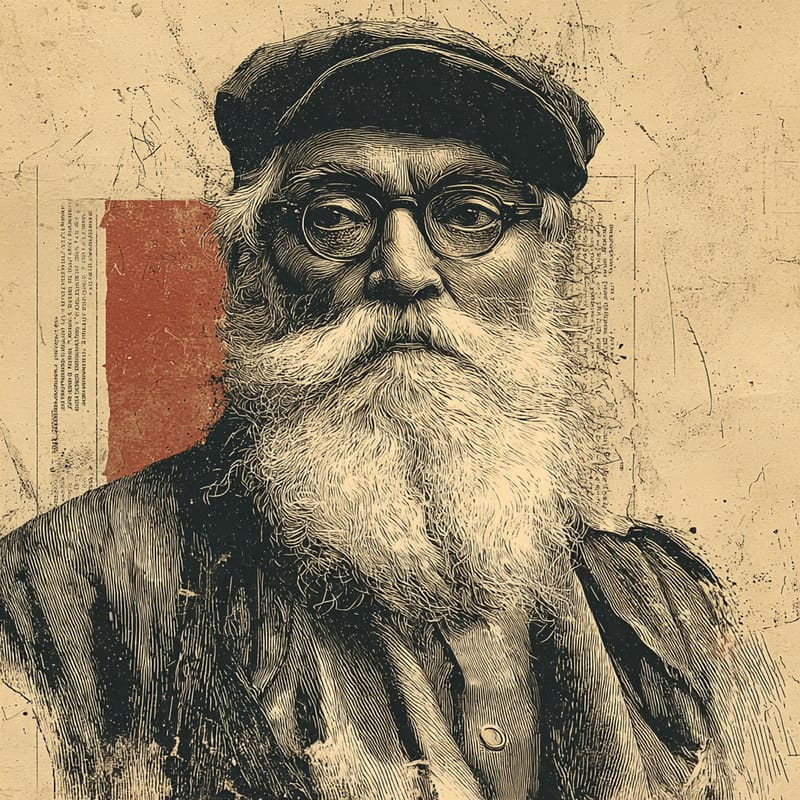
Abul A'la Maududi
The Islamic state, theorised
Sovereignty belongs to God alone.
Reactionary Autocratic TheocratOne of 729 ideologies · enter the Autocratic Theocrat hall →- Role
- Theorist & founder
- Era
- 1903–1979
- Region
- Pakistan
- Social band
- Reactionary
- Placement
- −2 · +88 · −82
§ Where Abul A'la Maududi stands
3 axesMaududi rejected both capitalism and socialism as un-Islamic, calling for an economy without interest, with zakat as a compulsory levy and wealth restrained by religious duty, aims the Jamaat-e-Islami he founded in 1941 made central demands. Yet he defended private property firmly and opposed the land reforms debated in Pakistan after independence as contrary to Islamic law, which keeps him at the centre of the economic axis.
Maududi's political theory placed sovereignty with God alone, so that rulers and legislators could interpret and enforce the sharia but never override it. He called this order a theo-democracy, in which Muslims choose leaders and consult but non-Muslims are barred from the highest offices, and he built Jamaat-e-Islami in 1941 as a disciplined vanguard to win and Islamise the state.
Maududi sought to order every sphere of life by religious law. His book Purdah defended the seclusion of women and strict separation of the sexes, he held that apostasy from Islam should be punished by death, and his 1953 pamphlet The Qadiani Problem demanded that Ahmadis be declared non-Muslims, a demand Pakistan enacted by constitutional amendment in 1974.
How close are you to Abul A'la Maududi?
Three statements, one per axis. Answer them and we’ll drop you on the compass next to them.
§ The story
HistoricalSayyid Abul A'la Maududi (1903–1979) was a South Asian Islamic scholar, journalist and political theorist. Born in Aurangabad in the princely state of Hyderabad, he worked as a journalist and editor in the 1920s and made his name with al-Jihad fil-Islam, a defence of Islamic teaching on war. From the 1930s he edited the journal Tarjuman al-Quran, in 1941 in Lahore he founded Jamaat-e-Islami as a disciplined vanguard party, and after partition in 1947 he moved to Pakistan, where he campaigned for an Islamic constitution.
Maududi argued that sovereignty belongs to God alone and that the state's task is to enforce divine law, a doctrine echoed in Pakistan's 1949 Objectives Resolution and taken up by Islamists far beyond South Asia, including Sayyid Qutb in Egypt. He was jailed several times; in 1953, after anti-Ahmadi riots in Lahore, a military court sentenced him to death over his writings, a sentence later commuted. His Quran commentary Tafhim-ul-Quran remains widely read, and his ideas informed Zia ul-Haq's Islamisation drive of the late 1970s. He died in 1979 in Buffalo, New York.
Notable for
- 01Founded Jamaat-e-Islami
- 02Theory of divine sovereignty (hakimiyya)
- 03Vast theological-political corpus
Key works & moments
- 1920sPublishes al-Jihad fil-Islam, a defence of Islamic teaching on war.
- 1930sEdits Tarjuman al-Quran, the monthly journal that becomes his lifelong platform.
- 1941Founds Jamaat-e-Islami in Lahore.
- 1947Moves to Pakistan after partition and campaigns for an Islamic constitution.
- 1953Sentenced to death by a military court over his pamphlet on the Ahmadis; the sentence is commuted.
- 1972Completes Tafhim-ul-Quran, his Urdu translation and commentary on the Quran.
§ Minds closest to Abul A'la Maududi
All minds →



§ Also in the Autocratic Theocrat hall
Enter the hall →§ Common questions
4 answersWhat was Abul A'la Maududi's political ideology?
Maududi was a founding theorist of modern Islamism who argued that the state must enforce God's law because sovereignty belongs to God alone: on the 99ideologies three-axis compass, a Reactionary Autocratic Theocrat. Economically he sat almost exactly at the centre (−2), opposing interest and imposing zakat while defending private property against socialism and land reform. On governance he was strongly authoritarian (+88), subordinating legislation to the sharia, and socially he was strongly traditional (−82), defending purdah and religious orthodoxy.
Was Maududi left-wing or right-wing?
Right-wing in compass terms. His demand that the sharia govern law, his defence of purdah and his campaign against the Ahmadis place him on the authoritarian, traditionalist right, and in the 1970s Jamaat-e-Islami fought Zulfikar Ali Bhutto's Pakistan Peoples Party and its programme of Islamic socialism. Economically he was a centrist critic of both capitalism and socialism. He also worked within electoral politics, and in 1965 his party even backed Fatima Jinnah's presidential campaign against the military ruler Ayub Khan.
What is hakimiyya in Maududi's thought?
Hakimiyya, or divine sovereignty, is Maududi's principle that absolute political and legal authority belongs to God alone. For him a government that legislates by popular will or national interest usurps a power that is God's, so the only legitimate state is one that enforces the sharia, with rulers acting as God's vicegerents. Sayyid Qutb took up the idea in Egypt and pushed it further, branding societies not ruled by divine law as jahiliyya, or pre-Islamic ignorance, a step that influenced later militant movements.
Which minds are closest to Abul A'la Maududi?
On the 99ideologies three-axis compass, the minds closest to Abul A'la Maududi are Hassan al-Banna (98% alike), Girolamo Savonarola (97% alike) and John Calvin (97% alike). The furthest is Emma Goldman (0% alike).