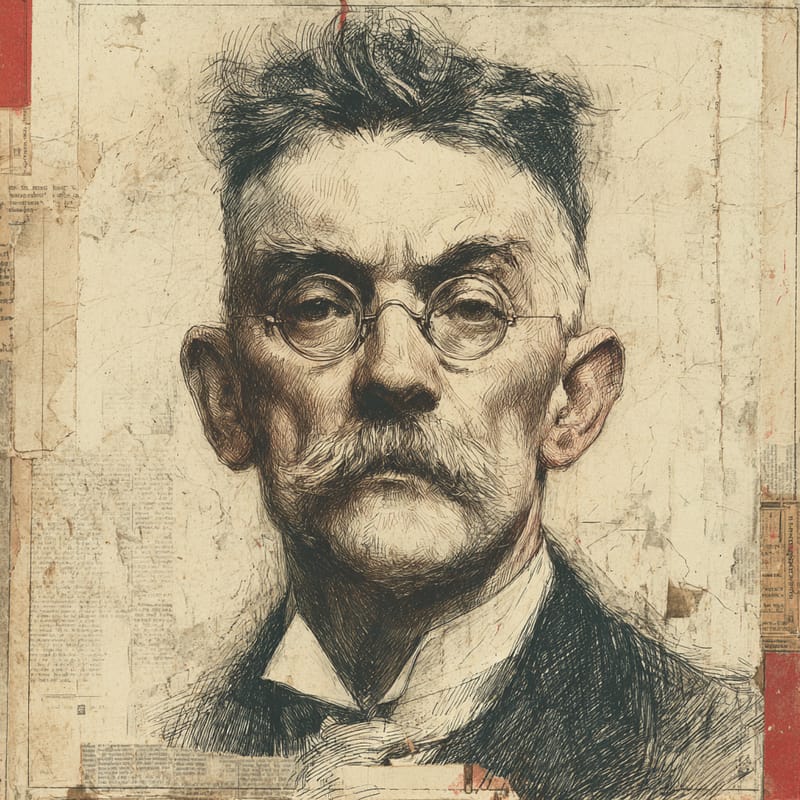
Othmar Spann
The true state
The corporatist theory, systematised.
Reactionary IntegralistOne of 729 ideologies · enter the Integralist hall →- Role
- Philosopher & economist
- Era
- 1878–1950
- Region
- Austria
- Social band
- Reactionary
- Placement
- 0 · +80 · −72
§ Where Othmar Spann stands
3 axesSpann rejected both liberal capitalism and Marxist socialism as products of individualism and materialism. In Der wahre Staat (1921) he proposed an economy organised by occupational estates, in which employers and workers in each branch would govern themselves under state supervision, keeping private property but subordinating it to the organic whole, a position deliberately between market and plan.
Spann's true state was openly authoritarian and anti-democratic. He dismissed majority voting as a mechanical, individualist principle and argued that the wisest should rule from the top of the hierarchy; his student Walter Heinrich helped draft the Heimwehr's 1930 Korneuburg Oath, which rejected Western parliamentary democracy, and Austria's 1934 constitution embodied the corporatist order he championed.
Spann was a romantic traditionalist who drew on Plato, medieval scholasticism and the German Romantic thinker Adam Müller. His vision subordinated the individual to inherited communities of family, estate, nation and faith, rejected the Enlightenment's egalitarian individualism and sought a revival of a Catholic, hierarchical social order, placing him at the reactionary end of the social spectrum.
How close are you to Othmar Spann?
Three statements, one per axis. Answer them and we’ll drop you on the compass next to them.
§ The story
HistoricalOthmar Spann (1878–1950) was an Austrian philosopher, economist and sociologist. Born near Vienna, he studied in Vienna, Zürich and Tübingen, taught at the German technical university in Brno, and from 1919 held a chair of political economy and sociology at the University of Vienna, where his charismatic lectures drew a devoted following known as the Spann circle. His books, above all Der wahre Staat (The True State, 1921), set out a doctrine he called universalism.
Spann's universalism held that society is an organic whole that precedes and shapes the individual, and that it should be organised as a hierarchy of estates crowned by an authoritarian state led by the best. These ideas fed the Austrian Heimwehr's Korneuburg Oath of 1930 and the corporatist Ständestaat of 1934, and influenced Sudeten German nationalists. The Nazis, however, rejected his Catholic-tinged universalism; after the 1938 Anschluss he was arrested and lost his chair, and he was not reinstated after the war.
Notable for
- 01'Der wahre Staat'
- 02Universalist corporatism
- 03Influenced Austrofascism
Key works & moments
- 1911Publishes Die Haupttheorien der Volkswirtschaftslehre, later translated as Types of Economic Theory.
- 1919Takes up a chair of political economy and sociology at the University of Vienna.
- 1921Publishes Der wahre Staat (The True State), his blueprint for a corporatist order.
- 1930The Heimwehr's Korneuburg Oath, shaped by his circle, rejects parliamentary democracy.
- 1934Austria's May Constitution proclaims a Christian corporative state.
- 1938Arrested after the Anschluss and stripped of his professorship by the Nazis.
§ Minds closest to Othmar Spann
All minds →

§ Also in the Integralist hall
Enter the hall →The closest minds above are this hall’s whole roster.
§ Common questions
4 answersWhat was Othmar Spann's political ideology?
Othmar Spann was the theorist of universalism, a romantic, Catholic-inflected corporatism: on the 99ideologies three-axis compass, a Reactionary Integralist. Economically he sat exactly at the centre (0), rejecting both capitalism and socialism in favour of self-governing occupational estates. On governance he was strongly authoritarian (+80), calling for a hierarchical true state ruled by the best. Socially he was deeply traditional (−72), subordinating the individual to family, estate, nation and faith.
Was Othmar Spann left-wing or right-wing?
Right-wing. Spann was a leading intellectual of the anti-democratic right in interwar Central Europe, and his corporatism was meant as an alternative to Marxism as much as to liberalism. His ideas influenced the Austrian Heimwehr, the authoritarian Ständestaat of the 1930s and Sudeten German nationalists. His hostility to capitalism has led some to see a left-wing streak, but his hierarchical, elitist and traditionalist vision places him firmly on the reactionary right.
Was Othmar Spann a Nazi?
His relationship with Nazism was ambiguous. Spann shared the Nazis' hostility to democracy, liberalism and Marxism, and in the early 1930s some of his followers hoped to give the German right a corporatist programme. But Nazi ideologists rejected his universalism, which put the organic whole and its spiritual order above race and was tied to Catholic and Austrian traditions. After the Anschluss of 1938 the regime arrested Spann and removed him from his university chair.
Which minds are closest to Othmar Spann?
On the 99ideologies three-axis compass, the minds closest to Othmar Spann are The Corporate State (archetype) (100% alike), Charles Maurras (99% alike) and Miguel Primo de Rivera (98% alike). The furthest is Emma Goldman (0% alike).