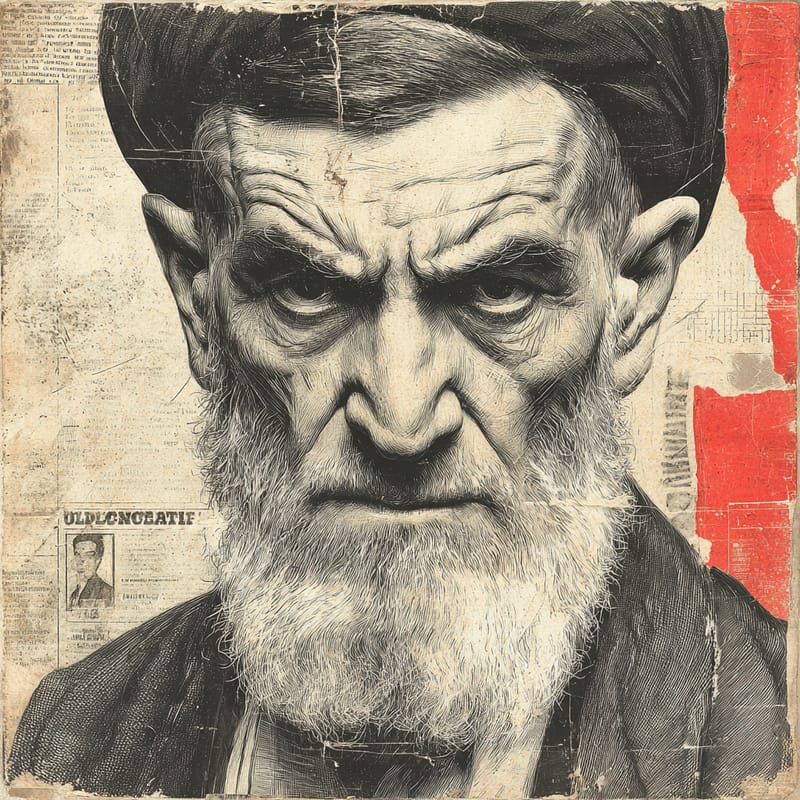
Ruhollah Khomeini
Guardianship of the jurist
Clerical rule as the form of the state.
Reactionary Autocratic TheocratOne of 729 ideologies · enter the Autocratic Theocrat hall →- Role
- Supreme Leader
- Era
- 1902–1989
- Region
- Iran
- Social band
- Reactionary
- Placement
- −5 · +96 · −85
§ Where Ruhollah Khomeini stands
3 axesKhomeini spoke for the mostazafin, the dispossessed, and after the revolution of 1979 banks, insurance and major industries were nationalised and the Shah's family wealth passed to the Foundation of the Oppressed. Yet he also protected the bazaar merchants who had financed the revolution, and the Guardian Council repeatedly blocked radical land reform as un-Islamic, leaving a mixed economy of state, foundation and private enterprise.
Khomeini's lectures in Najaf, published in 1970 as Islamic Government, argued that in the absence of the Hidden Imam a just jurist should rule. The 1979 constitution enshrined that doctrine, giving the Supreme Leader authority over the armed forces and the judiciary above the elected president and parliament, and his regime crushed opposition through revolutionary courts, culminating in the prison massacres of 1988.
Khomeini imposed strict religious law on public and private life. His government suspended the Shah's Family Protection Law in 1979, made the hijab compulsory for women in public from the early 1980s, closed the universities for a cultural revolution in 1980 and persecuted the Baháʼí minority. In 1962–63 he had already led clerical opposition to the Shah's enfranchisement of women.
How close are you to Ruhollah Khomeini?
Three statements, one per axis. Answer them and we’ll drop you on the compass next to them.
§ The story
HistoricalRuhollah Khomeini (1902–1989) was an Iranian Shia cleric who led the 1979 revolution and ruled the Islamic Republic as its first Supreme Leader until his death. Born in Khomein in central Iran, he trained in Arak and Qom and rose to become a senior religious authority. His denunciations of the Shah's reforms and of American influence led to his arrest in 1963 and exile in 1964, first to Turkey and then to Najaf in Iraq, from where his recorded sermons circulated throughout Iran.
Returning to Tehran in February 1979 after the Shah fled, Khomeini founded an Islamic Republic built on velayat-e faqih, the guardianship of the Islamic jurist, which placed a senior cleric above elected institutions. His rule brought the 444-day hostage crisis at the US embassy, which he endorsed, the eight-year war with Iraq, the suppression of leftist, liberal and ethnic opponents and the execution of thousands of political prisoners in 1988. His 1989 fatwa calling for the death of the novelist Salman Rushdie projected his authority abroad, and the system he designed outlived him.
Notable for
- 01Led the 1979 Iranian Revolution
- 02Doctrine of velayat-e faqih
- 03Founded the Islamic Republic
Key works & moments
- 1940sPublishes Kashf al-Asrar, attacking the secularising reforms of Reza Shah.
- 1963Arrested after denouncing the Shah, sparking the June uprising of 15 Khordad.
- 1964Exiled after condemning legal immunity for US military personnel in Iran.
- 1970His Najaf lectures, Islamic Government, set out the doctrine of velayat-e faqih.
- 1979Returns from exile in February; the Islamic Republic is proclaimed on 1 April.
- 1989Issues a fatwa against Salman Rushdie in February; dies in Tehran on 3 June.
§ Minds closest to Ruhollah Khomeini
All minds →

§ Also in the Autocratic Theocrat hall
Enter the hall →§ Common questions
4 answersWhat was Ruhollah Khomeini's political ideology?
Khomeini was the architect of modern Shia theocracy, rule by a senior Islamic jurist under the doctrine of velayat-e faqih: on the 99ideologies three-axis compass, a Reactionary Autocratic Theocrat. Economically he sat just left of centre (−5), championing the dispossessed and nationalising banks while protecting bazaar commerce and private property. On governance he was at the authoritarian extreme (+96), placing the Supreme Leader above elected institutions, and socially he was strongly traditional (−85), enforcing religious law on dress, family and culture.
Was Khomeini left-wing or right-wing?
Right-wing on the compass, despite his revolutionary rhetoric. Khomeini borrowed the language of anti-imperialism and spoke for the oppressed, which won him leftist allies in 1978–79, and his state nationalised much of the economy. But his goal was clerical rule enforcing traditional religious law, and once in power he crushed the leftists who had helped him, including the People's Mujahedin from 1981 and the communist Tudeh Party in 1983. Authoritarian theocracy and social traditionalism define him more than his economic populism.
What is velayat-e faqih?
Velayat-e faqih, the guardianship of the Islamic jurist, is the doctrine that during the absence of the Twelfth Imam a qualified senior cleric should hold political authority over the Muslim community. Earlier Shia scholars mostly limited the jurist's guardianship to matters such as orphans and religious endowments; Khomeini extended it to rule over the state in his 1970 Najaf lectures. Iran's 1979 constitution enshrined it, making him Supreme Leader, and in 1988 he ruled that the Islamic state's authority could override even religious obligations when its interests required.
Which minds are closest to Ruhollah Khomeini?
On the 99ideologies three-axis compass, the minds closest to Ruhollah Khomeini are Aunt Lydia (98% alike), Girolamo Savonarola (97% alike) and Hassan al-Banna (97% alike). The furthest is Emma Goldman (0% alike).