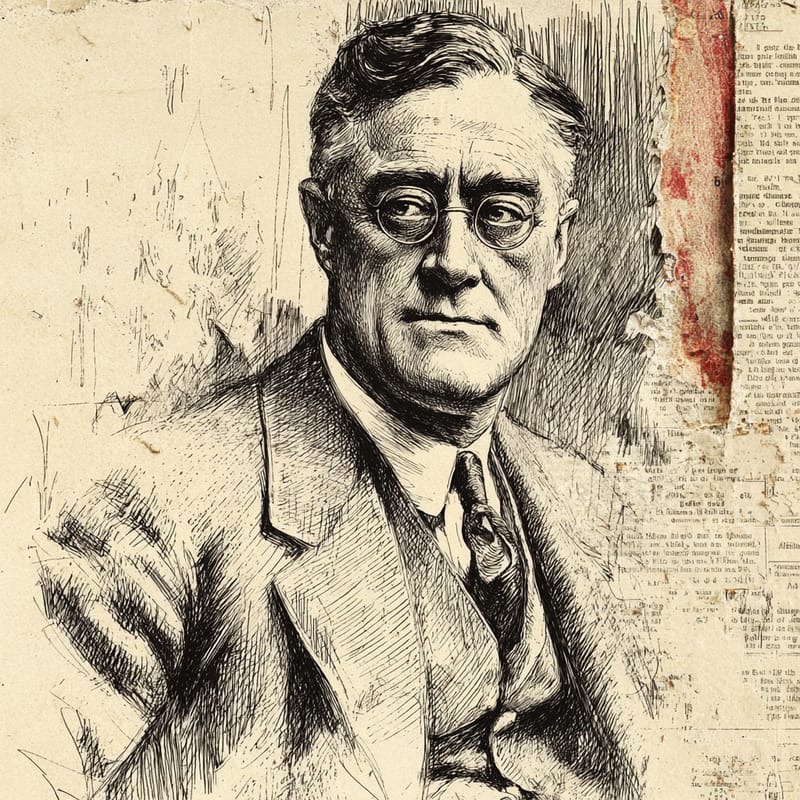
Franklin D. Roosevelt
The New Deal
Saved capitalism by reforming it.
Heterodox LiberalOne of 729 ideologies · enter the Liberal hall →- Role
- President
- Era
- 1882–1945
- Region
- United States
- Social band
- Heterodox
- Placement
- −30 · +8 · +35
§ Where Franklin D. Roosevelt stands
3 axesRoosevelt sought to save capitalism by reforming it. His administrations insured bank deposits under the Banking Act of 1933, created the Securities and Exchange Commission in 1934, built public works through the Works Progress Administration, and enacted the Social Security Act and the National Labor Relations Act in 1935 and a federal minimum wage in 1938. He left ownership largely private, placing him left of centre rather than among socialists.
Roosevelt expanded federal and presidential power more than any predecessor, governing through new executive agencies, winning four elections and attempting in 1937 to add justices to a Supreme Court that had struck down New Deal laws. His Executive Order 9066 of 1942 authorised the removal and internment of Japanese Americans. He nonetheless worked within elections and the Constitution, which leaves him modestly on the authoritarian side of the centre.
Roosevelt led a broad progressive coalition, appointing Frances Perkins as the first woman cabinet secretary and issuing Executive Order 8802 in 1941 to bar racial discrimination in the defence industries. Yet he declined to back federal anti-lynching legislation for fear of losing Southern Democrats, and many of his programmes reinforced segregation, which keeps him moderately rather than strongly progressive.
How close are you to Franklin D. Roosevelt?
Three statements, one per axis. Answer them and we’ll drop you on the compass next to them.
§ The story
HistoricalFranklin Delano Roosevelt (1882–1945) was the 32nd president of the United States, elected four times and serving from March 1933 until his death in April 1945. Born into a wealthy family in Hyde Park, New York, and educated at Groton, Harvard and Columbia Law School, he served in the New York State Senate, as assistant secretary of the Navy under Woodrow Wilson and as the Democratic vice-presidential nominee in 1920. Paralysed from the waist down by an illness diagnosed as polio in 1921, he returned to politics as governor of New York from 1929 to 1932.
Roosevelt's New Deal answered the Great Depression with banking reform, public works, farm support, the Social Security Act and the Wagner Act, building the modern American regulatory state and a durable Democratic coalition. He led the United States through the Second World War, supplying Britain through Lend-Lease before Pearl Harbor and shaping the Allied alliance and plans for the United Nations. His record also includes the failed 1937 plan to enlarge the Supreme Court, the internment of some 120,000 Japanese Americans under Executive Order 9066, and New Deal programmes that accommodated Southern segregation.
Notable for
- 01The New Deal
- 02Social Security Act
- 03Led the US through the Depression and WWII
Key works & moments
- 1933Launches the New Deal in his first hundred days, starting with emergency banking legislation.
- 1935Signs the Social Security Act and the National Labor Relations Act.
- 1937Proposes enlarging the Supreme Court; Congress rejects the court-packing plan.
- 1941Sets out the Four Freedoms and signs Lend-Lease to supply Britain against Nazi Germany.
- 1942Signs Executive Order 9066, authorising the internment of Japanese Americans.
- 1945Attends the Yalta conference, then dies at Warm Springs, Georgia, on 12 April.
In their own words
“The only thing we have to fear is fear itself.”
“The test of our progress is not whether we add more to the abundance of those who have much; it is whether we provide enough for those who have too little.”
§ Minds closest to Franklin D. Roosevelt
All minds →

§ Also in the Liberal hall
Enter the hall →§ Common questions
4 answersWhat was Franklin D. Roosevelt's political ideology?
Franklin D. Roosevelt was a New Deal liberal: on the 99ideologies three-axis compass, a Heterodox Liberal. Economically he sat left of centre (−30), regulating finance, building public works and creating Social Security while preserving private ownership. On governance he leaned modestly authoritarian (+8), expanding presidential power, seeking to enlarge the Supreme Court and ordering Japanese American internment, and socially he was moderately progressive (+35), a coalition-builder whose reforms were constrained by Southern segregationists.
Was Franklin D. Roosevelt left-wing or right-wing?
Left of centre. Roosevelt moved American politics decisively leftward, attacking what he called economic royalists, creating Social Security and protecting union organising, and he made the Democrats the party of active government. But he was a pragmatist rather than an ideologue, he rejected socialism, and his stated aim was to preserve capitalism by curbing its excesses. Business conservatives saw him as a radical, while socialists of his day saw him as capitalism's rescuer.
Was FDR a socialist?
No. Roosevelt never called himself a socialist and did not nationalise industry; the New Deal regulated banks, stock markets and labour relations, insured deposits and created social insurance, but it left factories, farms and banks in private hands. The Socialist Party's Norman Thomas, who ran against him, argued that the New Deal fell far short of socialism. Roosevelt's goal, as he repeatedly said, was to rescue a capitalist system in crisis, which is why historians describe him as a liberal reformer.
Which minds are closest to Franklin D. Roosevelt?
On the 99ideologies three-axis compass, the minds closest to Franklin D. Roosevelt are Beatrice Webb (97% alike), John Maynard Keynes (96% alike) and John Rawls (95% alike). The furthest is Adam Sutler (23% alike).