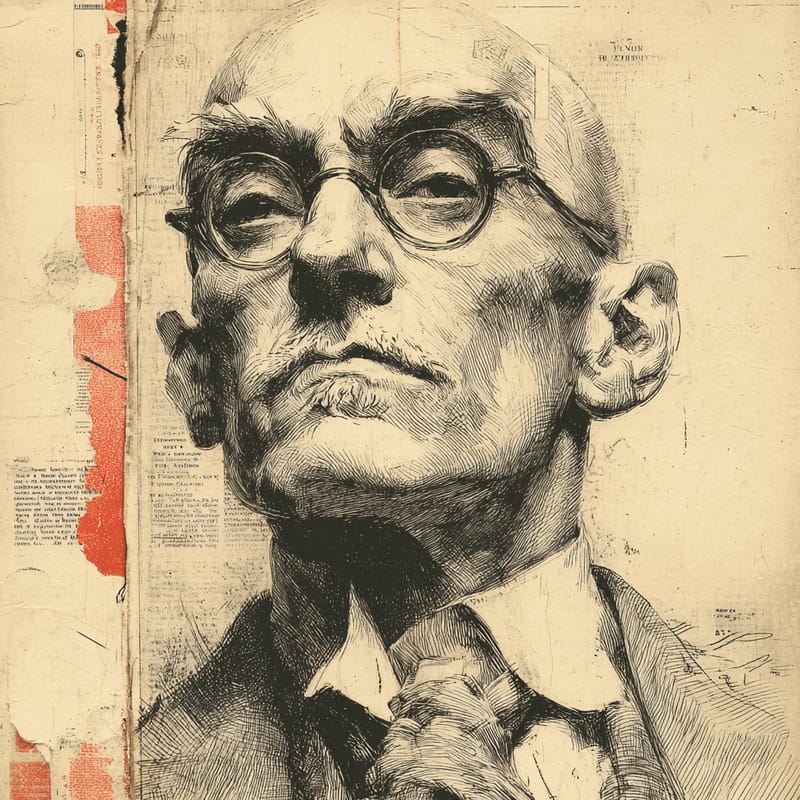
Karl Korsch
Marxism and philosophy
Recovering Marx's revolutionary core.
Heterodox Orthodox MarxistOne of 729 ideologies · enter the Orthodox Marxist hall →- Role
- Theorist
- Era
- 1886–1961
- Region
- Germany
- Social band
- Heterodox
- Placement
- −90 · +6 · +30
§ Where Karl Korsch stands
3 axesKorsch never abandoned the goal of abolishing capitalism. His 1919 pamphlet What Is Socialisation? sketched a socialised economy combining workers' control with public oversight, and Marxism and Philosophy (1923) treated Marx's critique of political economy as inseparable from revolutionary practice. His late work questioned Marxist orthodoxy, but not common ownership.
Korsch moved from party office to fierce independence. In 1923 he served as justice minister in Thuringia's short-lived coalition of Social Democrats and Communists, and he sat in the Reichstag as a Communist, but after his expulsion in 1926 he attacked Soviet Marxism as a new orthodoxy and drew close to council communists who favoured workers' self-rule over party dictatorship.
Korsch was a heterodox progressive who treated Marxism as a living, critical method rather than a dogma. His Ten Theses on Marxism Today (1950) argued that Marxism had to be rethought as one strand of a broader movement for human emancipation, and his teaching shaped Brecht's political theatre, linking him to the cultural avant-garde of Weimar Berlin.
How close are you to Karl Korsch?
Three statements, one per axis. Answer them and we’ll drop you on the compass next to them.
§ The story
HistoricalKarl Korsch (1886–1961) was a German Marxist theorist, jurist and communist politician. Born near Hamburg, he studied law and philosophy, spent the years before 1914 in London, where he was drawn to the Fabian socialists, and served at the front in the First World War, which he opposed. Radicalised by the revolution of 1918–19, he joined the Communist Party of Germany in 1920, served briefly as justice minister in the state of Thuringia in 1923 and sat in the Reichstag for the communists from 1924 to 1928.
Marxism and Philosophy (1923), published in the same year as György Lukács's History and Class Consciousness, argued that Marxism was a revolutionary philosophy rather than a positive science, and that the Second International had forgotten its Hegelian roots. Denounced by Comintern leaders in 1924 and expelled from the party in 1926 as an ultra-leftist, Korsch moved towards council communism and influenced Bertolt Brecht, who attended his study circles in Berlin. He went into exile in 1933 and settled in the United States in 1936, spending his last decades in relative obscurity.
Notable for
- 01'Marxism and Philosophy'
- 02Co-founder of Western Marxism
- 03Council-communist sympathies
Key works & moments
- 1919Publishes What Is Socialisation?, a programme for socialising the economy through workers' councils.
- 1923Publishes Marxism and Philosophy and serves as Thuringia's justice minister.
- 1924Elected to the Reichstag for the Communist Party; Comintern leaders condemn his work.
- 1926Expelled from the Communist Party of Germany as an ultra-leftist.
- 1938Publishes Karl Marx, a study of Marx's thought, in exile.
- 1950Writes Ten Theses on Marxism Today.
§ Minds closest to Karl Korsch
All minds →

§ Also in the Orthodox Marxist hall
Enter the hall →§ Common questions
4 answersWhat was Karl Korsch's political ideology?
Korsch was a heterodox Western Marxist who ended as a council communist: on the 99ideologies three-axis compass, a Heterodox Orthodox Marxist. Economically he sat at the far left (−90), seeking the socialisation of production through workers' councils. On governance he sat near the centre (+6), having served as a Communist minister and Reichstag deputy before turning against party dictatorship, and socially he was progressive (+30), treating Marxism as an open, critical philosophy.
Was Karl Korsch left-wing or right-wing?
Left-wing, and on the far left of the communist movement. Korsch was expelled from the Communist Party of Germany in 1926 not for moderation but as an ultra-leftist who criticised the Soviet leadership and the Comintern's line. He then aligned with council communists who rejected both social-democratic reformism and Bolshevik party rule. His late writings questioned Marxism itself, but he remained committed to the self-emancipation of the working class.
What is Marxism and Philosophy about?
Korsch's 1923 essay argues that Marxism is a revolutionary philosophy, not a neutral science, and that it had lost its philosophical and Hegelian roots in the hands of the Second International. Korsch applied Marx's own method to Marxism, dividing its history into stages and arguing that theory must be understood in relation to revolutionary practice. Published in the same year as Lukács's History and Class Consciousness, it was condemned by Comintern leaders in 1924 and became a founding text of Western Marxism.
Which minds are closest to Karl Korsch?
On the 99ideologies three-axis compass, the minds closest to Karl Korsch are György Lukács (99% alike), Paul Sweezy (96% alike) and Louis Althusser (96% alike). The furthest is Adam Sutler (7% alike).