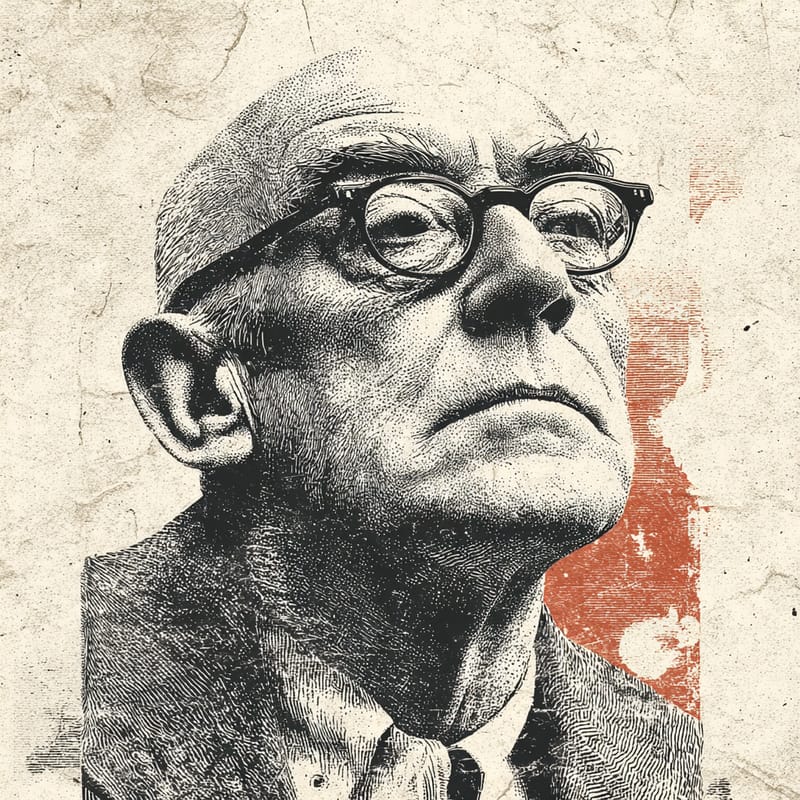
Theodor Adorno
The culture industry
Critical theory against mass deception.
Reformist Orthodox MarxistOne of 729 ideologies · enter the Orthodox Marxist hall →- Role
- Philosopher
- Era
- 1903–1969
- Region
- Germany
- Social band
- Reformist
- Placement
- −88 · +4 · +42
§ Where Theodor Adorno stands
3 axesAdorno regarded capitalism as a totality that shapes even private life and taste. In Dialectic of Enlightenment (1947) he and Horkheimer argued that the culture industry turns art into standardised commodities, and Minima Moralia (1951) traced the damage done to individual experience by a society ruled by exchange. He offered no blueprint for socialism, but his critique presupposed a society beyond the market.
Adorno kept his distance from parties, states and movements alike, believing that critical thought must not be subordinated to practical politics. He condemned Soviet communism and fascism, worked within West Germany's liberal democracy, and in 1969 called the police when students occupied his institute, a stance that infuriated the New Left and keeps him close to the centre of this axis.
Adorno was a progressive modernist who championed difficult avant-garde art, especially Arnold Schoenberg's atonal music in Philosophy of New Music (1949). His 1966 radio lecture 'Education after Auschwitz' made preventing a repetition of Auschwitz the first demand on education, and his work on the authoritarian personality shaped later research into prejudice, though his scorn for jazz and popular culture revealed an elitist streak.
How close are you to Theodor Adorno?
Three statements, one per axis. Answer them and we’ll drop you on the compass next to them.
§ The story
HistoricalTheodor W. Adorno (1903–1969) was a German philosopher, sociologist, music theorist and composer, and the leading thinker of the Frankfurt School after the Second World War. Born in Frankfurt to a Jewish wine merchant father and a Catholic singer mother, he trained in philosophy and studied composition with Alban Berg in Vienna. Forced into exile by the Nazis, he worked at Oxford and in the United States, including on a radio research project at Princeton, before rejoining Max Horkheimer in California in 1941.
With Horkheimer he wrote Dialectic of Enlightenment (1947), whose chapter on the 'culture industry' indicted mass entertainment as a means of social control, and he co-authored the influential study The Authoritarian Personality (1950). Back in Frankfurt from 1949, he became a leading public intellectual of the young Federal Republic, urging Germans to confront the Nazi past. His last years were soured by conflict with radical students, whose occupation of the institute in January 1969 he ended by calling the police; he died that August.
Notable for
- 01'Dialectic of Enlightenment'
- 02The 'culture industry'
- 03Frankfurt School critical theory
Key works & moments
- 1934Leaves Nazi Germany for Oxford, later joining the exiled institute in America.
- 1947Publishes Dialectic of Enlightenment with Max Horkheimer in Amsterdam.
- 1949Returns to Frankfurt and publishes Philosophy of New Music.
- 1950Co-authors The Authoritarian Personality, introducing the F-scale for measuring fascist tendencies.
- 1966Publishes Negative Dialectics and broadcasts the lecture 'Education after Auschwitz'.
- 1969Calls police on students occupying the institute; dies in Switzerland in August.
In their own words
“To write poetry after Auschwitz is barbaric.”
“Wrong life cannot be lived rightly.”
§ Minds closest to Theodor Adorno
All minds →

§ Also in the Orthodox Marxist hall
Enter the hall →§ Common questions
4 answersWhat was Theodor Adorno's political ideology?
Adorno was a Western Marxist and the central figure of Frankfurt School critical theory: on the 99ideologies three-axis compass, a Reformist Orthodox Marxist. Economically he sat on the far left (−88), treating capitalism as a totality that commodifies culture and experience. On governance he sat near the centre (+4), keeping his distance from parties and revolutionary movements, and socially he was progressive (+42), a modernist who made confronting fascism and Auschwitz a central task of education.
Was Theodor Adorno left-wing or right-wing?
Left-wing, but a left-winger who distrusted the left's own movements. Adorno's critique of capitalism, mass culture and authoritarianism made him a founding thinker of the postwar intellectual left. Yet he rejected Soviet communism, refused to turn theory into a party programme and clashed bitterly with the student radicals of the late 1960s, who accused him of retreating into the ivory tower. He answered them in his 1969 essay 'Resignation', defending critical thought against demands for action.
What is the culture industry according to Adorno?
It is Adorno's term for the mass production of culture under capitalism. In the chapter 'The Culture Industry: Enlightenment as Mass Deception' in Dialectic of Enlightenment (1947), Adorno and Horkheimer argued that film, radio, magazines and popular music are manufactured like other commodities, standardised for profit and designed to keep audiences passive and content. Rather than offering escape, they reproduce the routines of work and discourage critical thought. The idea remains central to media studies, though critics call it elitist.
Which minds are closest to Theodor Adorno?
On the 99ideologies three-axis compass, the minds closest to Theodor Adorno are Max Horkheimer (99% alike), Eric Hobsbawm (98% alike) and Herbert Marcuse (96% alike). The furthest is Adam Sutler (5% alike).