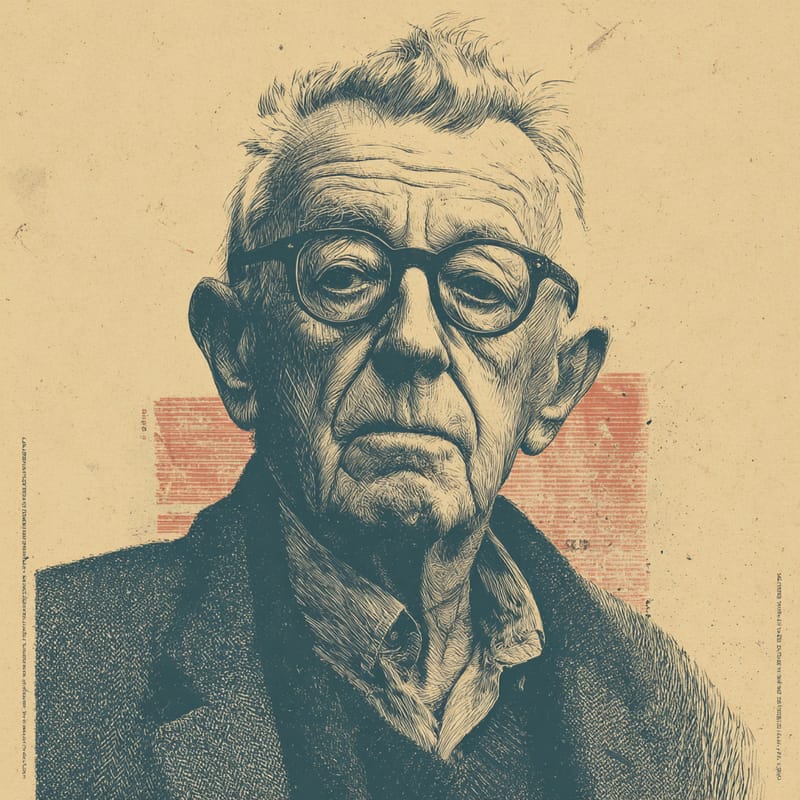
Eric Hobsbawm
The age of revolution
Marxist history of the modern world.
Reformist Orthodox MarxistOne of 729 ideologies · enter the Orthodox Marxist hall →- Role
- Historian
- Era
- 1917–2012
- Region
- United Kingdom
- Social band
- Reformist
- Placement
- −90 · 0 · +42
§ Where Eric Hobsbawm stands
3 axesHobsbawm remained committed to socialism and the labour movement all his life. His four 'Age of' volumes treated industrial capitalism as the motor of modern history and its crises as structural, and in How to Change the World (2011) he argued that the 2008 financial crash had made Marx's analysis relevant again. He accepted that Soviet central planning had failed, but never abandoned the case against capitalism.
Hobsbawm was a lifelong Communist Party member who nonetheless distanced himself from Soviet orthodoxy, sympathising with the reformist Eurocommunism of the Italian party. He signed a 1956 letter protesting at the British party's support for the Soviet invasion of Hungary yet stayed in, and his 1978 lecture urged the left to build broad democratic alliances rather than await revolution.
Hobsbawm was a cosmopolitan, secular progressive who wrote sympathetically about peasants, workers and outlaws in Primitive Rebels (1959) and Bandits (1969). The Invention of Tradition (1983), which he edited with Terence Ranger, showed how supposedly ancient customs were often recent creations, and Nations and Nationalism since 1780 (1990) treated nationalism with the scepticism of an internationalist.
How close are you to Eric Hobsbawm?
Three statements, one per axis. Answer them and we’ll drop you on the compass next to them.
§ The story
HistoricalEric Hobsbawm (1917–2012) was a British historian, widely regarded as one of the most influential Marxist historians of the twentieth century. Born in Alexandria to a British father and an Austrian mother, he grew up in Vienna and Berlin, where as an orphaned teenager he joined a communist school students' group before moving to London in 1933. He studied at King's College, Cambridge, joined the Communist Party of Great Britain in 1936 and taught for most of his career at Birkbeck College, London, later serving as its president.
Hobsbawm's four volumes from The Age of Revolution (1962) to The Age of Extremes (1994) told the history of the modern world through the rise and crisis of capitalism, and his work on bandits, invented traditions and nationalism shaped whole fields. He stayed in the Communist Party until it dissolved in 1991, even after the Soviet invasion of Hungary drove many colleagues out, which critics regarded as a moral failure. His 1978 lecture 'The Forward March of Labour Halted?' influenced Labour's later modernisers, and he was made a Companion of Honour in 1998.
Notable for
- 01'The Age of Revolution'
- 02Marxist historiography
- 03Theorist of nationalism
Key works & moments
- 1936Joins the Communist Party of Great Britain as a Cambridge undergraduate.
- 1952Helps found the historical journal Past & Present.
- 1962Publishes The Age of Revolution: Europe 1789–1848.
- 1978Delivers the Marx Memorial Lecture 'The Forward March of Labour Halted?'.
- 1983Co-edits The Invention of Tradition with Terence Ranger.
- 1994The Age of Extremes completes his history of the modern world.
§ Minds closest to Eric Hobsbawm
All minds →

§ Also in the Orthodox Marxist hall
Enter the hall →§ Common questions
4 answersWhat was Eric Hobsbawm's political ideology?
Hobsbawm was a Marxist and lifelong communist of an increasingly democratic, reform-minded kind: on the 99ideologies three-axis compass, a Reformist Orthodox Marxist. Economically he sat at the far left (−90), committed to socialism and the labour movement. On governance he sat at the centre (0), a Communist Party member who rejected Soviet orthodoxy and backed broad democratic alliances, and socially he was progressive (+42), a cosmopolitan internationalist sceptical of nationalism and invented tradition.
Was Eric Hobsbawm left-wing or right-wing?
Left-wing throughout his life. Hobsbawm joined the Communist Party in 1936 and remained a member until it dissolved in 1991, interpreted history through Marx and stayed a critic of capitalism after the fall of the Soviet Union. His politics softened in practice: he admired Italian Eurocommunism and encouraged the British Labour Party to modernise in the 1980s. He was a far-left intellectual in theory and often a pragmatic social democrat in his practical advice.
Why did Eric Hobsbawm stay in the Communist Party?
Out of loyalty to the cause he had embraced as a teenager in Berlin. In his autobiography Interesting Times (2002) Hobsbawm traced that loyalty to his political awakening amid the rise of Nazism and a refusal to repudiate the commitment he made then. He criticised the 1956 invasion of Hungary but remained a member until the party dissolved in 1991. Critics saw this as an evasion of Stalin's crimes, and a 1994 BBC interview in which he agreed that millions of deaths might have been justified had they produced a true communist society deepened the controversy.
Which minds are closest to Eric Hobsbawm?
On the 99ideologies three-axis compass, the minds closest to Eric Hobsbawm are Max Horkheimer (99% alike), Theodor Adorno (98% alike) and Herbert Marcuse (97% alike). The furthest is Adam Sutler (3% alike).