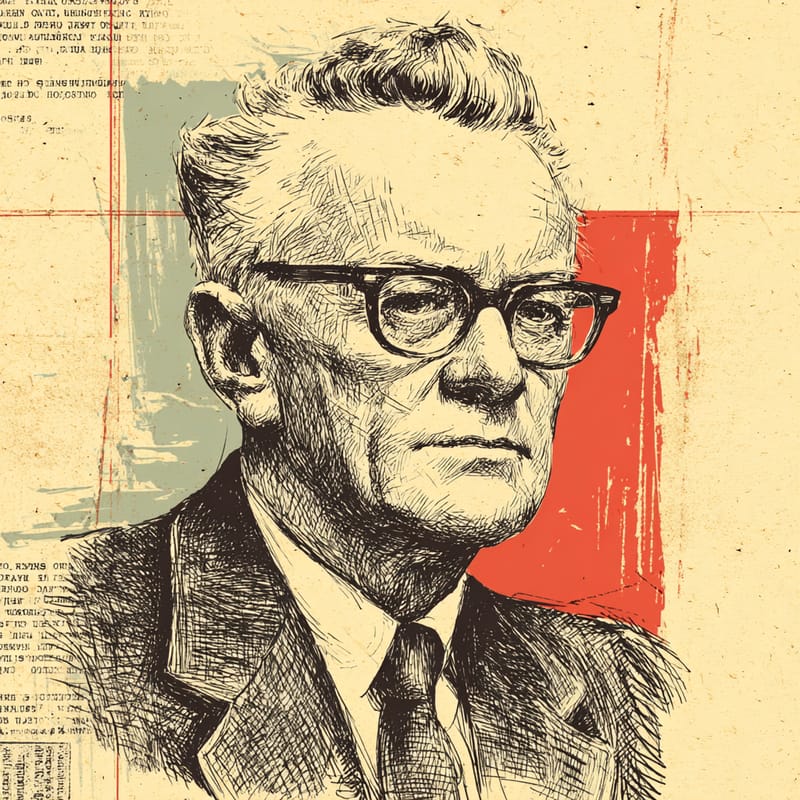
Edvard Kardelj
Architect of self-management
Built Yugoslavia's market-socialist system.
Heterodox Market SocialistOne of 729 ideologies · enter the Market Socialist hall →- Role
- Theorist & politician
- Era
- 1910–1979
- Region
- Yugoslavia
- Social band
- Heterodox
- Placement
- −78 · +6 · +25
§ Where Edvard Kardelj stands
3 axesKardelj designed an economy in which enterprises were socially owned and run by elected workers' councils, starting with the 1950 law on workers' management and culminating in the 1976 Law on Associated Labour. Firms traded in markets, but private ownership of large-scale capital was excluded and the party shaped investment, placing him far to the left while short of Soviet-style central planning.
He pushed power down from the federal state to republics, communes and enterprises, most dramatically in the 1974 constitution, and in his late writings spoke of a pluralism of self-managing interests. Yet he never accepted competing parties and remained a pillar of the League of Communists' monopoly on power, which offsets his decentralism and leaves him just on the authoritarian side of the centre.
Kardelj was a secular Marxist moderniser who saw self-management as the path to a classless society in which the state would eventually wither away. His regime promoted mass education, legal equality for women and rapid industrialisation, but it suppressed religious and nationalist expression, a mix of modernising and controlling impulses that places him moderately on the progressive side.
How close are you to Edvard Kardelj?
Three statements, one per axis. Answer them and we’ll drop you on the compass next to them.
§ The story
HistoricalEdvard Kardelj (1910–1979) was a Slovene communist revolutionary and, for three decades, one of the most powerful men in Tito's Yugoslavia. Born in Ljubljana, he joined the illegal Communist Party as a young man, was imprisoned in the early 1930s and trained in the Soviet Union before helping lead the Slovene Liberation Front and the Partisan resistance during the Second World War. After 1945 he served as deputy prime minister, as foreign minister from 1948 to 1953 and later as president of the Federal Assembly, and was the regime's leading ideologist.
Kardelj was the principal architect of workers' self-management, the system Yugoslavia adopted after Tito's 1948 break with Stalin, and he shaped the constitutional law of 1953, the constitutions of 1963 and 1974 and the 1976 Law on Associated Labour. His theory of associated labour aimed to replace both capitalist ownership and Soviet state control with decentralised social ownership. He also helped build and run a one-party state that killed and imprisoned opponents after the war and sent suspected Stalin loyalists to the Goli Otok prison camp. He died in 1979, a year before Tito.
Notable for
- 01Architect of self-management
- 02Yugoslav constitutional theory
- 03Decentralised socialism
Key works & moments
- 1941Helps lead the Slovene Liberation Front and Partisan resistance against Axis occupation.
- 1948After Tito's split with Stalin, becomes foreign minister and begins building a distinct Yugoslav socialism.
- 1950A law on workers' councils, which he helped design, launches self-management in Yugoslav enterprises.
- 1963Becomes president of the Federal Assembly as a new constitution extends self-management.
- 1974Shapes a new constitution that decentralises power to the republics and autonomous provinces.
- 1976The Law on Associated Labour codifies his theory of self-managed social ownership.
§ Minds closest to Edvard Kardelj
All minds →

§ Also in the Market Socialist hall
Enter the hall →§ Common questions
4 answersWhat was Edvard Kardelj's political ideology?
Edvard Kardelj was a Yugoslav communist and the chief theorist of self-managed socialism: on the 99ideologies three-axis compass, a Heterodox Market Socialist. Economically he sat far to the left (−78), replacing private and state ownership with social ownership run by workers' councils trading in markets. On governance he sits just on the authoritarian side of the centre (+6), decentralising power while defending one-party rule, and socially he was moderately progressive (+25), a secular moderniser.
Was Edvard Kardelj left-wing or right-wing?
Left-wing. Kardelj was a lifelong Marxist revolutionary who fought in the communist-led Partisan war and spent his career building a socialist state. His heterodoxy lay in rejecting the Soviet model after 1948: he argued that state ownership and central planning bred bureaucracy, and that genuine socialism meant workers managing enterprises themselves. That made him a leading figure of non-Soviet communism, though always within a one-party system that tolerated no organised opposition.
Did Edvard Kardelj create Yugoslav workers' self-management?
He was its principal architect, though not alone. After Tito's break with Stalin in 1948, Kardelj, Milovan Đilas and Boris Kidrič developed the idea of handing enterprise management to elected workers' councils, introduced by law in 1950. Kardelj then spent nearly three decades elaborating the system in constitutional law, from the 1953 reforms to the 1974 constitution and the 1976 Law on Associated Labour, which makes him its chief theorist and legal designer.
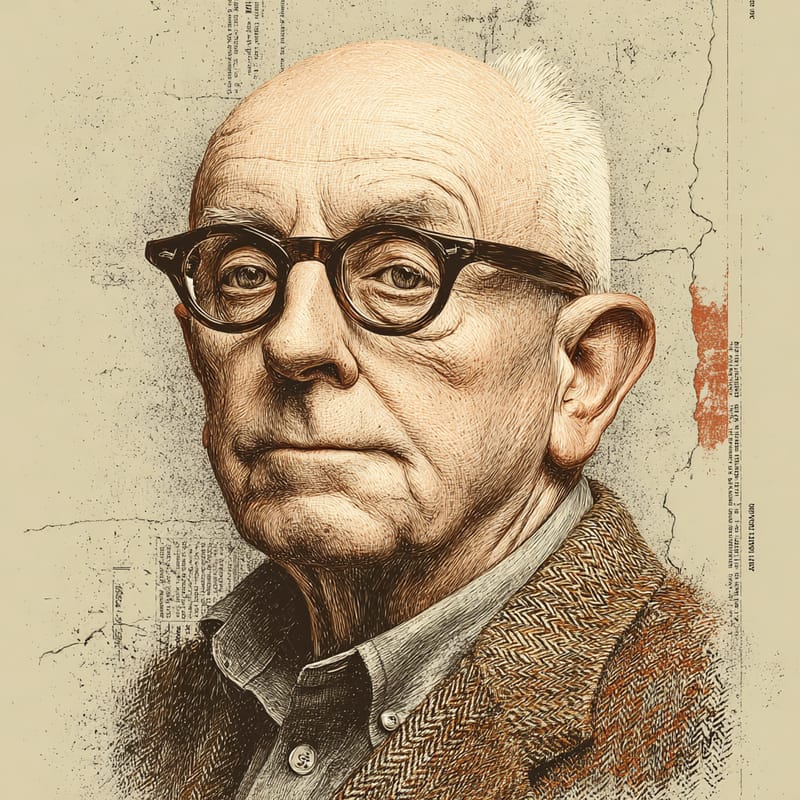
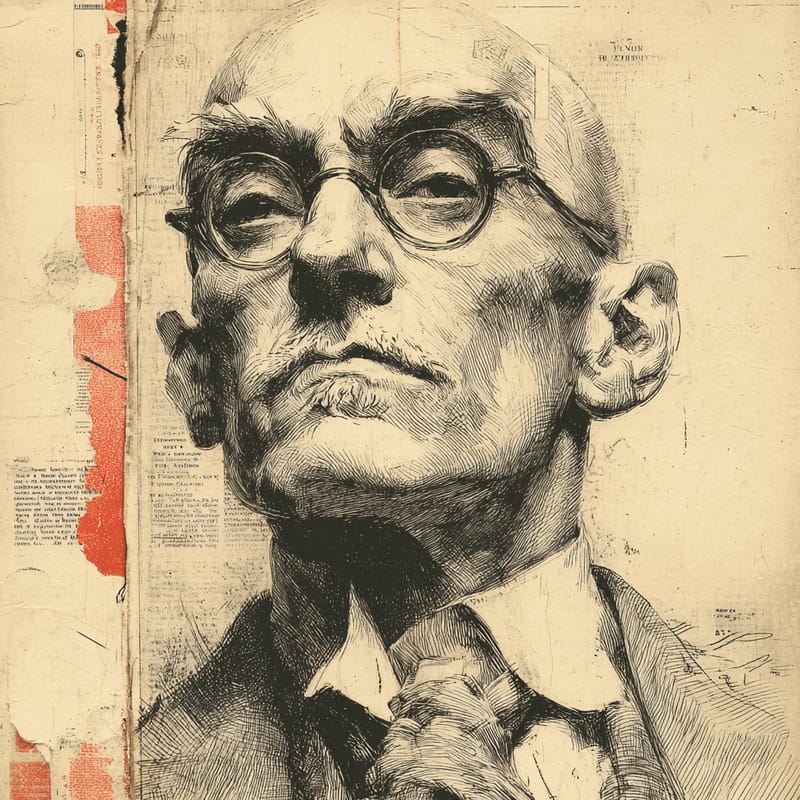
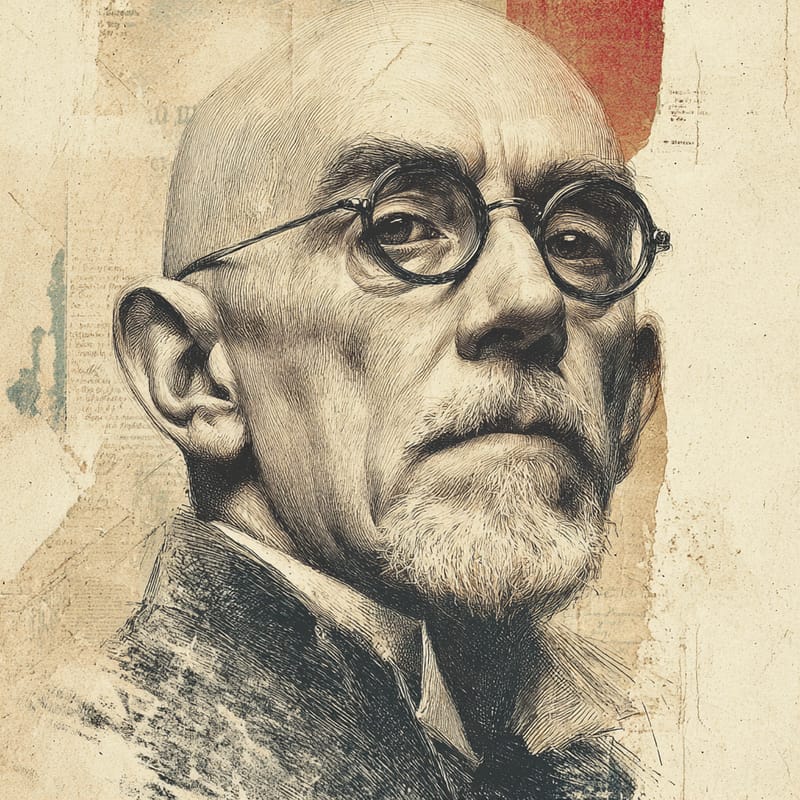
Which minds are closest to Edvard Kardelj?
On the 99ideologies three-axis compass, the minds closest to Edvard Kardelj are Oskar Lange (96% alike), Branko Horvat (96% alike) and Jaroslav Vanek (95% alike). The furthest is Adam Sutler (11% alike).