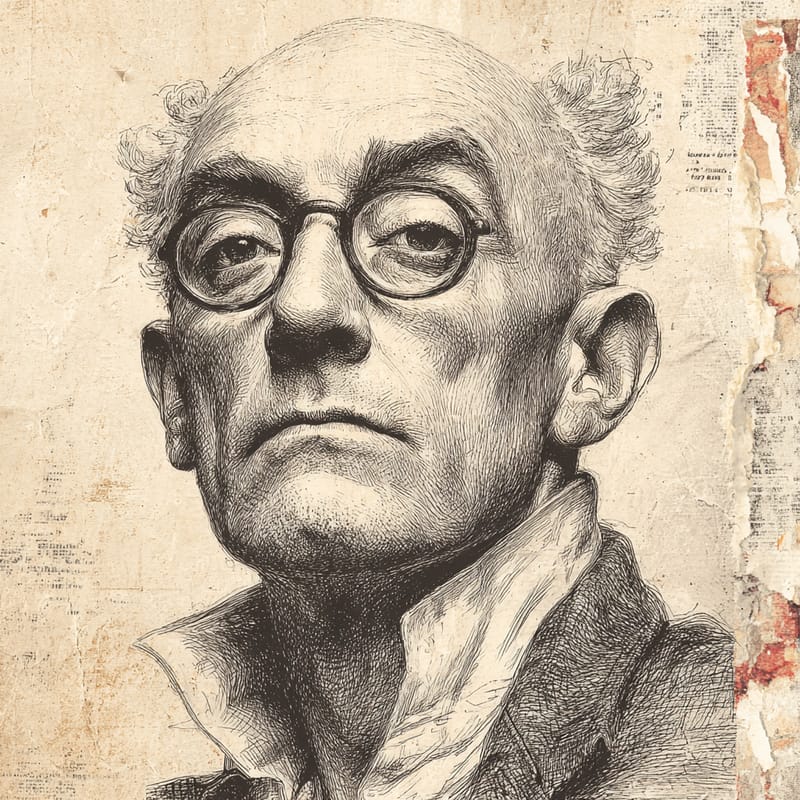
Louis Althusser
Ideological state apparatuses
A structuralist rereading of Marx.
Heterodox Orthodox MarxistOne of 729 ideologies · enter the Orthodox Marxist hall →- Role
- Philosopher
- Era
- 1918–1990
- Region
- France
- Social band
- Heterodox
- Placement
- −90 · −4 · +30
§ Where Louis Althusser stands
3 axesAlthusser defended the core of Marxist economics against revisionists, insisting in Reading Capital (1965) that Capital was a scientific analysis of the capitalist mode of production. His concept of overdetermination, set out in For Marx (1965), complicated simple economic determinism but kept the economy decisive 'in the last instance', and he never wavered from the goal of abolishing capitalist property relations.
Althusser's 1970 essay on ideological state apparatuses analysed how power works not only through police and courts but through schools, churches and families that secure consent to the existing order. He stayed in the French Communist Party all his life, yet attacked its leadership publicly in 1978 in What Must Change in the Party, a mix of loyalty and dissent that leaves him near the centre of this axis.
Althusser's progressivism was theoretical rather than activist. The 'theoretical anti-humanism' of For Marx (1965) rejected appeals to human nature as bourgeois ideology, while his 1970 theory of interpellation, the process by which ideology hails individuals as subjects, gave feminists, film theorists and cultural critics tools for analysing gender, race and media from the 1970s onwards.
How close are you to Louis Althusser?
Three statements, one per axis. Answer them and we’ll drop you on the compass next to them.
§ The story
HistoricalLouis Althusser (1918–1990) was a French Marxist philosopher who taught for more than three decades at the École normale supérieure in Paris. Born in French Algeria and raised a Catholic, he won a place at the school in 1939 but spent most of the Second World War as a prisoner of war in Germany. He joined the French Communist Party in 1948 and, as a teacher of philosophy at the école, influenced a generation of thinkers including Étienne Balibar, Jacques Rancière and Alain Badiou.
Althusser's For Marx and the collective Reading Capital, both published in 1965, recast Marxism as a science purged of humanism, and his 1970 essay on ideological state apparatuses explained how schools, churches, families and media reproduce capitalist society. His influence on literary theory, cultural studies and political philosophy was enormous through the 1970s. In November 1980, during a bout of severe mental illness, he strangled his wife, the sociologist Hélène Rytmann; he was found unfit to stand trial, confined to a psychiatric hospital, and spent much of his last decade in psychiatric care.
Notable for
- 01'Ideological State Apparatuses'
- 02Structuralist Marxism
- 03'Reading Capital'
Key works & moments
- 1940–45Held as a prisoner of war in a German camp.
- 1948Joins the French Communist Party and begins teaching philosophy at the École normale supérieure.
- 1965Publishes For Marx and, with his students, Reading Capital.
- 1970Publishes 'Ideology and Ideological State Apparatuses'.
- 1978Publishes a sharp public critique of the Communist Party's leadership.
- 1980Kills his wife, Hélène Rytmann, during a mental breakdown; declared unfit to stand trial.
In their own words
“Ideology represents the imaginary relationship of individuals to their real conditions of existence.”
§ Minds closest to Louis Althusser
All minds →


§ Also in the Orthodox Marxist hall
Enter the hall →§ Common questions
4 answersWhat was Louis Althusser's political ideology?
Althusser was a structuralist Marxist and lifelong communist: on the 99ideologies three-axis compass, a Heterodox Orthodox Marxist. Economically he sat at the far left (−90), defending Marx's Capital as the science of capitalist exploitation. On governance he sat near the centre (−4), analysing how state and ideological institutions reproduce power while remaining a critical member of the French Communist Party, and socially he was progressive (+30), a theorist of the academic left.
Was Louis Althusser left-wing or right-wing?
Left-wing. Althusser was a member of the French Communist Party from 1948 until his death and devoted his work to renewing Marxist theory. Within the left he was a distinctive figure: he opposed the humanist and reformist Marxism popular after 1956, drew on Mao's writings on contradiction, and was sceptical of the spontaneous revolt of May 1968, yet he also criticised his own party's leadership. His ideas became central to the academic left in the 1970s.
What are ideological state apparatuses?
They are Althusser's term for the institutions that secure people's acceptance of capitalism without force. In his 1970 essay he distinguished the repressive state apparatus, such as the police, courts and army, from ideological state apparatuses, such as schools, churches, families, the media and trade unions, which shape how people see themselves and the world. Through interpellation, ideology 'hails' individuals as subjects who accept their place. He argued that the school had become the dominant ideological apparatus of modern capitalism.
Which minds are closest to Louis Althusser?
On the 99ideologies three-axis compass, the minds closest to Louis Althusser are Paul Sweezy (98% alike), Karl Korsch (96% alike) and György Lukács (96% alike). The furthest is Adam Sutler (5% alike).