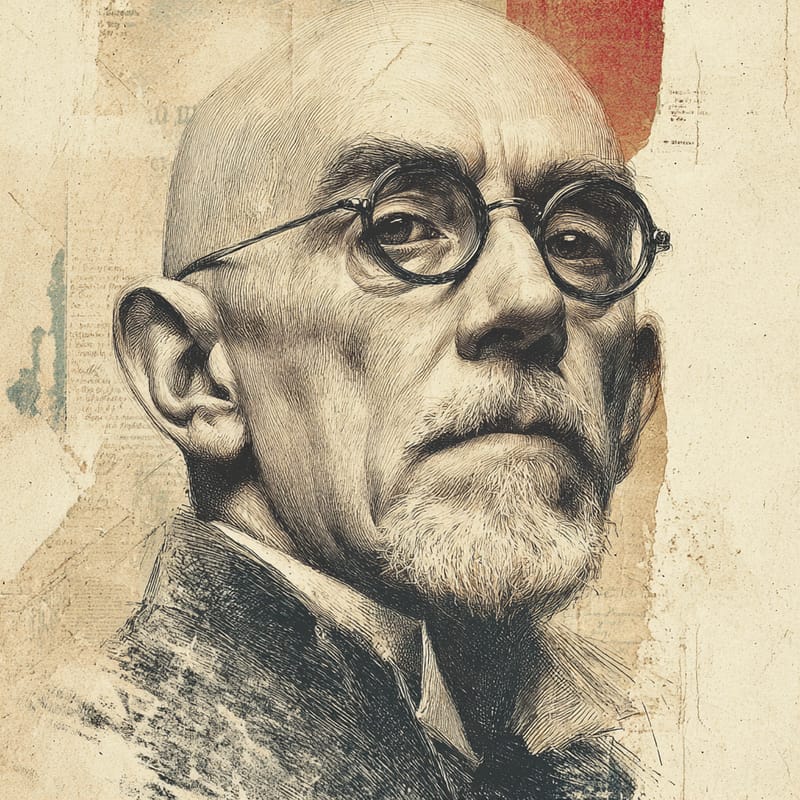
György Lukács
History and class consciousness
Marxism as a philosophy of totality.
Heterodox Orthodox MarxistOne of 729 ideologies · enter the Orthodox Marxist hall →- Role
- Philosopher
- Era
- 1885–1971
- Region
- Hungary
- Social band
- Heterodox
- Placement
- −90 · +6 · +32
§ Where György Lukács stands
3 axesLukács never wavered from the goal of a classless, collectively owned economy. History and Class Consciousness (1923) argued that capitalist commodity exchange produces reification, turning relations between people into relations between things, which only proletarian revolution and social ownership could overcome. He served the 1919 Hungarian Soviet Republic, which nationalised industry, banks and large estates.
Lukács's relationship to power was ambivalent. He held office in the 1919 Soviet Republic and later accommodated Stalinism in Moscow, recanting his own work when the party demanded it; yet his 1928 Blum Theses argued for a democratic transitional stage, and in 1956 he joined Imre Nagy's reform government. The balance places him close to the centre of this axis, slightly on the authoritarian side.
Lukács was a humanist progressive who saw culture as a weapon against fascism and irrationalism. The Destruction of Reason (1954) traced a line of German irrationalist philosophy that he believed culminated in Hitler, and The Historical Novel (1937) prized literature that exposed social contradictions, though his hostility to modernists such as Kafka and Joyce made his literary tastes conservative in form.
How close are you to György Lukács?
Three statements, one per axis. Answer them and we’ll drop you on the compass next to them.
§ The story
HistoricalGyörgy Lukács (1885–1971) was a Hungarian philosopher and literary critic, widely regarded as the founder of Western Marxism. Born into a wealthy Jewish banking family in Budapest, he studied in Berlin and Heidelberg, where he moved in the circles of Georg Simmel and Max Weber and wrote The Theory of the Novel. He joined the Hungarian Communist Party in December 1918 and served as people's commissar for education in Béla Kun's short-lived Soviet Republic in 1919, then fled into exile in Vienna.
History and Class Consciousness (1923), with its theory of reification and its stress on totality and class consciousness, revived the Hegelian roots of Marxism and inspired the Frankfurt School, but the Comintern condemned it and Lukács later distanced himself from it. He survived the Stalin years in Moscow by accommodating the party line while writing major studies of realism and the historical novel. In 1956 he served as culture minister in Imre Nagy's reform government, was deported to Romania after the Soviet invasion, and spent his last years in Budapest working on an ontology of social being.
Notable for
- 01'History and Class Consciousness'
- 02Theory of reification
- 03Marxist aesthetics
Key works & moments
- 1916Publishes The Theory of the Novel.
- 1919Serves as people's commissar for education in the Hungarian Soviet Republic.
- 1923Publishes History and Class Consciousness, a founding text of Western Marxism.
- 1937Completes The Historical Novel in Moscow exile.
- 1954Publishes The Destruction of Reason, an attack on German irrationalist philosophy.
- 1956Becomes culture minister in Imre Nagy's government; deported to Romania after the Soviet invasion.
In their own words
“Orthodox Marxism, therefore, does not imply the uncritical acceptance of the results of Marx's investigations. It is not the 'belief' in this or that thesis, nor the exegesis of a 'sacred' book. On the contrary, orthodoxy refers exclusively to method.”
§ Minds closest to György Lukács
All minds →

§ Also in the Orthodox Marxist hall
Enter the hall →§ Common questions
4 answersWhat was György Lukács's political ideology?
Lukács was a Hegelian Marxist and communist philosopher: on the 99ideologies three-axis compass, a Heterodox Orthodox Marxist. Economically he sat at the far left (−90), committed to revolution and collective ownership. On governance he sat near the centre (+6), oscillating between party loyalty under Stalin and reform communism in 1956, and socially he was progressive (+32), a humanist critic of fascism and irrationalism, though conservative in his literary tastes.
Was György Lukács left-wing or right-wing?
Left-wing: Lukács was a communist from 1918 until his death, served in two revolutionary governments and spent his life developing Marxist philosophy. He belonged to the movement's intellectual and often dissident wing rather than its apparatus: his early masterpiece was condemned by the Comintern, and he sided with Imre Nagy in 1956. That mix of loyalty and heresy is why he is remembered both as a founder of Western Marxism and as a compromised servant of the party.
What is reification according to Lukács?
Reification is Lukács's term for the way capitalism makes social relations between people appear as relations between things. In 'Reification and the Consciousness of the Proletariat', the central essay of History and Class Consciousness (1923), he extended Marx's idea of commodity fetishism to argue that market exchange and bureaucratic rationalisation turn human activity, and even consciousness, into calculable objects. Lukács believed only the proletariat, grasping society as a totality, could see through reification, an idea that deeply shaped the Frankfurt School.
Which minds are closest to György Lukács?
On the 99ideologies three-axis compass, the minds closest to György Lukács are Karl Korsch (99% alike), Paul Sweezy (97% alike) and Louis Althusser (96% alike). The furthest is Adam Sutler (6% alike).