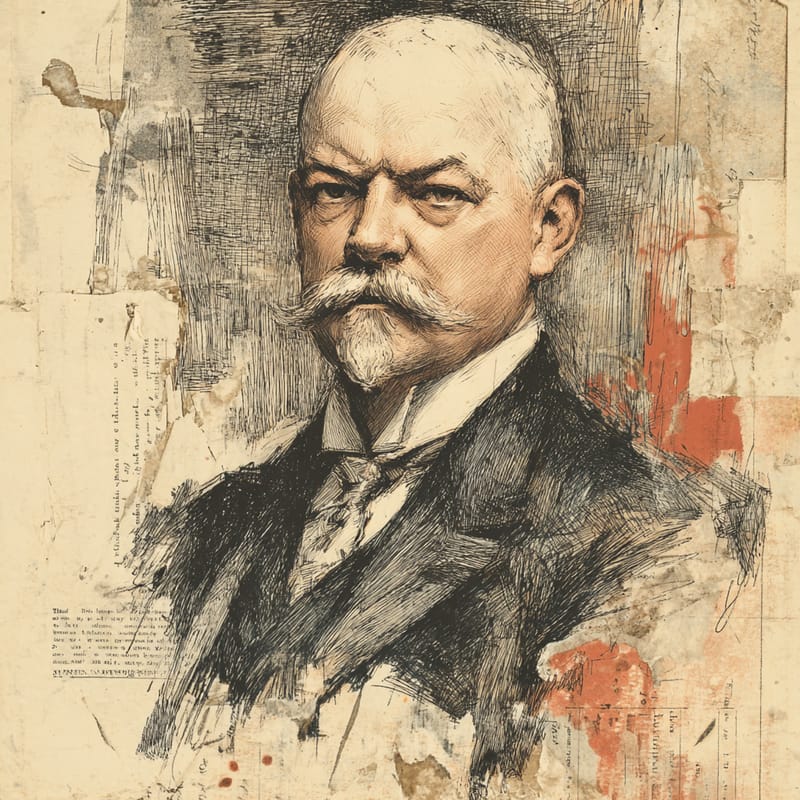
Hiram Johnson
Kick out the railroads
Direct democracy on the Pacific coast.
Reformist ProgressiveOne of 729 ideologies · enter the Progressive hall →- Role
- Governor & Senator
- Era
- 1866–1945
- Region
- United States
- Social band
- Reformist
- Placement
- −44 · −52 · +42
§ Where Hiram Johnson stands
3 axesJohnson's central economic cause was breaking monopoly power, above all the Southern Pacific's control of rates and politicians. The Public Utilities Act of 1911 gave the state Railroad Commission power to set rates for railroads and utilities, and his administration added workers' compensation and an eight-hour day for women. He later backed parts of Franklin Roosevelt's New Deal while remaining a Republican defender of private enterprise.
Johnson believed the cure for machine politics was more democracy. In a special election in October 1911 Californians approved his programme of the initiative, referendum and recall, letting voters write laws, overturn statutes and remove officials, and his government made local offices nonpartisan and introduced cross-filing in primaries. Those measures shifted lasting power from parties and legislators to voters.
Johnson backed votes for women, which California's male electorate approved in 1911, and reforms protecting women and child workers. His progressivism was bounded by the nativism of his era: he signed the 1913 Alien Land Law targeting Japanese immigrants, and his later isolationism reflected a deep suspicion of foreign entanglements.
How close are you to Hiram Johnson?
Three statements, one per axis. Answer them and we’ll drop you on the compass next to them.
§ The story
HistoricalHiram Warren Johnson (1866–1945) was a Californian lawyer and politician, born in Sacramento, who rose to fame by taking over the San Francisco graft prosecutions in 1908 after the chief prosecutor was shot in court. Elected governor of California in 1910 on a pledge to break the Southern Pacific Railroad's grip on state politics, he served until 1917 and was Theodore Roosevelt's running mate on the Progressive ticket in 1912. He then sat in the US Senate from 1917 until his death.
Johnson's governorship remade California's political system: voters adopted the initiative, referendum and recall and women's suffrage in 1911, and his administration regulated utilities and protected workers. Those direct-democracy tools still shape the state, from tax revolts to the recall of a governor in 2003. His record also included the 1913 Alien Land Law, aimed at Japanese immigrant farmers. In the Senate he became a leading isolationist, fighting the League of Nations in 1919 and sponsoring the 1934 Johnson Act against loans to governments in default on war debts.
Notable for
- 01Initiative, referendum and recall
- 02Broke the railroad machine
- 03TR's 1912 running mate
Key works & moments
- 1908Takes over the San Francisco graft prosecution after prosecutor Francis Heney is shot in court.
- 1910Elected governor of California pledging to kick the Southern Pacific Railroad out of politics.
- 1911Californians adopt the initiative, referendum, recall and women's suffrage in a special election.
- 1912Runs for vice-president as Theodore Roosevelt's Progressive Party running mate.
- 1913Signs the Alien Land Law, aimed at stopping Japanese immigrants from owning farmland.
- 1919Leads 'irreconcilable' Senate opposition to the Treaty of Versailles and the League of Nations.
§ Minds closest to Hiram Johnson
All minds →


§ Also in the Progressive hall
Enter the hall →§ Common questions
4 answersWhat was Hiram Johnson's political ideology?
Hiram Johnson was a Progressive Republican reformer: on the 99ideologies three-axis compass, a Reformist Progressive. Economically he sat left of centre (−44), breaking the Southern Pacific's monopoly power, regulating utilities and introducing workers' compensation. On governance he leaned libertarian (−52), giving Californians the initiative, referendum and recall to bypass party machines. Socially he was moderately progressive (+42), backing women's suffrage while signing an anti-Japanese land law and later championing isolationism.
Was Hiram Johnson left-wing or right-wing?
Left of centre in his reforming years, though he remained largely a Republican. As governor he attacked corporate control of politics, regulated railroads and utilities and expanded democracy, positions on the progressive wing of American politics, and he endorsed Franklin Roosevelt in 1932. He later broke with Roosevelt over the 1937 court-packing plan and foreign policy, and his nativism and isolationism aligned with the right. He is best remembered as a populist reformer.
Why does California have the recall?
Largely because of Hiram Johnson. Elected governor in 1910 on a promise to end the Southern Pacific Railroad's domination of state politics, Johnson argued that voters needed tools to check corrupt legislators and officials. In October 1911 Californians approved constitutional amendments creating the initiative, referendum and recall. The recall removed a sitting governor for the first time in 2003, when Gray Davis was replaced by Arnold Schwarzenegger, and the initiative process has produced landmark measures such as Proposition 13.
Which minds are closest to Hiram Johnson?
On the 99ideologies three-axis compass, the minds closest to Hiram Johnson are Frances Willard (95% alike), Theodore Roosevelt (94% alike) and Robert La Follette (94% alike). The furthest is Adam Sutler (5% alike).