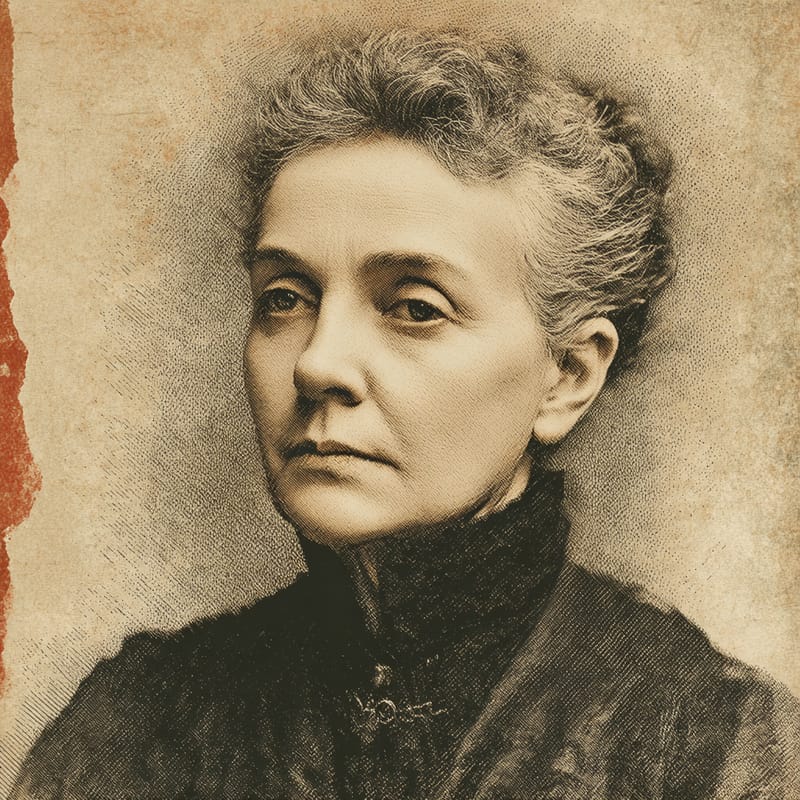
Jane Addams
The settlement house
Democracy lived in the neighbourhood.
ProgressiveOne of 729 ideologies · enter the Progressive hall →- Role
- Reformer & social worker
- Era
- 1860–1935
- Region
- United States
- Social band
- Progressive
- Placement
- −52 · −46 · +68
§ Where Jane Addams stands
3 axesAddams wanted government to protect workers and the urban poor, and Hull House residents led by Florence Kelley helped win Illinois's 1893 Factory Act, which limited child labour and women's working hours. In her essay A Modern Lear she sympathised with the Pullman strikers of 1894, yet she never joined the Socialist Party, seeking reform and conciliation rather than the abolition of capitalism.
Addams treated democracy as a way of living together, not only a system of government: Democracy and Social Ethics (1902) argued that reformers must work with the poor rather than for them. She practised that ethic as a neighbourhood garbage inspector in the 1890s, served on Chicago's school board and helped found the American Civil Liberties Union in 1920.
Addams was a pioneering progressive on almost every front: she served as a vice-president of the National American Woman Suffrage Association, helped found the NAACP in 1909, welcomed immigrants as neighbours rather than problems, and led the Women's International League for Peace and Freedom from 1919. Her pacifism during the First World War cost her public standing for years.
How close are you to Jane Addams?
Three statements, one per axis. Answer them and we’ll drop you on the compass next to them.
§ The story
HistoricalLaura Jane Addams (1860–1935) was an American social reformer, born into a prosperous family in Cedarville, Illinois. After graduating from Rockford Female Seminary and visiting Toynbee Hall, the pioneering settlement house in London's East End, she co-founded Hull House in Chicago in 1889 with Ellen Gates Starr. It grew into a complex of clubs, classes, a kindergarten and social services for the city's immigrant poor, and a base for women reformers who pressed for new labour and welfare laws.
Addams became one of the most admired women in America and a founding figure of social work and of community-based social research. She backed women's suffrage, helped found the NAACP and the American Civil Liberties Union, and seconded Theodore Roosevelt's nomination for the Progressive Party in 1912. Her pacifist opposition to American entry into the First World War made her one of the most vilified figures in the country for a time, but in 1931 she became the first American woman to win the Nobel Peace Prize.
Notable for
- 01Founded Hull House
- 02Nobel Peace Prize, 1931
- 03Women's suffrage and peace movements
Key works & moments
- 1889Co-founds Hull House on Chicago's Near West Side with Ellen Gates Starr.
- 1893Hull House reformers help win Illinois's Factory Act limiting child labour and women's hours.
- 1909Joins the founders of the National Association for the Advancement of Colored People.
- 1912Seconds Theodore Roosevelt's nomination at the Progressive Party convention.
- 1915Chairs the International Congress of Women at The Hague, seeking mediation to end the First World War.
- 1931Becomes the first American woman awarded the Nobel Peace Prize.
§ Minds closest to Jane Addams
All minds →


§ Also in the Progressive hall
Enter the hall →§ Common questions
4 answersWhat was Jane Addams's political ideology?
Jane Addams was a Progressive Era social reformer and pacifist: on the 99ideologies three-axis compass, a Progressive. Economically she sat left of centre (−52), supporting labour laws, public services and unions while stopping short of socialism. On governance she leaned libertarian (−46), building democracy from the neighbourhood up and defending civil liberties. Socially she was strongly progressive (+68), campaigning for women's suffrage, racial equality, immigrant welfare and peace.
Was Jane Addams left-wing or right-wing?
Left of centre, in the reformist rather than revolutionary sense. Addams pushed for factory laws, juvenile courts, women's suffrage and civil rights, and she backed Theodore Roosevelt's Progressive Party in 1912. She sympathised with labour and counted socialists among her friends, but she never joined their party, preferring conciliation between classes and practical reform. Her pacifism during the First World War also put her at odds with mainstream patriotic opinion, earning attacks from the right.
Why did Jane Addams win the Nobel Peace Prize?
For decades of work for international peace. Addams chaired the International Congress of Women at The Hague in 1915, which sought mediation to end the First World War, and from 1919 she was the first president of the Women's International League for Peace and Freedom. Her opposition to American entry into the war had made her deeply unpopular, but by 1931 opinion had shifted, and she shared the prize with Nicholas Murray Butler, becoming the first American woman to receive it.
Which minds are closest to Jane Addams?
On the 99ideologies three-axis compass, the minds closest to Jane Addams are Lisa Simpson (99% alike), John Dewey (97% alike) and Upton Sinclair (95% alike). The furthest is Adam Sutler (0% alike).