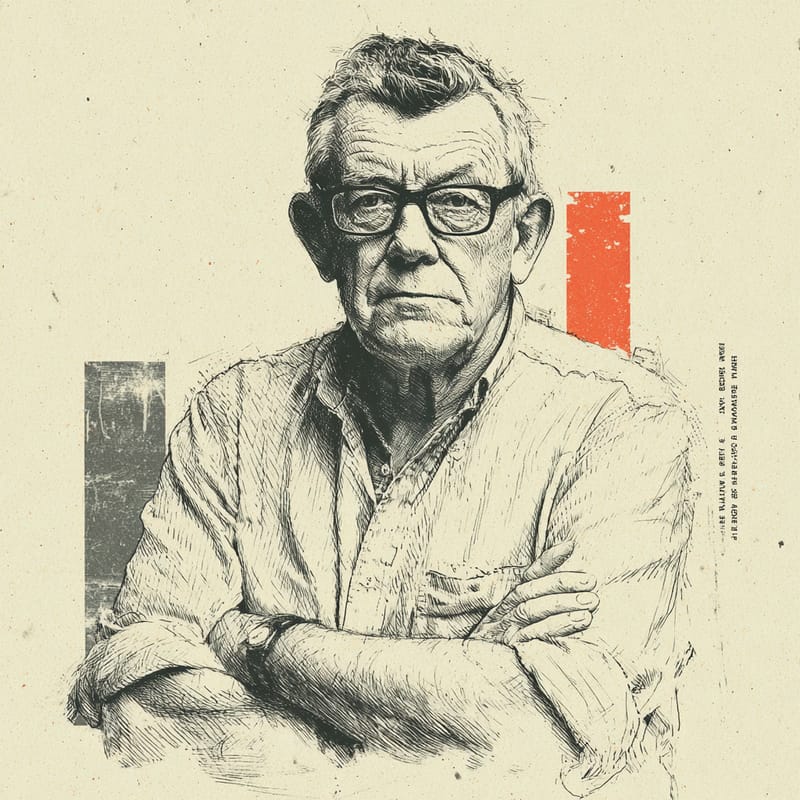
Hans Rosling
Factfulness
Reason, data, and global progress.
Reformist Nordic LiberalOne of 729 ideologies · enter the Nordic Liberal hall →- Role
- Physician & statistician
- Era
- 1948–2017
- Region
- Sweden
- Social band
- Reformist
- Placement
- −24 · −44 · +46
§ Where Hans Rosling stands
3 axesRosling credited economic growth, trade and technology with lifting billions out of extreme poverty, which kept him well away from anti-market politics. But he stressed that public investment in health, education, family planning and electricity came first, arguing in his talks of the 2000s that falling child mortality drives development, and he often used Sweden's own rise from poverty as an example.
A liberal pragmatist, Rosling distrusted ideology on both left and right and asked that policy follow evidence. Factfulness (2018) warns against the urgency and blame instincts that push societies toward drastic, poorly considered measures, and while he noted that democracy was not a precondition for growth, he defended liberal democracy as the best way to govern.
Rosling was a humane internationalist who attacked the us-and-them picture of rich and poor countries, insisting that most of humanity lives in middle-income countries. He championed girls' education, contraception and global health equity, and his message that the world is getting better while still being bad aimed to replace fear and prejudice with factual understanding.
How close are you to Hans Rosling?
Three statements, one per axis. Answer them and we’ll drop you on the compass next to them.
§ The story
LivingHans Rosling (1948–2017) was a Swedish physician, statistician and public educator, born in Uppsala. After studying medicine and statistics, he worked from 1979 to 1981 as a district medical officer in Nacala, Mozambique, where he investigated an outbreak of the paralytic disease konzo, the subject of his doctorate. He later became professor of international health at the Karolinska Institutet, helped found the Swedish branch of Médecins Sans Frontières, and in 2005 co-founded the Gapminder Foundation with his son Ola and daughter-in-law Anna Rosling Rönnlund.
Rosling became famous for animated bubble charts, built with Gapminder's Trendalyzer software, that showed falling child mortality and rising incomes across the world, first in a celebrated 2006 TED talk and then in lectures and BBC documentaries. He argued that most people, experts included, hold an outdated, overdramatic picture of a world split into rich and poor. His posthumous book Factfulness (2018) became a global best-seller, though some critics argued that his optimism understated inequality and environmental risk.
Notable for
- 01'Factfulness'
- 02Co-founded Gapminder
- 03Viral data lectures
Key works & moments
- 1979–81Serves as a district medical officer in Nacala, northern Mozambique.
- 1981Investigates a paralysis outbreak in Mozambique, linking it to cyanide in poorly processed cassava.
- 2005Co-founds the Gapminder Foundation with Ola Rosling and Anna Rosling Rönnlund.
- 2006His TED talk on global development statistics becomes a worldwide hit.
- 2014Works in Liberia during the West African Ebola epidemic.
- 2018Factfulness, co-written with his son and daughter-in-law, is published after his death.
§ Minds closest to Hans Rosling
All minds →

§ Also in the Nordic Liberal hall
Enter the hall →§ Common questions
4 answersWhat was Hans Rosling's political ideology?
Hans Rosling was an evidence-driven liberal internationalist: on the 99ideologies three-axis compass, a Reformist Nordic Liberal. Economically he sat slightly left of centre (−24), welcoming growth and trade while stressing public investment in health, education and family planning. On governance he leaned libertarian (−44), a pragmatic liberal democrat wary of ideological crusades and drastic measures. Socially he was progressive (+46), a humane globalist who challenged prejudice about poorer countries.
Was Hans Rosling left-wing or right-wing?
Neither label fits him well, though he leaned toward the liberal centre-left. Rosling's message that markets, trade and growth had cut extreme poverty appealed to free-market optimists, while his emphasis on public health, education, women's rights and global equity drew him toward the Nordic social-liberal tradition. He deliberately avoided partisan politics, insisting that decisions be made from data rather than ideology, and he criticised activists and pessimists across the spectrum for exaggerating.
What is Factfulness about?
Factfulness (2018), written by Hans Rosling with his son Ola Rosling and daughter-in-law Anna Rosling Rönnlund, argues that most people misjudge the state of the world in a systematically negative way. Drawing on Gapminder's surveys, it shows that extreme poverty, child mortality and illiteracy have fallen sharply, and it identifies ten instincts, such as the gap, negativity and fear instincts, that distort our view. Its political point is that good policy needs an accurate picture of progress, not complacency.
Which minds are closest to Hans Rosling?
On the 99ideologies three-axis compass, the minds closest to Hans Rosling are Georg Brandes (98% alike), Birger (the reasonable Scandinavian, archetype) (96% alike) and Johan Norberg (95% alike). The furthest is Adam Sutler (10% alike).