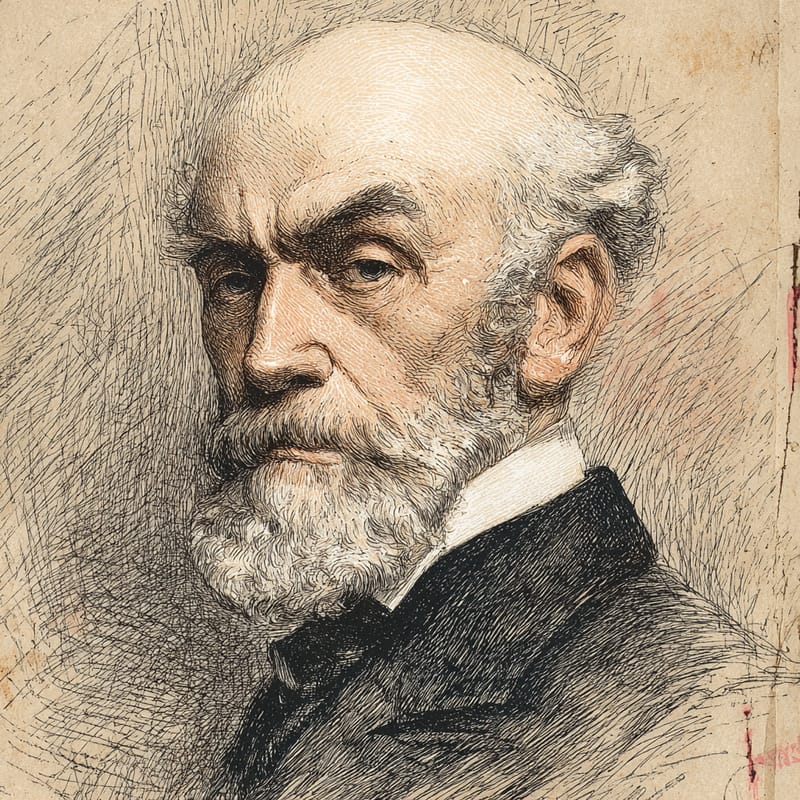
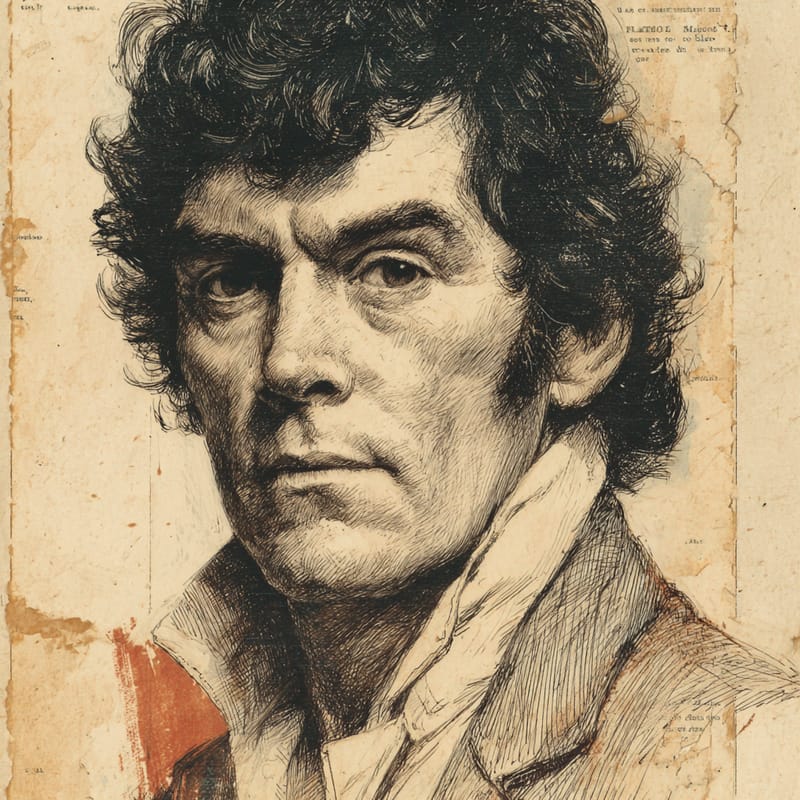
Herbert Spencer
The right to ignore the state
Liberty as the law of equal freedom.
VoluntaristOne of 729 ideologies · enter the Voluntarist hall →- Role
- Philosopher
- Era
- 1820–1903
- Region
- United Kingdom
- Social band
- Centre (no modifier)
- Placement
- +74 · −70 · +10
§ Where Herbert Spencer stands
3 axesSpencer was an uncompromising champion of free markets and voluntary exchange. Social Statics (1851) opposed poor laws, state education, sanitary regulation, tariffs and state control of currency, and The Man Versus the State (1884) condemned housing, factory and welfare legislation as the coming slavery. His early argument that land should belong to the community, which he later abandoned, marks the one exception.
Spencer pushed liberal individualism to its limit. The chapter The Right to Ignore the State in Social Statics (1851) held that, under the law of equal freedom, a citizen may withdraw from the state altogether, declining its protection and its taxes, a position later voluntaryists claimed as their own. In The Man Versus the State (1884) he argued that true liberalism must now limit the powers of parliaments as it had once limited kings.
Socially Spencer was a freethinking individualist rather than a traditionalist. He rejected religious orthodoxy, placing ultimate reality beyond knowledge in First Principles (1862), defended equal rights for women in Social Statics (1851) and opposed militarism, imperialism and the Boer War. Yet he grew more cautious with age, and his evolutionary view of society rejected deliberate social engineering in favour of gradual change.
How close are you to Herbert Spencer?
Three statements, one per axis. Answer them and we’ll drop you on the compass next to them.
§ The story
HistoricalHerbert Spencer (1820–1903) was an English philosopher, sociologist and biologist, one of the most widely read thinkers of the Victorian age. Born in Derby to a Dissenting family and largely self-educated, he worked as a railway engineer and then as a sub-editor at The Economist from 1848 to 1853, before devoting himself to his vast System of Synthetic Philosophy, which sought to explain the physical, biological and social worlds through a single law of evolution. He coined the phrase survival of the fittest in 1864.
Spencer's first book, Social Statics (1851), set out a law of equal freedom and argued, in its chapter The Right to Ignore the State, that a citizen may decline both the protection and the burdens of government. That radical individualism, which he later softened by dropping the chapter, made him a hero to British and American advocates of laissez-faire, and The Man Versus the State (1884) attacked the new Liberal reforms as a road to slavery. Critics tied him to Social Darwinism and to callousness toward the poor; Henry George denounced his retreat from land reform, and his reputation collapsed in the twentieth century.
Notable for
- 01'Social Statics'
- 02'The Right to Ignore the State'
- 03Law of equal freedom
Key works & moments
- 1848Becomes sub-editor of The Economist in London, a post he holds until 1853.
- 1851Publishes Social Statics, including the chapter The Right to Ignore the State.
- 1862Publishes First Principles, opening his System of Synthetic Philosophy.
- 1864Coins the phrase survival of the fittest in The Principles of Biology.
- 1884Publishes The Man Versus the State, attacking the growth of state power.
In their own words
“Every man has freedom to do all that he wills, provided he infringes not the equal freedom of any other man.”
§ Minds closest to Herbert Spencer
All minds →



§ Also in the Voluntarist hall
Enter the hall →§ Common questions
4 answersWhat was Herbert Spencer's political ideology?
Herbert Spencer was a radical individualist and laissez-faire liberal whose law of equal freedom anticipated modern libertarianism: on the 99ideologies three-axis compass, a Voluntarist. Economically he sat firmly on the market side (+74), opposing poor laws, state education and economic regulation. On governance he was strongly anti-state (−70), arguing in 1851 that citizens could ignore the state altogether, and socially he leaned slightly progressive (+10), a freethinker who defended women's equal rights while favouring gradual change.
Was Herbert Spencer left-wing or right-wing?
By modern standards he belongs on the libertarian right. Spencer's opposition to welfare, regulation and state education made him a favourite of free-market conservatives and businessmen, especially in the United States. But in his own time he was a radical: he attacked aristocracy, militarism, imperialism and established religion, and his early work argued for women's rights and common ownership of land. He saw himself as a true liberal defending liberty against both old and new forms of coercion.
Was Herbert Spencer a Social Darwinist?
Largely, though the label was applied mostly by his critics. Spencer coined the phrase survival of the fittest in 1864 and argued that state aid to the poor interfered with natural social progress, ideas later grouped under the name Social Darwinism. But his evolutionism owed as much to Lamarck's belief in inherited adaptation as to Darwin, he opposed war and imperialism, and he praised voluntary charity. The term itself was popularised after his death, above all by the historian Richard Hofstadter's Social Darwinism in American Thought (1944).
Which minds are closest to Herbert Spencer?
On the 99ideologies three-axis compass, the minds closest to Herbert Spencer are Robert LeFevre (95% alike), Auberon Herbert (94% alike) and Carl Watner (92% alike). The furthest is Pol Pot (1% alike).