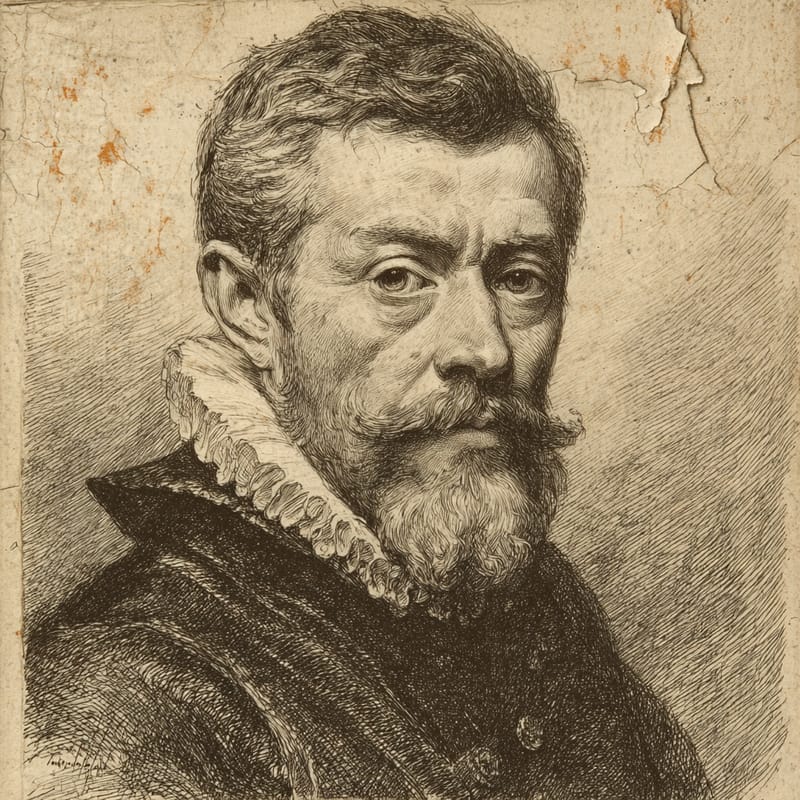
Étienne de La Boétie
The discourse on voluntary servitude
Tyranny survives only on our consent.
Heterodox VoluntaristOne of 729 ideologies · enter the Voluntarist hall →- Role
- Writer
- Era
- 1530–1563
- Region
- France
- Social band
- Heterodox
- Placement
- +64 · −74 · +30
§ Where Étienne de La Boétie stands
3 axesLa Boétie wrote no economics, but his Discourse portrays tyranny as a system of plunder: the ruler and a chain of favourites live off the labour and property of everyone else, buying obedience with offices and spoils. Murray Rothbard's introduction to a 1975 English edition read this as a theory of the state as predator on a productive society, the basis of the market-libertarian reading.
The Discourse on Voluntary Servitude holds that all tyranny rests on the consent of the governed, and that withdrawing it, without violence, is enough to bring a tyrant down. That insight makes him a forerunner of civil disobedience and voluntaryism, though in life he served the crown loyally as a magistrate in the Parlement of Bordeaux from 1554.
La Boétie was a Renaissance humanist who argued in the Discourse that nature made all people free and equal, companions rather than masters and slaves, and that servitude is learned through custom. His translations of Xenophon and Plutarch, published by Montaigne in 1571, reflect the classical republican models behind his ideal of liberty.
How close are you to Étienne de La Boétie?
Three statements, one per axis. Answer them and we’ll drop you on the compass next to them.
§ The story
HistoricalÉtienne de La Boétie (1530–1563) was a French humanist writer, poet and magistrate. Born in Sarlat in the Périgord, he studied law at the University of Orléans and in 1554 took up a seat as a councillor in the Parlement of Bordeaux, where he formed a celebrated friendship with the young Michel de Montaigne. As a student he wrote the Discourse on Voluntary Servitude, a short, fiery essay asking why multitudes obey a single tyrant. He died near Bordeaux in 1563, aged 32, and Montaigne inherited his papers.
The Discourse argues that tyranny rests on nothing but the consent of the governed, sustained by habit, flattery and a pyramid of beneficiaries who share in the tyrant's spoils, and that people need only refuse to serve for it to collapse. Circulated in manuscript, it was printed by Huguenot pamphleteers in the 1570s as a weapon against royal power. Later readers, from anarchists to theorists of non-violent resistance and libertarians such as Murray Rothbard, made it a founding text of civil disobedience and voluntaryism.
Notable for
- 01'Discourse on Voluntary Servitude'
- 02Theory of consent and tyranny
- 03Inspired civil disobedience
Key works & moments
- c. 1550Writes the Discourse on Voluntary Servitude as a young student.
- 1554Takes his seat as a councillor in the Parlement of Bordeaux.
- c. 1558Begins his celebrated friendship with fellow magistrate Michel de Montaigne.
- 1563Dies near Bordeaux aged 32, leaving his papers to Montaigne.
- 1570sHuguenot pamphleteers print the Discourse as a tract against royal tyranny.
- 1580Montaigne's essay Of Friendship immortalises their bond.
In their own words
“Resolve to serve no more, and you are at once freed.”
§ Minds closest to Étienne de La Boétie
All minds →


§ Also in the Voluntarist hall
Enter the hall →§ Common questions
4 answersWhat was Étienne de La Boétie's political ideology?
Étienne de La Boétie was a Renaissance humanist whose theory of consent is the deep root of voluntaryism: on the 99ideologies three-axis compass, a Heterodox Voluntarist. Economically he sits firmly on the market side (+64), reflecting the libertarian reading of his attack on tyranny as plunder. On governance he is strongly anti-authoritarian (−74), holding that all tyranny depends on consent, and socially he is moderately progressive (+30), affirming that nature made all people free and equal.
Was Étienne de La Boétie left-wing or right-wing?
Neither term existed in his day, and both sides have claimed him. Huguenot rebels used the Discourse against the French monarchy in the 1570s; later anarchists and socialists read it as a call to popular resistance; and libertarians such as Murray Rothbard made it a classic of anti-statism. Its core claim, that power depends on obedience and collapses when obedience is withdrawn, is radical but not partisan, which is why it appeals across the spectrum.
Was Étienne de La Boétie an anarchist?
Not in the modern sense. La Boétie wrote three centuries before anarchism existed as a movement, served the French crown as a magistrate and never proposed abolishing government. But his argument that every tyranny rests on the consent of its subjects, and falls when they simply stop obeying, made him a forerunner claimed by anarchists such as Gustav Landauer and by voluntaryists and libertarians. His Discourse is also cited as an early theory of non-violent resistance and civil disobedience.
Which minds are closest to Étienne de La Boétie?
On the 99ideologies three-axis compass, the minds closest to Étienne de La Boétie are George H. Smith (98% alike), The Consenting Neighbour (archetype) (97% alike) and Auberon Herbert (97% alike). The furthest is Pol Pot (4% alike).