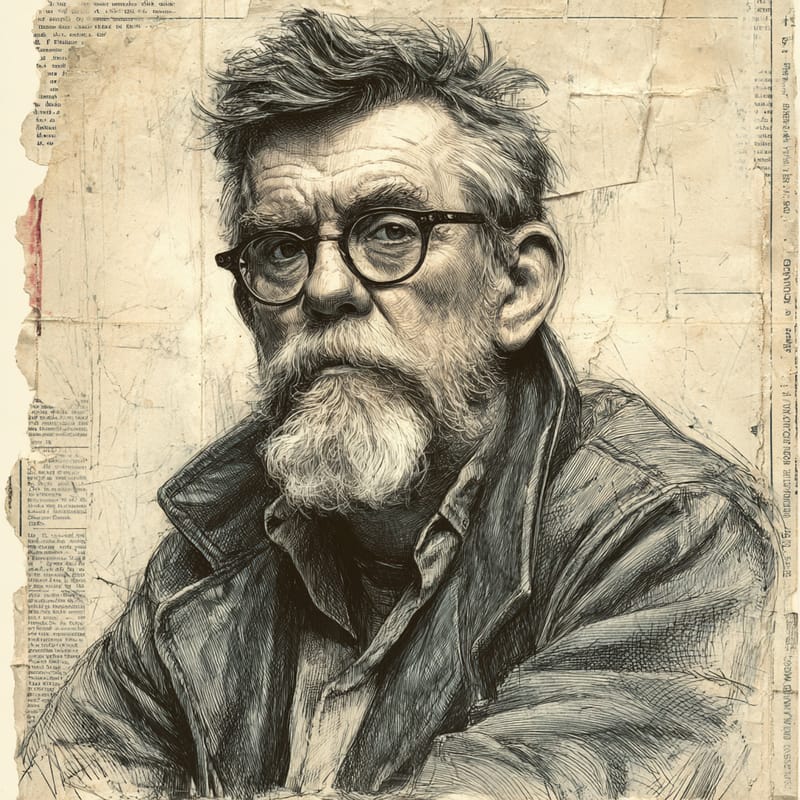
Loren Lomasky
Persons, rights, community
The project-pursuer's liberty.
Minarcho-CapitalistOne of 729 ideologies · enter the Minarcho-Capitalist hall →- Role
- Philosopher
- Era
- b. 1943
- Region
- United States
- Social band
- Centre (no modifier)
- Placement
- +88 · −72 · −4
§ Where Loren Lomasky stands
3 axesLomasky sees free markets as the natural home of project pursuit, since they let each person use their own resources for their own ends without needing anyone else's approval. Persons, Rights, and the Moral Community (1987) grounds strong property rights in project pursuers' need to control the means of carrying out their plans, and Justice at a Distance, written with Fernando Tesón, treats extending economic liberty across borders as central to global justice.
Lomasky defends a limited state whose main task is to protect basic rights rather than to pursue collective goals. His expressive theory of voting, developed with Geoffrey Brennan in Democracy and Decision (1993), argues that because no single vote is likely to decide an election, voters indulge sentiments they would not act on if they bore the costs themselves, a reason to keep the reach of electoral politics narrow.
Lomasky's social outlook is a pluralist individualism. Persons, Rights, and the Moral Community (1987) holds that each person's commitments, religious or secular, conventional or unusual, deserve the same protected space, so the state should neither impose a moral code nor promote particular ways of life, while people remain free to live traditionally if they choose.
How close are you to Loren Lomasky?
Three statements, one per axis. Answer them and we’ll drop you on the compass next to them.
§ The story
HistoricalLoren E. Lomasky is an American political philosopher and one of the leading academic defenders of a rights-based classical liberalism. After teaching for many years at the University of Minnesota Duluth and then at Bowling Green State University, he became Cory Professor of Political Philosophy, Policy and Law at the University of Virginia, where he directed its programme in political philosophy, policy and law. His first book, Persons, Rights, and the Moral Community (1987), made his name in the field.
Lomasky's central argument is that human beings are project pursuers, people whose lives are organised around long-term commitments of their own choosing, and that basic rights exist to protect the moral space those projects need. From that premise he defends a market order and a limited state. With Geoffrey Brennan he wrote Democracy and Decision (1993), a founding work of the theory of expressive voting, which holds that voters often express attitudes rather than decide outcomes, a conclusion with sobering implications for faith in democratic choice. He later extended his liberalism to global questions in Justice at a Distance, written with Fernando Tesón.
Notable for
- 01'Persons, Rights, and the Moral Community'
- 02Project-pursuit theory
- 03Liberal-libertarian philosophy
Key works & moments
- 1987Publishes Persons, Rights, and the Moral Community with Oxford University Press.
- 1993Publishes Democracy and Decision with Geoffrey Brennan, a key text on expressive voting.
- 2000sBecomes Cory Professor of Political Philosophy, Policy and Law at the University of Virginia.
- 2010sCo-writes Justice at a Distance: Extending Freedom Globally with Fernando Tesón.
§ Minds closest to Loren Lomasky
All minds →



§ Also in the Minarcho-Capitalist hall
Enter the hall →The closest minds above are this hall’s whole roster.
§ Common questions
4 answersWhat is Loren Lomasky's political ideology?
Loren Lomasky is a classical liberal philosopher who grounds a minimal-state libertarianism in the moral standing of persons as project pursuers: on the 99ideologies three-axis compass, a Minarcho-Capitalist. Economically he sits firmly on the market side (+88), defending strong property rights and free exchange. On governance he is strongly libertarian (−72), confining the state largely to protecting basic rights, and socially he sits close to the centre (−4), a pluralist who leaves each person free to pursue traditional or unconventional commitments.
Is Loren Lomasky left-wing or right-wing?
He is on the libertarian right of academic political philosophy, though he is often described simply as a classical liberal. Lomasky defends private property, markets and a limited state, and he is sceptical of democratic majorities extending government's reach, positions associated with the right. But his commitment to individual choice also separates him from social conservatism: his theory gives equal protection to religious and secular, conventional and unconventional ways of life, and his later work stresses extending freedom across borders.
What is project pursuit in Lomasky's philosophy?
Project pursuit is Lomasky's account of what gives individuals moral standing. In Persons, Rights, and the Moral Community (1987) he argues that persons are distinctive because they organise their lives around long-term projects, commitments that give them reasons of their own and make their lives their own. Because everyone has such projects, everyone has a strong interest in noninterference, and basic rights are the rules that secure that moral space for all, chiefly by protecting liberty and property rather than guaranteeing outcomes.
Which minds are closest to Loren Lomasky?
On the 99ideologies three-axis compass, the minds closest to Loren Lomasky are Randy Barnett (99% alike), The Night-Watchman State (archetype) (97% alike) and Tibor Machan (96% alike). The furthest is Pol Pot (0% alike).