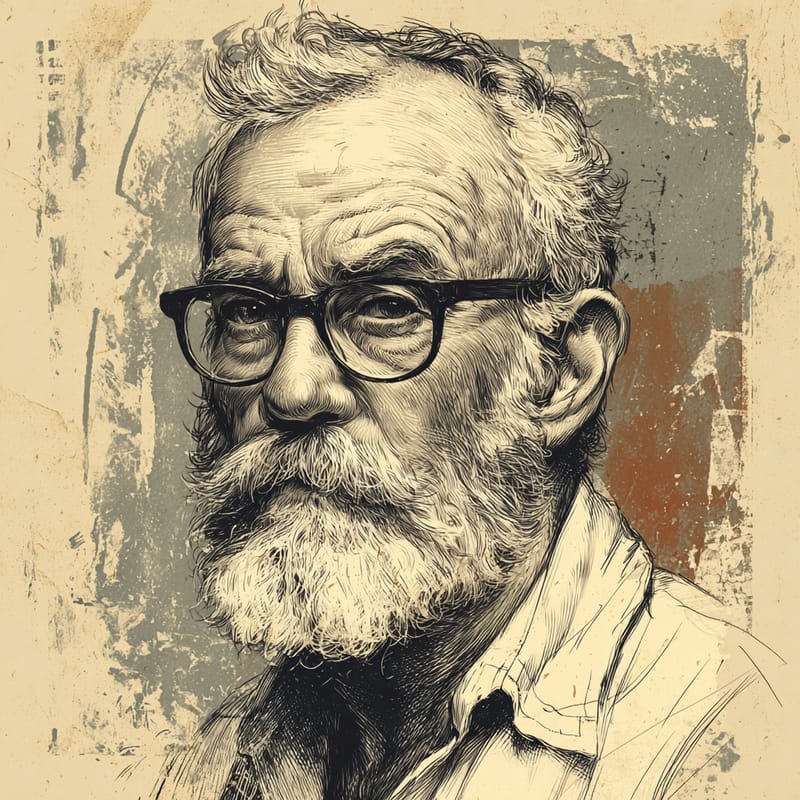
Carl Watner
The Voluntaryist
Kept the idea alive in print.
Heterodox VoluntaristOne of 729 ideologies · enter the Voluntarist hall →- Role
- Writer & historian
- Era
- 1948–2020
- Region
- United States
- Social band
- Heterodox
- Placement
- +70 · −82 · +25
§ Where Carl Watner stands
3 axesWatner defended voluntary exchange and private property as the economic form of consent, treating taxation as a taking that no majority vote can legitimise. The Voluntaryist, which he edited from 1982, consistently argued that markets, mutual aid and private institutions could meet every need now met by compulsion.
Watner rejected the state and also the usual routes to reforming it. Neither Bullets nor Ballots (1983) argued that electoral politics legitimises the state and that violent revolution merely replaces one ruling group with another, so change must come through non-violent withdrawal of consent. National Identification Systems (2004), which he co-edited with Wendy McElroy, attacked state identification and surveillance.
Watner's social outlook was quietist and personal: a free society, in his view, begins with individuals reforming their own conduct, refusing to take part in coercion and persuading others by example. His anthology I Must Speak Out (1999) gathered essays on conscience, non-violence and personal responsibility, reflecting a tolerant individualism rather than a programme for cultural change.
How close are you to Carl Watner?
Three statements, one per axis. Answer them and we’ll drop you on the compass next to them.
§ The story
HistoricalCarl Watner, born in 1948, became the leading editor and historian of modern American voluntaryism. In 1982 he co-founded The Voluntaryist newsletter with George H. Smith and Wendy McElroy, and he went on to edit and publish it from South Carolina for decades, making it the movement's journal of record. A careful researcher, he wrote historical essays on the libertarian tradition for the Journal of Libertarian Studies and other outlets, and compiled anthologies of voluntaryist writing such as I Must Speak Out (1999).
Watner's significance lies in preserving and sharpening the voluntaryist strategy: that a free society cannot be reached by voting or violence, only by education, persuasion and the peaceful withdrawal of consent. Neither Bullets nor Ballots (1983), written with Smith and McElroy, set out that position against both the Libertarian Party's electoral strategy and revolutionary violence. His biography of the educator Robert LeFevre and his anthologies on subjects such as national identification systems documented a quieter, non-political tradition of resistance to state power.
Notable for
- 01Edited 'The Voluntaryist'
- 02'I Must Speak Out' anthology
- 03Voluntaryist history
Key works & moments
- 1970s–80sPublishes historical essays on libertarian thought in the Journal of Libertarian Studies.
- 1982Co-founds The Voluntaryist newsletter with George H. Smith and Wendy McElroy.
- 1983Neither Bullets nor Ballots rejects both electoral politics and revolutionary violence.
- 1999Publishes I Must Speak Out: The Best of The Voluntaryist, 1982–1999.
- 2004Co-edits National Identification Systems: Essays in Opposition with Wendy McElroy.
§ Minds closest to Carl Watner
All minds →

§ Also in the Voluntarist hall
Enter the hall →§ Common questions
4 answersWhat was Carl Watner's political ideology?
Carl Watner's work defends voluntaryism, a society built entirely on consent and reached only by peaceful, non-political means: on the 99ideologies three-axis compass, a Heterodox Voluntarist. Economically that places him firmly on the market side (+70), defending private property and voluntary exchange. On governance he ranks among the most anti-state figures (−82), since his writing rejects even voting as a source of legitimacy, and socially he is mildly progressive (+25), a quietist individualist stressing conscience and personal example.
Was Carl Watner left-wing or right-wing?
Neither, in the conventional sense. Watner's defence of private property and free markets places his work on the libertarian right of the economic spectrum, but his voluntaryism rejects the whole apparatus of party politics that left and right compete to control. His writing opposes war, taxation and state surveillance, and favours non-violent resistance in the tradition of Étienne de La Boétie and Henry David Thoreau, making him an anarchist of a distinctly peaceful, non-electoral kind.
Why do voluntaryists like Carl Watner refuse to vote?
Because they believe voting lends legitimacy to the state. In Neither Bullets nor Ballots (1983), Watner, George H. Smith and Wendy McElroy argued that taking part in elections endorses a system in which majorities may coerce minorities, and that even libertarian candidates end up strengthening the institutions they oppose. Since means shape ends, they held, a free society can only be reached by consistent means: education, persuasion and the peaceful refusal to cooperate with the state, rather than electoral campaigns or violent revolution.
Which minds are closest to Carl Watner?
On the 99ideologies three-axis compass, the minds closest to Carl Watner are The Consenting Neighbour (archetype) (97% alike), Robert LeFevre (97% alike) and Nick Szabo (96% alike). The furthest is Pol Pot (0% alike).