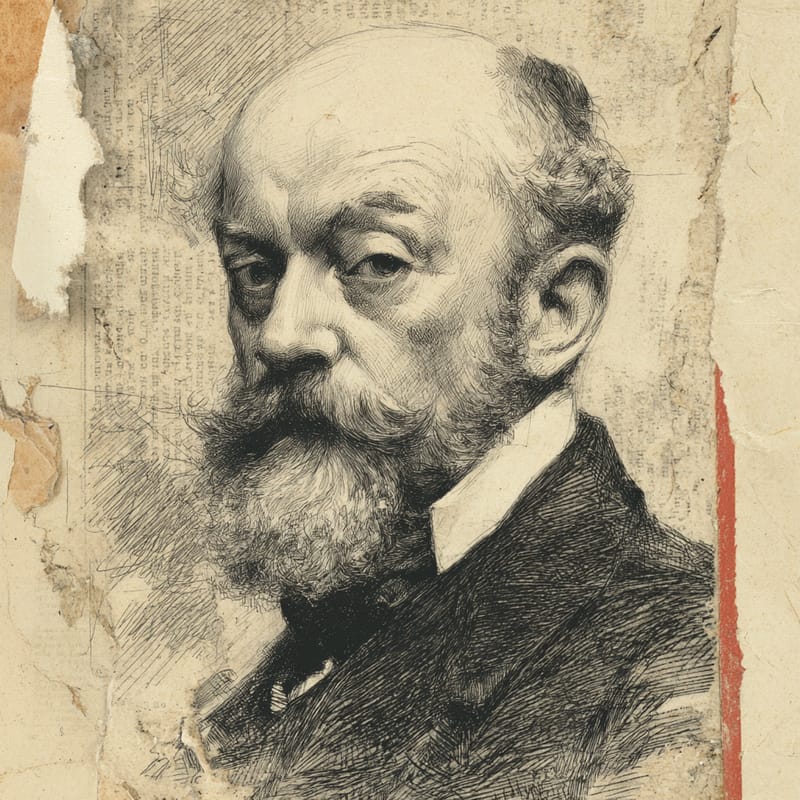
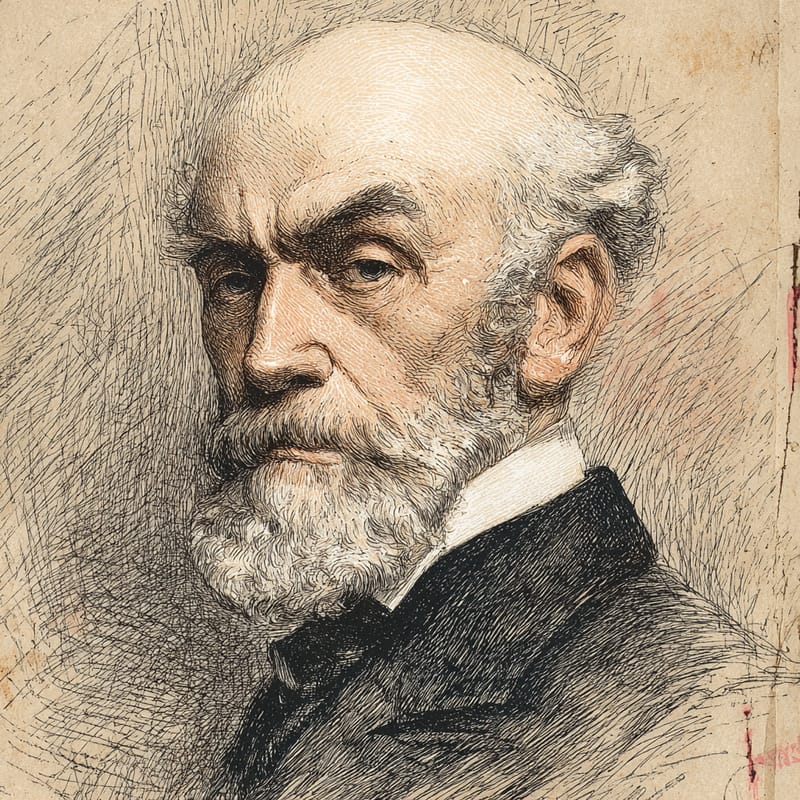
Auberon Herbert
Voluntaryism, named
No force, only consent.
Heterodox VoluntaristOne of 729 ideologies · enter the Voluntarist hall →- Role
- Theorist
- Era
- 1838–1906
- Region
- United Kingdom
- Social band
- Heterodox
- Placement
- +70 · −72 · +25
§ Where Auberon Herbert stands
3 axesHerbert was a thoroughgoing advocate of free markets, private property and free trade, opposing state provision in education, welfare and industry as compulsion. In The Right and Wrong of Compulsion by the State (1885) he argued that people should keep the full fruits of their labour, and that taxation itself should become voluntary, with the state funded only by willing contributions.
Herbert held the non-initiation of force as the one inviolable principle, applying it even to the state. He accepted a government to defend persons and property against aggression, which separates him from the anarchists, but insisted that it be funded voluntarily and that no majority may compel a minority, as he argued in The Right and Wrong of Compulsion by the State (1885).
Herbert was an individualist liberal of conscience. As an MP in 1872 he seconded Sir Charles Dilke's motion questioning the Civil List, defying aristocratic convention, and he defended freedom of religion, opinion and personal conduct against state interference. His tolerance was principled rather than permissive: he prized self-reliance and moral seriousness, but held that virtue could not be compelled.
How close are you to Auberon Herbert?
Three statements, one per axis. Answer them and we’ll drop you on the compass next to them.
§ The story
HistoricalAuberon Herbert (1838–1906) was an English aristocrat, Liberal politician and individualist philosopher. A younger son of the 3rd Earl of Carnarvon, he was educated at Eton and Oxford, served briefly in the army and sat as Liberal MP for Nottingham from 1870 to 1874, during which he seconded Sir Charles Dilke's motion questioning the cost of the monarchy. His encounter with the work and person of Herbert Spencer in the 1870s turned him from radical Liberalism toward a thoroughgoing individualism.
Herbert's significance is that he carried classical liberalism to its logical edge. He called his creed voluntaryism: every human relation should rest on consent, and even the state's protective functions should be funded by voluntary contributions rather than compulsory taxes. He set out the case in essays such as The Right and Wrong of Compulsion by the State (1885) and in his newspaper Free Life, and gave the Herbert Spencer Lecture at Oxford in 1906, the year he died. Later libertarians claimed him as a forerunner, though he rejected the anarchist label.
Notable for
- 01Coined 'voluntaryism'
- 02Non-aggression principle
- 03'A Politician in Sight of Haven'
Key works & moments
- 1870Elected Liberal MP for Nottingham at a by-election.
- 1872Seconds Sir Charles Dilke's Commons motion questioning the cost of the monarchy.
- 1884A Politician in Trouble About His Soul charts his conversion to individualism.
- 1885Publishes The Right and Wrong of Compulsion by the State.
- 1890sEdits the weekly Free Life, advocating voluntary taxation and a voluntary state.
- 1906Delivers the Herbert Spencer Lecture at Oxford and dies later that year.
§ Minds closest to Auberon Herbert
All minds →



§ Also in the Voluntarist hall
Enter the hall →§ Common questions
4 answersWhat was Auberon Herbert's political ideology?
Auberon Herbert was a voluntaryist, the Victorian individualist who held that every human relation, even funding the state, must rest on consent: on the 99ideologies three-axis compass, a Heterodox Voluntarist. Economically he sat firmly on the market side (+70), defending free trade and the full fruits of labour. On governance he was strongly libertarian (−72), accepting only a voluntarily funded protective state, and socially he was mildly progressive (+25), a liberal of conscience who opposed compelled virtue.
Was Auberon Herbert left-wing or right-wing?
He began on the radical wing of Victorian Liberalism, as an MP who challenged the cost of the monarchy, and ended as an uncompromising individualist opposed to nearly all state action. By modern standards his free-market economics place him on the libertarian right, but his consistent anti-statism and his defence of individual conscience against every majority make him an ancestor of libertarianism rather than of conservatism.
Was Auberon Herbert an anarchist?
No, though he came close and is often claimed by anarchists. Herbert accepted that a government was needed to defend people against force and fraud, which separates him from individualist anarchists such as Benjamin Tucker. But he insisted that this government be funded only by voluntary contributions and that it could never compel anyone beyond preventing aggression. His voluntaryism therefore occupies a border zone between minimal-state liberalism and individualist anarchism.
Which minds are closest to Auberon Herbert?
On the 99ideologies three-axis compass, the minds closest to Auberon Herbert are The Consenting Neighbour (archetype) (97% alike), Robert LeFevre (97% alike) and Étienne de La Boétie (97% alike). The furthest is Pol Pot (3% alike).