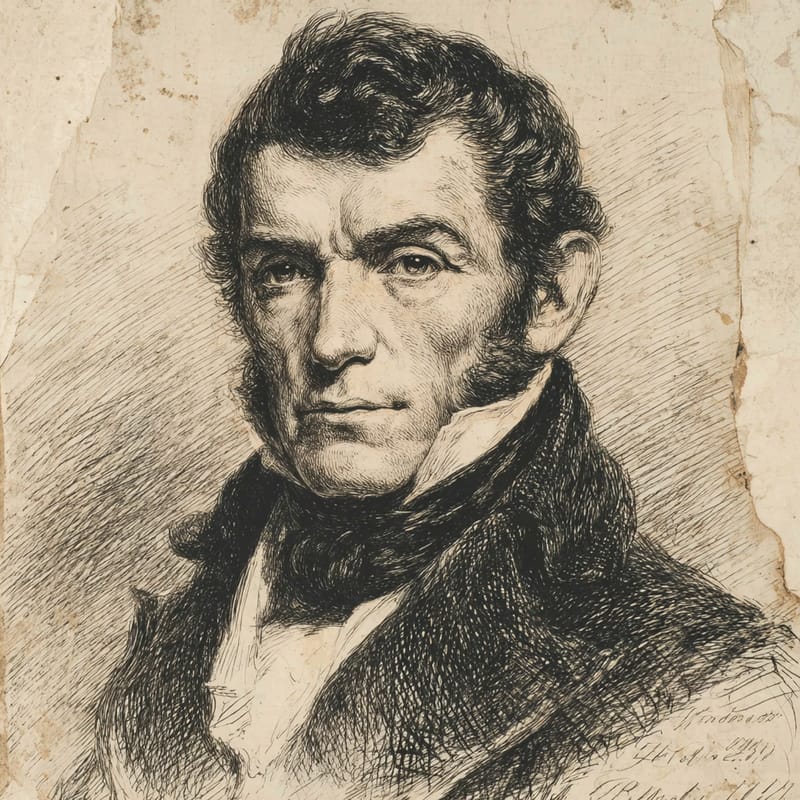
Guizot (Doctrinaire archetype)
Enrichissez-vous
'Get rich' — bourgeois order incarnate.
Traditional Conservative CapitalistOne of 729 ideologies · enter the Conservative Capitalist hall →- Role
- Statesman (François Guizot)
- Era
- 1787–1874
- Region
- France
- Social band
- Traditional
- Placement
- +90 · +34 · −52
§ Where Guizot (Doctrinaire archetype) stands
3 axesGuizot saw property and commerce as the foundations of a free society and the measure of political capacity. His government passed the 1842 railway law, which joined state-built infrastructure to private operating companies, and he tied the vote to wealth through a tax-qualified franchise. Like most of the July Monarchy's elite, though, he kept France's high protective tariffs, stopping short of free trade.
Guizot believed in constitutional government by an enlightened elite, which the Doctrinaires called the sovereignty of reason, rather than popular sovereignty. He served in the ministry that passed the restrictive September Laws on the press in 1835, resisted every proposal to widen the franchise during the 1840s and banned the reformist banquet of February 1848, a step that provoked the revolution.
A devout Protestant and a moralist of the bourgeois virtues of work, thrift and family, Guizot defended religion and established order against revolution. His 1833 education law spread primary schooling while keeping moral and religious instruction at its heart, and he resisted both radical democracy and the emerging socialist movements of the 1840s.
How close are you to Guizot (Doctrinaire archetype)?
Three statements, one per axis. Answer them and we’ll drop you on the compass next to them.
§ The story
HistoricalFrançois Guizot (1787–1874) was a French historian and statesman who dominated the July Monarchy of King Louis-Philippe. Born into a Protestant family in Nîmes, he lost his father to the guillotine in 1794 and was educated in Geneva before winning fame as a historian at the Sorbonne. A leading liberal-conservative 'Doctrinaire' under the Restoration, he became a minister after the 1830 revolution and, as foreign minister from 1840 and premier from 1847, led the government until 1848.
Guizot stood for rule by a propertied and educated middle class, defending a franchise limited to fewer than a quarter of a million taxpayers against demands for reform. His 1833 education law required every commune to maintain a primary school, and his histories of European civilisation influenced writers from Tocqueville to Marx. His refusal to widen the vote and his government's ban on a reformist banquet helped trigger the February Revolution of 1848, which swept away both him and the monarchy; he spent his later decades writing history and memoirs.
Notable for
- 01'Enrichissez-vous'
- 02Doctrinaire liberalism
- 03July-Monarchy order
Key works & moments
- 1812Appointed professor of modern history at the Sorbonne.
- 1828His lectures appear as the General History of Civilisation in Europe.
- 1833As education minister, passes the Guizot Law requiring a primary school in every commune.
- 1840Becomes foreign minister and the dominant figure in the government.
- 1847Becomes president of the council of ministers, still refusing electoral reform.
- 1848Dismissed during the February Revolution; flees to London as the monarchy falls.
§ Minds closest to Guizot (Doctrinaire archetype)
All minds →

§ Also in the Conservative Capitalist hall
Enter the hall →§ Common questions
4 answersWhat was François Guizot's political ideology?
Guizot was a liberal conservative of the Doctrinaire school: on the 99ideologies three-axis compass, a Traditional Conservative Capitalist. Economically he sat far to the market side (+90), treating property and commerce as the basis of society and of political rights. On governance he favoured order under a constitutional monarchy run by a propertied elite (+34), and socially he was traditional (−52), a Protestant moralist who defended religion, family and established order.
Was François Guizot left-wing or right-wing?
Centre-right by the standards of his time, and conservative by modern ones. Guizot began as a liberal opponent of the ultra-royalists and supported the 1830 revolution that installed a constitutional monarchy. In power, however, he became the symbol of resistance to change, defending a property-based franchise against democrats and socialists until the 1848 revolution. He stood for a middle way between reaction and democracy, which looked ever more conservative as the suffrage question sharpened.
Why did Guizot refuse to extend the right to vote?
Because he believed political rights belonged to those with the property and education to exercise them wisely. Under the July Monarchy only men paying at least 200 francs a year in direct taxes could vote, fewer than a quarter of a million in a country of some 35 million people. His answer to the excluded was popularly summed up as 'enrichissez-vous': get rich, and you will qualify. His refusal provoked the reform banquets of 1847–48 and the revolution that toppled him.
Which minds are closest to Guizot (Doctrinaire archetype)?
On the 99ideologies three-axis compass, the minds closest to Guizot (Doctrinaire archetype) are Mahathir Mohamad (99% alike), Chiang Ching-kuo (99% alike) and The Chicago-School technocrat (archetype) (98% alike). The furthest is Emma Goldman (0% alike).